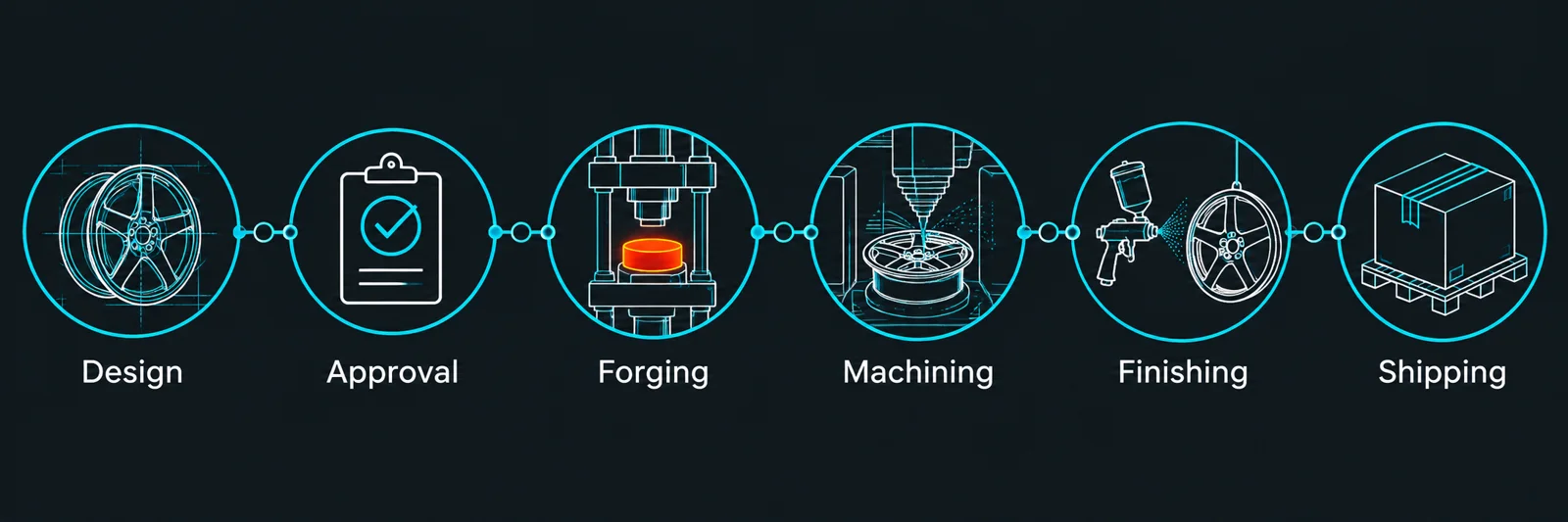
Forged wheels lead time at a glance
Forged wheels lead time is the question almost every buyer asks first, and the honest answer has two parts: how long the wheels take to make, and how long they take to reach you. At VEXORA, production typically takes approximately 20 days once the specification, technical drawing and finish are approved. Shipping is a separate stage, and its duration depends on your destination country.
That distinction matters because many quotations quote a single number from the day you first send an inquiry. A custom forged wheel cannot start production until the details that define it are fixed, so the most useful way to think about lead time is in stages, each with its own owner.
VEXORA does not keep a stock catalog or ready-to-ship inventory. Every wheel is engineered and forged to your vehicle, dimensions and finish. There is no shelf to ship from, which is exactly why the approval stage is the part you can speed up the most.
| Stage | What happens | Typical driver of time |
|---|---|---|
| 1. Brief | You send vehicle, sizes, material, construction, design direction and finish | How complete the first brief is |
| 2. Fitment review | PCD, offset, center bore, seat type, tire and brake clearance are checked | Missing measurements or brake data |
| 3. Drawing approval | A technical drawing is issued and revised until you approve it | Number of revision rounds |
| 4. Finish approval | Finish type, color, gloss and zones are confirmed in writing | Custom color matching, two-tone layouts |
| 5. Production | Forging, heat treatment, CNC machining, inspection and finishing | Approximately 20 days after approval |
| 6. Shipping | Packing, export, transit and delivery | Destination country; DDP where available |
Only stage 5 has a confirmed typical duration. Stages 1–4 depend on how quickly decisions are made, and stage 6 depends on where the wheels are going. VEXORA confirms timing per project in the quotation.
When does the 20-day clock start?
The production clock starts after approval, not at first contact. Approval means you have signed off on three things: the specification (sizes, offsets, PCD, center bore, load requirement), the technical drawing that turns your design direction into a machinable wheel, and the finish specification.
Changing any of these after approval can mean re-drawing or re-programming the CNC work, and in some cases re-forging a blank. That is why a careful approval step usually saves more time than it costs. If you want the shortest overall lead time, spend effort up front on a complete brief rather than trying to compress production.
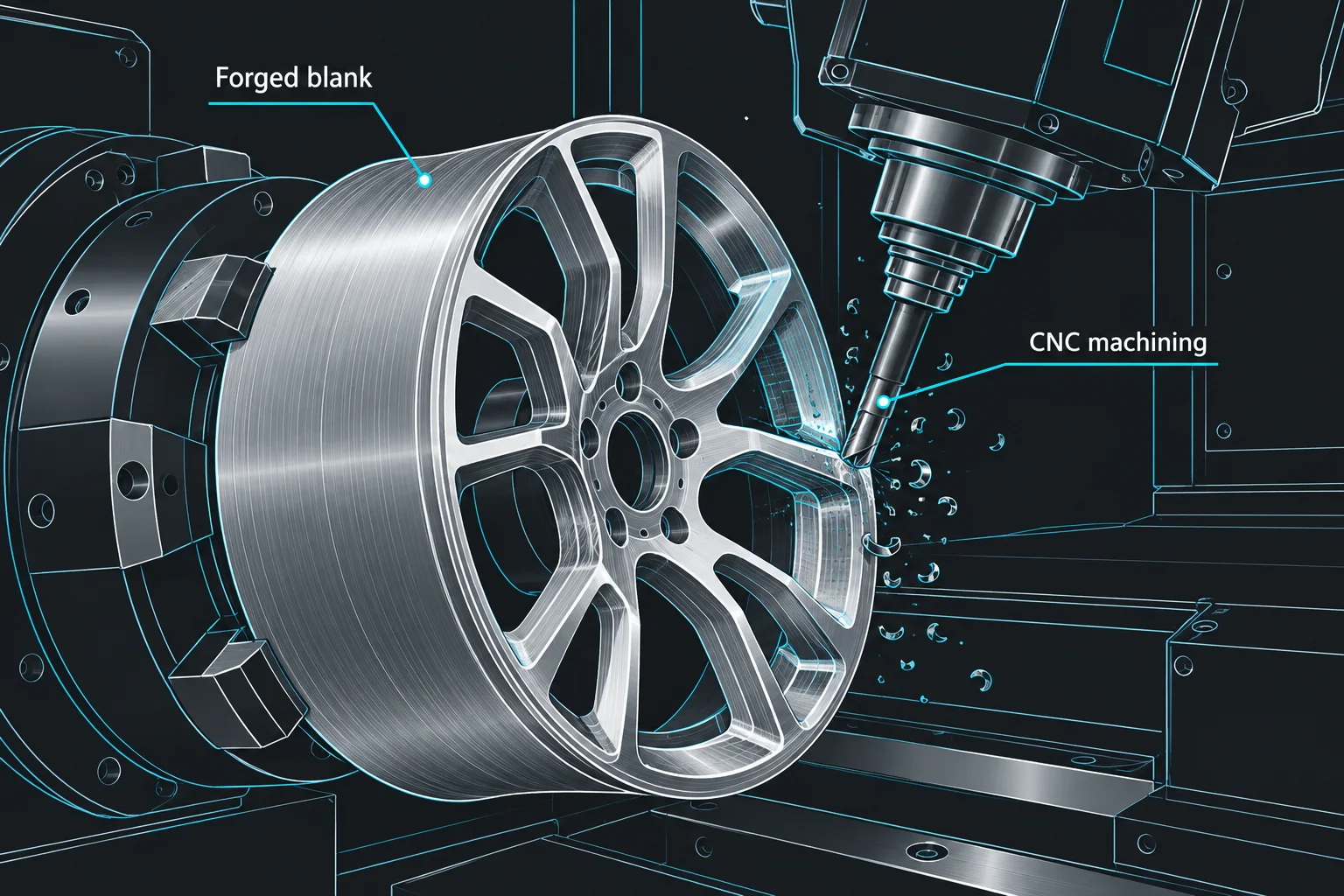
What drives forged wheel lead time
Approvals and communication
The biggest variable in total lead time is usually the buyer side of the process. A brief that includes the exact vehicle, brake setup, target sizes and reference images can move from fitment review to drawing in a short exchange. A brief with open questions on offset, caliper clearance or finish needs more rounds. Our guide to specifying custom forged wheels lists what to include.
Material: aluminum vs magnesium
Most custom builds use forged aluminum, typically 6061-T6. Forged magnesium wheels use AZ80- or ZK60-type alloys, which are common in the industry and confirmed per project. Magnesium requires a dedicated protective finish system, so the finish step deserves extra attention during approval. Whether a specific material changes your schedule is confirmed in the quotation rather than assumed; see magnesium vs aluminum wheels for the material trade-offs.
Construction: monoblock, 2-piece or 3-piece
A monoblock wheel is machined from one forged blank. Two-piece and three-piece wheels combine a forged center with separate barrel sections and hardware, which adds parts to specify and assemble. The construction choice affects drawing complexity and the number of details to approve. The trade-offs are covered in monoblock vs 2-piece vs 3-piece forged wheels.
Finish complexity
A single solid color is simpler to specify than a brushed face with a polished lip, a two-tone window layout or a color matched to a sample. Complex finishes are not a problem, but they need precise written instructions and sometimes a sample or reference before approval. Browse the options on custom wheel finishes.
Quantity and repeat orders
Every VEXORA set is made to order, and custom orders start from a single pair. MOQ: 1 pair (2 wheels). A single pair or set for a personal car follows the same steps as a larger trade order. For workshops and brands ordering multiple sets, quantity is part of the timing conversation, and repeat orders of an already approved design can skip the drawing stage. Ask for timing per order rather than relying on a general figure.
Shipping time is separate from production
Once production and final inspection are complete, the wheels are packed and shipped. Shipping time varies by destination country and by the shipping method. VEXORA does not publish a single worldwide transit figure, because it would not be accurate for every buyer.
Where DDP (Delivered Duty Paid) is available for your country, orders ship DDP: import duties and taxes are handled and the wheels are delivered to your door. That removes a common source of delay and surprise cost at customs. For the paperwork side, read importing forged wheels from China.
How to shorten your forged wheels lead time
- Send exact vehicle data: year, model, trim, market and brake system
- Include caliper model or a brake template if you run a big-brake kit
- State target diameter, width and offset, or say you want them recommended
- Attach design references and say which features matter most
- Specify finish type, color, gloss and which zones it covers
- Consolidate feedback on the drawing into one reply per revision
- Confirm delivery address and whether DDP is available for your country
None of these steps changes how the wheel is made. They simply remove waiting time between stages, which is where most calendar time is lost.
Custom forged vs catalog wheel timing
Catalog wheels are sometimes available from stock, which is why their delivery can look faster. The trade-off is that you choose from existing designs, sizes and offsets. A fully custom forged set is engineered to your vehicle, so the extra time goes into fitment review and drawing approval. If a supplier promises custom forged wheels with almost no lead time, ask whether the wheels are truly drawn to your specification or adapted from stock blanks and designs.
Questions about forged wheels lead time
How long does it take to make custom forged wheels?
Production typically takes approximately 20 days once the specification, drawings and finish are approved, confirmed per project. Shipping time is added afterwards and varies by destination.
Does the lead time start when I send my inquiry?
No. The approximately 20-day production stage starts after drawing and finish approval. Time before that depends on how quickly fitment questions and revisions are resolved.
Are forged magnesium wheels slower to make?
Any schedule difference is confirmed per project in the quotation. Magnesium needs a dedicated protective finish system, so finish details should be approved carefully.
Can I order just one pair?
Every VEXORA set is made to order, and custom orders start from a single pair. MOQ: 1 pair (2 wheels).
Do you ship DDP?
Where DDP is available for your country, orders ship DDP: duties and taxes are handled and the wheels are delivered to your door.
Can I change the design after approval?
Changes after approval may require re-drawing or re-machining and can extend lead time. Final checks before approval are the best way to protect your schedule.
Plan your timeline
If you have a date in mind, a show, a track day or a vehicle delivery, mention it in your brief and work backwards from it: allow time for approval, approximately 20 days of production, then shipping to your country. Request a quote with your vehicle and target sizes, or see how the custom process runs from brief to delivery. Email sales@vexoraforged.com or message WhatsApp +86 159 2056 8771.