
Three ways to build a forged wheel
Custom forged wheels are built in one of three common constructions. Monoblock wheels are machined from a single forging. 2-piece wheels join a forged center to a separate barrel. 3-piece wheels combine a forged center with separate inner and outer barrel halves. Each construction can be fully custom; the right one depends on the look, the size and the use. Which constructions suit a particular VEXORA design and size is confirmed per project.
| Monoblock | 2-piece | 3-piece | |
|---|---|---|---|
| Parts | 1 forging | Center + barrel | Center + inner + outer barrel |
| Joining | None | Bolted or welded | Bolted with sealant |
| Weight potential | Typically lowest | Medium | Often highest |
| Lip depth flexibility | Limited by offset | Good | Greatest |
| Width/offset changes later | No | Limited | Possible with new barrel halves |
| Maintenance | Lowest | Low to medium | Highest (hardware, seals) |
Monoblock forged wheels
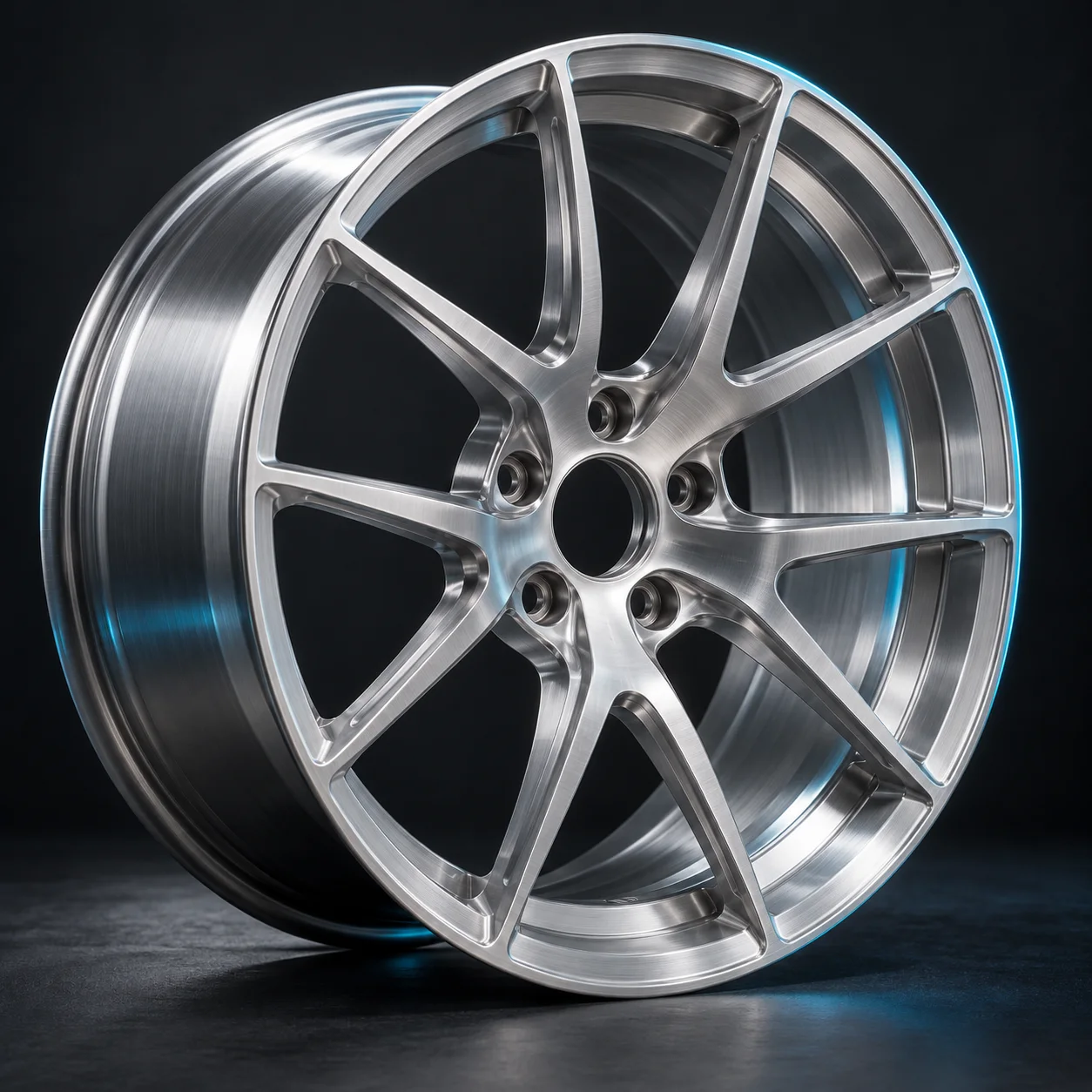
A monoblock wheel is forged and machined as one piece. With no joints or assembly hardware, it offers an excellent stiffness-to-weight ratio and the simplest ownership. It is the usual choice for performance road and track builds and for most forged magnesium wheels, where weight is the priority. The trade-off is that lip depth is set by width and offset; a low-offset wide wheel can show a lip, while a high-offset wheel will not.
2-piece forged wheels
A 2-piece wheel uses a forged center attached to a barrel. In bolted designs the center is fastened to the barrel with a ring of bolts and sealed; in welded designs the center is joined to the barrel permanently. The separate barrel allows more freedom in width and lip depth for a given center design, and makes staggered setups and stepped lips easier. Hidden-hardware designs can give a clean, monoblock-like face.
3-piece forged wheels
A 3-piece wheel combines a forged center with separate inner and outer barrel halves, assembled with a ring of bolts and sealant. Because the halves can be specified independently, widths and offsets can be tuned precisely and deep, stepped lips are possible. The exposed hardware is part of the classic look. 3-piece wheels have more parts to inspect and seal, and hardware must be maintained to specification.
Barrels and lips
Multi-piece barrels may be spun, flow-formed or machined, and the outer lip can be polished, brushed or colored. A polished lip on an aluminum barrel is a common choice; lip finishes must be protected with clear coat or maintained.
Sealing and air retention
On bolted multi-piece wheels the joint must be sealed to retain tire pressure. Sealant is applied during assembly and should be inspected if the wheel is disassembled or damaged. A slow leak at the joint is a known maintenance item on multi-piece wheels.
Hardware and torque
Assembly bolts are tightened in sequence to specified torque. Hardware should be checked periodically and replaced with correct parts if damaged. Titanium or decorative hardware is a styling option; the specification must still meet the joint's requirements.
Which construction should you choose?
- Lowest weight and simplest care: monoblock
- Deep lip with a clean face, or staggered widths: 2-piece
- Maximum lip depth, classic look, tunable widths: 3-piece
- Forged magnesium for weight: usually monoblock
Ordering
Whichever construction you choose, every VEXORA set is fully custom. Every VEXORA set is made to order, and custom orders start from a single pair. MOQ: 1 pair (2 wheels). Production typically takes approximately 20 days once the specification, drawings and finish are approved, confirmed per project. Shipping time varies by destination country. Where DDP (Delivered Duty Paid) is available for your country, orders ship DDP: import duties and taxes are handled and the wheels are delivered to your door.
How each construction is manufactured
Monoblock wheels follow the full chain on one part: forging, heat treatment, turning, milling and drilling. For 2-piece wheels the center is forged and machined like a monoblock face, while the barrel is produced separately, often spun or flow-formed, then machined at the joint. For 3-piece wheels two barrel halves are produced and machined, with matching bolt circles and sealing surfaces. After finishing, multi-piece wheels are assembled, sealed and checked for runout and air retention. More in how forged wheels are made.
Fitment considerations
Multi-piece wheels can simplify extreme fitments, such as low offsets on wide wheels, because barrel widths can be chosen independently. Bolted joints also add a ring of hardware inside or outside the barrel, which must clear big brake calipers and suspension. Always check brake templates against the actual center and barrel design. See the wheel fitment guide.
Finishing multi-piece wheels
Because parts are finished separately, multi-piece wheels make contrast finishes easy: a colored center with a polished or brushed lip, or color-matched hardware. Each part needs its own protective coat. See finishes.
Cost and lead time
Multi-piece wheels involve more parts, more machining at joints, separate finishing and assembly, so they usually cost more than a monoblock of similar size and design. Monoblock wheels involve more material removal from one forging but no assembly. For VEXORA, production is approximately 20 days after approval, confirmed per project; the construction you choose is reflected in the quotation.
Ownership over time
Monoblock wheels need routine cleaning and inspection only. Multi-piece wheels add periodic checks of assembly hardware and the sealed joint, particularly after tire changes, impacts or track use. Refinishing a multi-piece wheel can be done part by part, which some owners value when they want to change the look later.
Magnesium and multi-piece construction
Because the main reason to choose magnesium is weight, most forged magnesium wheels are monoblock: joints and assembly hardware add mass and introduce more interfaces between dissimilar metals. Multi-piece configurations involving magnesium are reviewed case by case for feasibility and protection.
Which constructions VEXORA builds
Monoblock, 2-piece and 3-piece constructions are reviewed per design and size. Every set is made to order, from one pair.
Quick decision guide
If you are unsure, start with the use. Track and performance road builds usually favour monoblock. Show cars, stance builds and classic styling often favour multi-piece for lip depth and finish contrast. Daily drivers in harsh climates benefit from the simplicity of monoblock. When the look you want depends on a deep stepped lip that a monoblock cannot give at your offset, that is the moment to consider 2-piece or 3-piece. Browse design directions for examples.
Summary
Monoblock offers the lowest weight and simplest ownership; 2-piece adds lip and width flexibility with a clean face; 3-piece offers the deepest lips and most configurable widths at the cost of more maintenance. Each can be fully custom; the right choice comes from your car, the look you want and how you drive it.
FAQ
Are multi-piece wheels weaker?
Not inherently; a properly engineered and assembled multi-piece wheel is designed to its load requirement. It does add joints that need care.
Can a 3-piece wheel be rebuilt to a new width?
Often, with new barrel halves of the required size, subject to review.
Is monoblock always lighter?
Usually at the same size, but compare documented weights for the actual designs.
Related: custom forged aluminum wheels · how forged wheels are made · how to spec custom forged wheels.
For one-piece construction on its own, including forged monoblock and 1 piece forged wheels, read monoblock wheels.