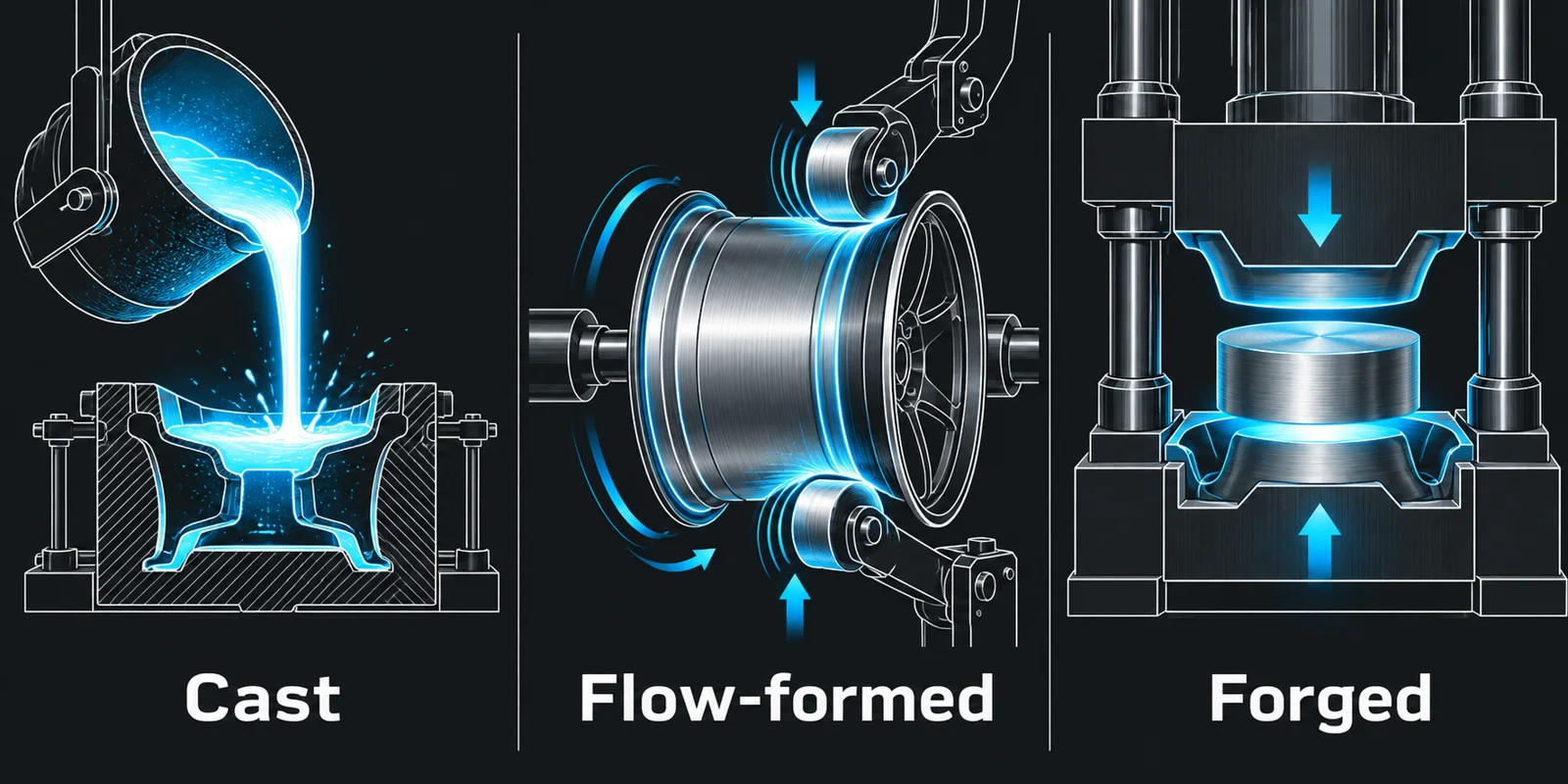
How the manufacturing routes differ
Cast wheels are made by introducing molten metal into a mold. Forged wheels begin with a solid workpiece that is formed under substantial pressure, then machined. Each route can use different alloys, heat treatments and production controls.
Flow forming is a separate process, often applied to the barrel of a cast wheel blank. It should not be described as equivalent to forging the entire wheel. Ask the supplier how the wheel center and barrel are made.
Are forged wheels stronger?
Forging can provide material characteristics that a designer can use to achieve a suitable combination of strength and mass. It does not mean every forged wheel is stronger than every cast wheel. Geometry, alloy, processing, load rating and test results still matter.
Are forged wheels lighter?
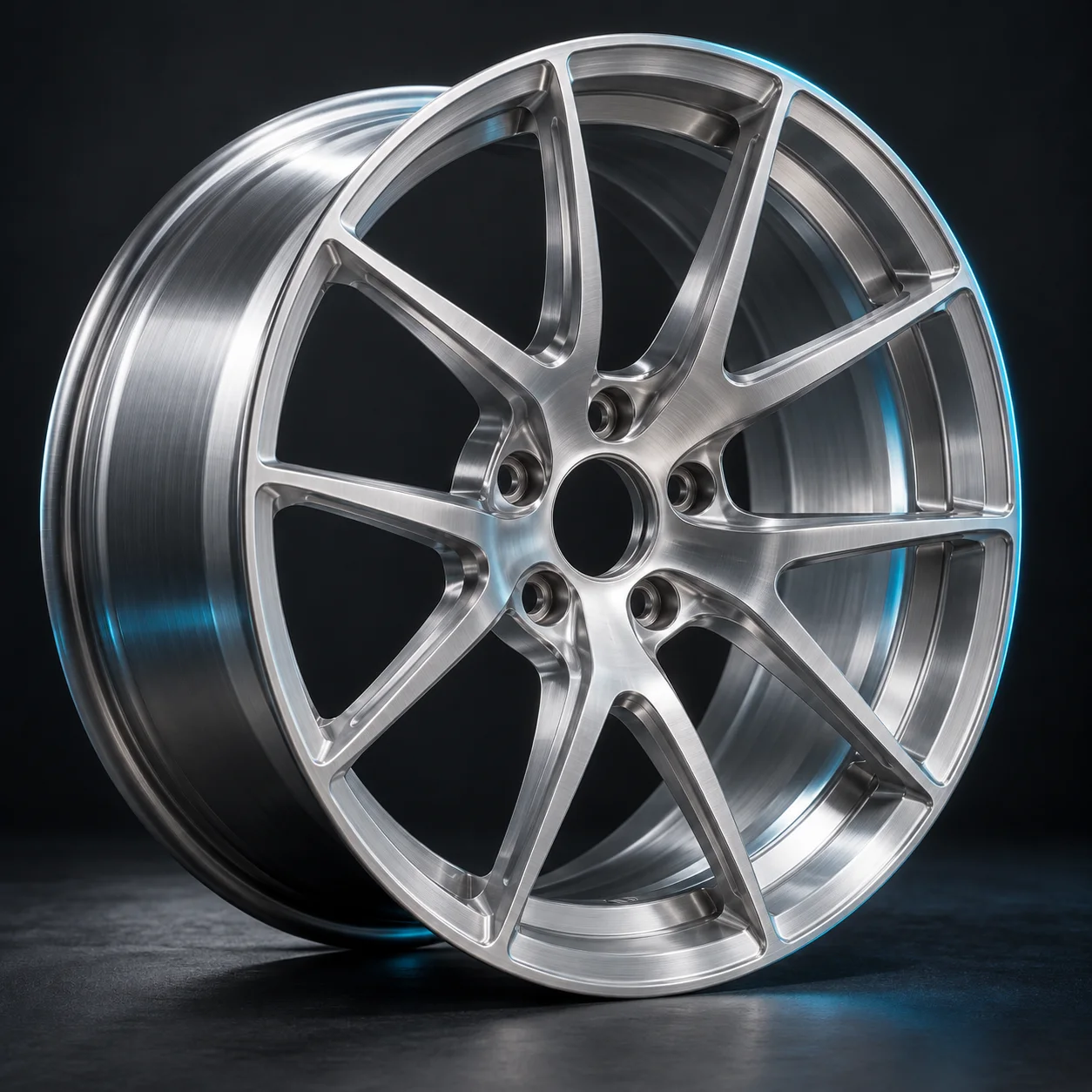
Some forged designs can meet their requirements using less material. The resulting weight saving is specific to the wheel. Compare identical dimensions, intended use and load capacity, and use documented weights rather than a generic percentage.
Why can a custom forged wheel cost more?
The forging supply, machining, design work, finishing and order quantity influence cost. A custom order may also require additional specification review. Compare the complete quote, including what is supplied, shipping, applicable taxes, warranty and any design fees.
What should you request before ordering?
Construction: a clear description of how the center and barrel are manufactured.
Specification: the exact alloy, dimensions, load capacity and actual wheel weight.
Validation: relevant test evidence and any approvals needed for your use and location.
Fitment: brake clearance, hardware and tire compatibility for your vehicle.
Bring the comparison back to your build
Read the wheel fitment guide before selecting dimensions. Explore custom forged wheels to prepare a design brief, or compare magnesium and aluminum if material choice is your next decision.
Forged, cast and flow formed compared
| Cast | Flow formed | Forged | |
|---|---|---|---|
| Starting material | Molten alloy | Cast blank, barrel rolled | Solid billet |
| Grain structure | Random, porosity possible | Improved in barrel | Compacted, follows the shape |
| Typical weight at same size | Heaviest | Medium | Lightest possible |
| Customisation | Molds limit options | Limited | Fully custom by CNC |
| Cost | Lowest | Medium | Highest |
Why forged wheels are usually 6061-T6 or forged magnesium
Forging-grade alloys are chosen because they forge well and reach high strength after heat treatment: 6061-T6 for forged aluminum, AZ80/ZK60-type alloys for forged magnesium.
Is a forged wheel worth it?
If you want exact fitment, lower weight at your size, or a design no catalog offers, forged is the route. A fully custom forged set is made to order, starting from one pair.
Forged vs cast FAQ
Are forged wheels safer?
A well-designed wheel of either type that meets its load requirement is safe. Forging allows the same requirement to be met with less material.
Can forged wheels be repaired?
Minor cosmetic damage can often be refinished; structural damage must be inspected and the wheel replaced if in doubt.
Forged vs Cast Wheels: What the Differences Mean on the Road
Comparing forged vs cast wheels means looking beyond appearance. Manufacturing method influences how a wheel can balance weight, strength, design freedom, and cost. But the right choice still depends on the specific wheel, your vehicle’s load requirements, tire choice, driving conditions, and fitment—not the manufacturing label alone.
Cast vs Forged Wheels: A Deeper Comparison
| Factor | Cast wheels | Forged wheels |
|---|---|---|
| Manufacturing process | Molten metal is poured or introduced into a mold, then cooled and finished. | A solid metal billet is shaped under pressure, then machined into the finished wheel design. |
| Material structure | Casting can introduce porosity; process control and wheel design are important to the finished result. | Forging develops a grain structure that can support efficient use of material in a properly engineered wheel. |
| Weight potential | May require more material to meet a given design’s structural requirements. | Can achieve lower weight for comparable dimensions and load requirements, depending on design. |
| Strength comparison | A correctly specified cast wheel can be suitable for everyday driving. | Forging offers strength-to-weight potential, but does not make every forged wheel suitable for every application. |
| Ride and handling | Results depend on wheel weight, tire construction, diameter, and the vehicle’s suspension. | Lower wheel weight may improve suspension response; benefits depend on the complete wheel-and-tire package. |
| Impact damage | Severe impacts can bend or crack a wheel. Tire sidewall height and impact conditions matter. | Also vulnerable to bending or cracking. Forged construction is not protection against pothole damage. |
| Fitment flexibility | Usually selected from available sizes, offsets, bolt patterns, and designs. | Made-to-order options can allow more precise specification of dimensions and clearances. |
| Cost and availability | Generally a lower-cost route, with many ready-made options. | Typically costs more; custom production also requires time for approval and manufacturing. |
For a meaningful comparison of forged rims vs cast, compare the same diameter, width, intended load, and similar design. A larger forged wheel is not automatically lighter than a smaller cast wheel, and a lighter wheel is not automatically the right choice for a heavier vehicle.
When Cast Wheels Are Enough
Cast wheels can be a practical choice for commuting, ordinary road use, and replacing damaged original wheels. If an available design meets your vehicle’s load and fitment requirements, there may be no need to choose custom forging simply for daily transportation.
- You want a standard size with straightforward tire compatibility.
- Your priority is managing purchase cost rather than minimizing wheel weight.
- You do not need unusual offsets, widths, or brake-clearance accommodations.
- You can verify the wheel’s suitability through clear manufacturer specifications.
On rough roads, retaining adequate tire sidewall can be more useful than selecting a larger wheel solely for its appearance. Neither construction method removes the need for correct tire pressure and sensible sizing.
Flow-Formed Wheels: The Middle Path
Flow-formed wheels typically start with a cast wheel blank. Rollers then shape and stretch the barrel during a controlled forming process. This can produce a lighter barrel than a conventional cast design, while the wheel center remains cast.
That makes flow forming worth considering when you want a weight-conscious upgrade without moving directly to fully forged construction. It is not the same manufacturing process as forging, and actual weight and suitability still require product-by-product comparison.
Explore the details in our forged vs flow-formed wheels guide, or use the forged, cast, and flow-formed wheels comparison hub to review all three options.
Why Custom Forged Fitment Can Matter
Custom fitment is especially relevant when standard catalog wheels do not suit your brake package, desired tire width, or body clearance. Diameter and bolt pattern are only the starting points: offset, center bore, mounting-seat compatibility, and spoke-to-caliper clearance also need attention.
Before approving a specification, confirm the vehicle model, axle loads, suspension changes, brake dimensions, and intended tire sizes. Check both inner clearance and outer fender clearance, including during steering and suspension movement. Custom dimensions should solve a fitment problem, not create one.
VEXORA FORGED offers 100% custom forged aluminum (6061-T6) and forged magnesium wheels, made to order with an MOQ of 1 pair. Production takes approximately 20 days after approval. Shipping time varies by country, with DDP available where offered.
For a plain-language definition before the comparison, see what are forged wheels.
Frequently Asked Questions
Are forged wheels always lighter than cast wheels?
No. Forging provides weight-saving potential, but diameter, width, spoke design, material, and load requirements affect the finished weight. Compare actual specifications for equivalent applications rather than assuming the manufacturing method guarantees a lighter wheel.
Are forged wheels worth choosing for daily driving?
They can be, particularly when you want custom fitment or a carefully specified lighter package. For routine driving with standard sizing, a suitable cast wheel may already meet your needs.
Can I use the same tires when switching from cast to forged wheels?
Possibly, if the new wheel diameter and width are compatible with those tires. Also verify tire load capacity, overall diameter, and vehicle clearance. Have a qualified installer check the complete combination before installation.
Once you choose forged construction, fitment still decides whether the set works on the car: see flush fitment for offset and width goals, how to measure wheel bolt pattern for PCD, and hub-centric vs lug-centric for center bore before you order.
Forged aluminum blanks are often described as 6061-T6 class — educational overview: 6061-T6 forged wheels. Design geometry such as concave faces: forged concave wheels.
Comparing forged metal with composites instead? See carbon fiber vs forged wheels.