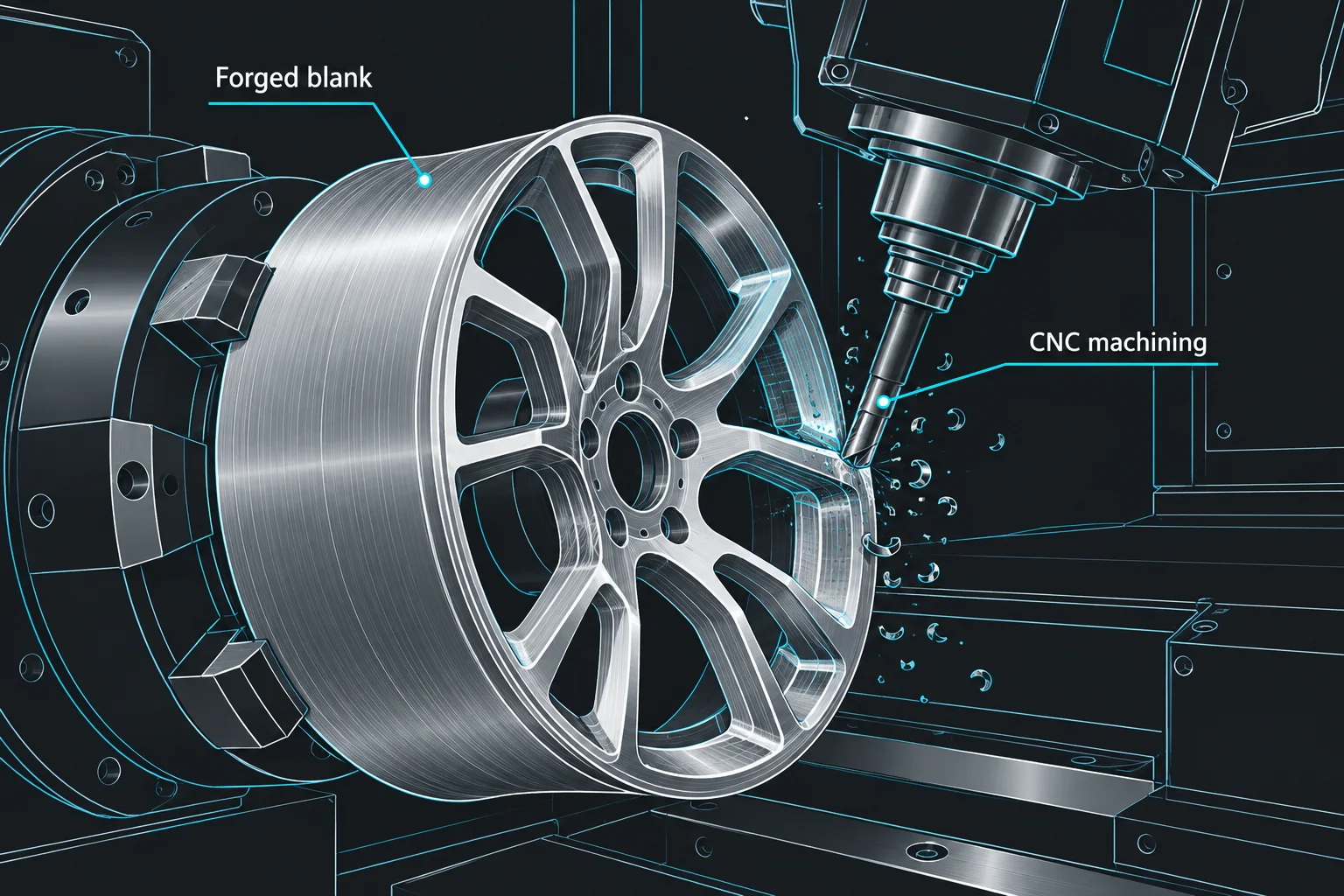
Why machining defines a custom forged wheel
Forging gives the metal its structure; machining gives the wheel its design and fitment. With a fully custom wheel, the forging blank can be fairly generic while the CNC program is written for one specific drawing: your spoke geometry, your profile, your offset, your bolt pattern. That is what makes truly made-to-order forged wheels possible in small quantities. At VEXORA, custom orders start from one pair.
From drawing to CNC program
The approved 3D model is converted into toolpaths using CAM software. Programmers choose cutting tools, sequence operations, and define fixturing so the wheel can be located accurately and repeatably. Fixturing and datum choice decide how well the finished faces, bores and seats relate to each other.
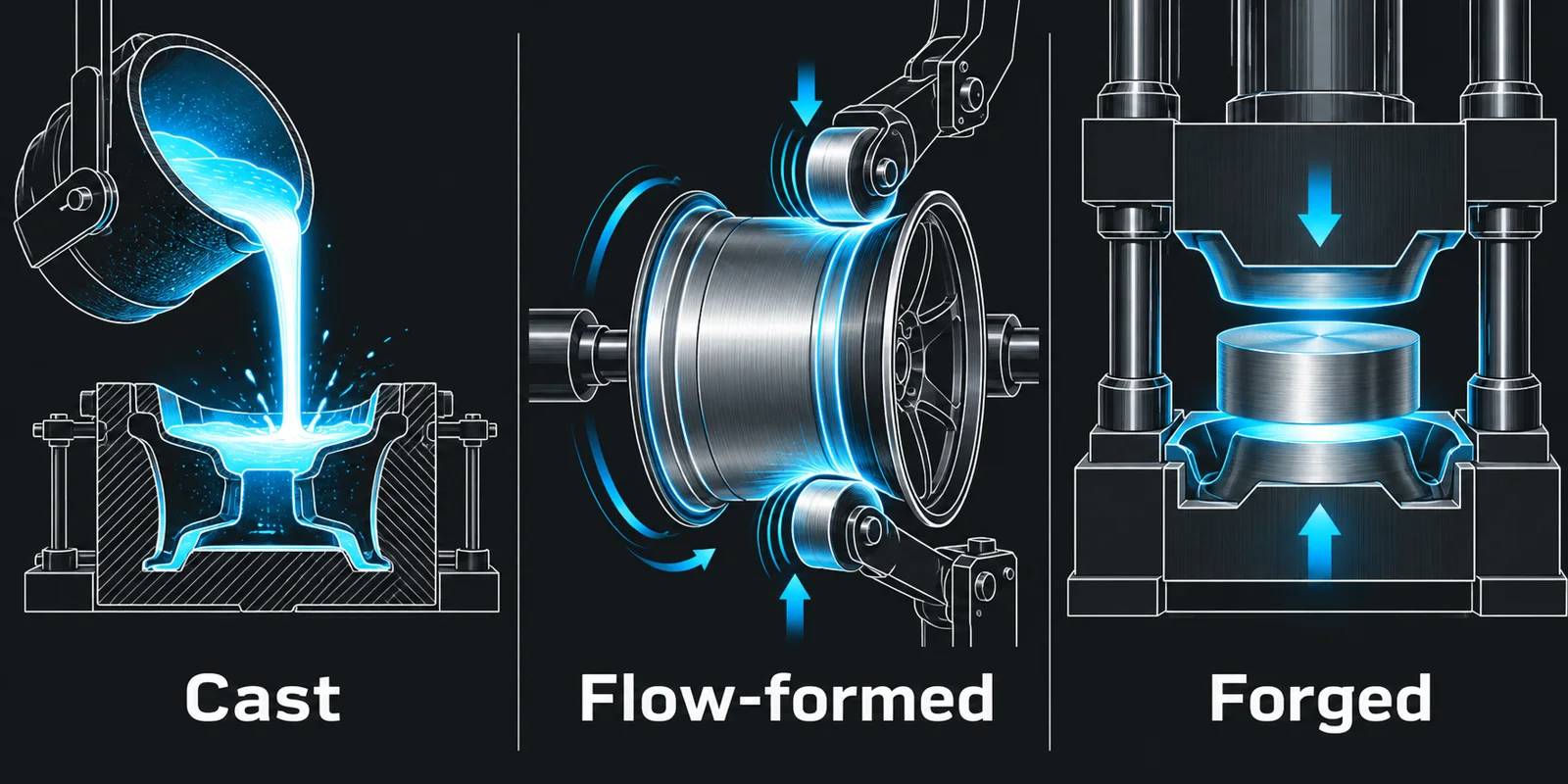
Rough turning
The heat-treated forging is mounted on a CNC lathe. Rough turning removes bulk material from the inner and outer barrel, lip and face, leaving a controlled allowance. Removing stock evenly helps release stresses before finishing, and establishes datums for subsequent operations.
Finish turning
Finish passes bring the barrel, bead seats, safety humps, flanges, lip and mounting pad to drawing dimensions and surface finish. Bead seat geometry affects tire mounting and air sealing; the flatness and squareness of the mounting pad influence runout and how the wheel seats on the hub.
Spoke window milling
On a multi-axis machining center, cutters plunge and profile through the face to open the spoke windows. The windows define the visible spoke pattern and strongly affect weight.
3D surface milling
Ball-nose and other tools then trace the three-dimensional surfaces of each spoke: concave sweeps, crowned tops, chamfers, step-downs and sharp design lines. Machine time rises quickly with complexity and with the surface finish required. Deep concave and directional designs typically need more 3D milling than flat designs.
Back-side pocketing and weight reduction
Material behind the spokes and around the hub can be pocketed out where it carries little load. Pocket design is an engineering decision tied to the load requirement and brake clearance, not just a weight target.
Drilling and lug seats
The bolt pattern (PCD) is drilled at the specified pitch circle and stud count. Lug seats are machined to the specified type: 60° conical, ball/radius or flat. The center bore is machined to your hub diameter for hub-centric fitment, and the valve hole is drilled to suit the valve or TPMS sensor.
Deburring and edge finishing
Edges are deburred and radiused so coatings cover them properly. Sharp edges are a common starting point for coating failure, especially on magnesium.
Measurement and inspection
Key dimensions are measured against the drawing: offset, PCD, center bore, seat geometry, bead seats and overall width. Radial and lateral runout are measured with the wheel rotating; balance is assessed according to the agreed inspection plan.
Machining magnesium
Magnesium machines easily, but fine chips and dust must be managed and kept away from ignition sources, with appropriate extraction and cleaning. The machined surface is then pretreated promptly as part of the protective system. See custom forged magnesium wheels.
What machining means for price and lead time
Machine hours are a major cost driver of custom forged wheels: more windows, deeper 3D surfaces and finer finishes take longer. Production typically takes approximately 20 days once the specification, drawings and finish are approved, confirmed per project.
Tolerances that matter most
Not every surface is equally critical. The mounting pad, center bore, lug seats and bead seats determine how the wheel locates on the hub and holds the tire, so they receive the closest attention. Decorative surfaces on the spokes matter for appearance and coating quality but have more freedom. Runout, the wobble of the rim as it rotates, depends on how accurately these critical surfaces relate to each other.
Surface finish and its effect on coatings
Tool marks left by milling can be a design feature (for example a visible machined texture) or something to blend before coating. The surface quality expected on each zone is part of the finish specification. Brushed and polished finishes require an especially consistent machined surface underneath. See custom wheel finishes.
Machining for multi-piece wheels
On 2-piece and 3-piece wheels, the center is machined with a bolt flange or weld interface, and the barrels are machined separately. Bolt holes must align precisely and sealing surfaces must be clean and flat. See 2-piece vs 3-piece construction.
Questions to ask about machining
- Is the design machined from a forging or from a cast blank?
- Which surfaces are finish-machined, and which are left as forged?
- How is the wheel located between operations?
- Are center bore and seats machined to my vehicle?
- How are runout and critical dimensions checked?
Machining time by design type
| Design type | Machining character |
|---|---|
| Simple flat multi-spoke | Fewer 3D surfaces; mostly window profiling and turning. |
| Concave split-spoke | Extensive 3D surfacing on each spoke and split; more tool changes. |
| Deep concave directional | Left and right wheels mirrored, more complex surfaces and longer programs. |
| Mesh / multi-element | Many small windows and intersections; long profiling time. |
| Heavily pocketed lightweight | Additional back-side machining tied to load requirement. |
More complex designs cost more to machine, but the program is still written for your specific wheel. Because every VEXORA set is made to order, design complexity is reflected in the quotation for your project rather than in a catalog price.
Mirrored and directional designs
Directional designs, where spokes sweep in the direction of rotation, need separate left and right machining programs so both sides of the car look correct. The same applies to some asymmetric concave designs. This adds programming and setup work and is reflected in the quotation for your project.
Valve and TPMS considerations
The valve hole position and angle are machined to suit the valve stem or TPMS sensor used on your vehicle. Tell us which sensor is fitted so clearance to the spokes and barrel can be checked.
Machining and weight targets
Weight on a forged wheel is largely decided at the machining stage: how deep the windows are, how thin the spokes and barrel can be, and how much material is pocketed from the back. Each of those choices is constrained by the load requirement and by the brake and suspension clearance for your car. That is why a weight target should be agreed together with the load rating and design, not as a standalone number.
For inspiration on spoke styles that machining can produce, see design directions.
Summary
CNC machining is where a forged blank becomes your wheel: turning sets the barrel and mounting surfaces, milling creates the spokes and the design, drilling sets the fitment to your car, and inspection confirms it. Because every VEXORA set is fully custom, the program is written for your drawing, and orders start from one pair.
FAQ
Is a machined face the same as a diamond-cut finish?
Diamond cutting is a finishing operation that re-machines a coated face to expose bright metal. Structural machining happens before finishing.
Can any design be machined?
Feasibility depends on tool access, wall thickness and load requirement, confirmed per project.
Do you keep machined wheels in stock?
No. Every wheel is machined to its own order.
Related: how forged wheels are made · our custom process · request a quote.