Key takeaways
- How are forged wheels made? A solid billet is heated, pressed in a closed die, heat-treated, then CNC-machined into the final design and fitment.
- Forging sets the dense metal structure; most of the visible spoke and barrel shape is cut afterward on CNC.
- Flow-formed usually means a cast center with a rolled barrel - a different route from forging the whole wheel blank.
- Ask any maker: alloy and temper, forging stages, barrel route, which dimensions are checked on every wheel, and production time after drawing approval.
- At VEXORA every set is made to order from your brief (MOQ 1 pair). Production is typically about 20 days after drawings and finish are approved, confirmed per project.
How are forged wheels made? The short answer
A forged wheel starts as a solid aluminum or magnesium billet. The billet is heated, pressed under high force into a closed die, heat-treated to the design temper, then CNC-machined for spokes, barrel, bolt pattern, center bore and mounting face. Finishing and inspection complete the set. Multi-piece wheels add an assembly step for the center and barrels.
The steps below describe common industry practice. For VEXORA, every set is fully custom and made to order, and the exact route for your wheel is confirmed per project.
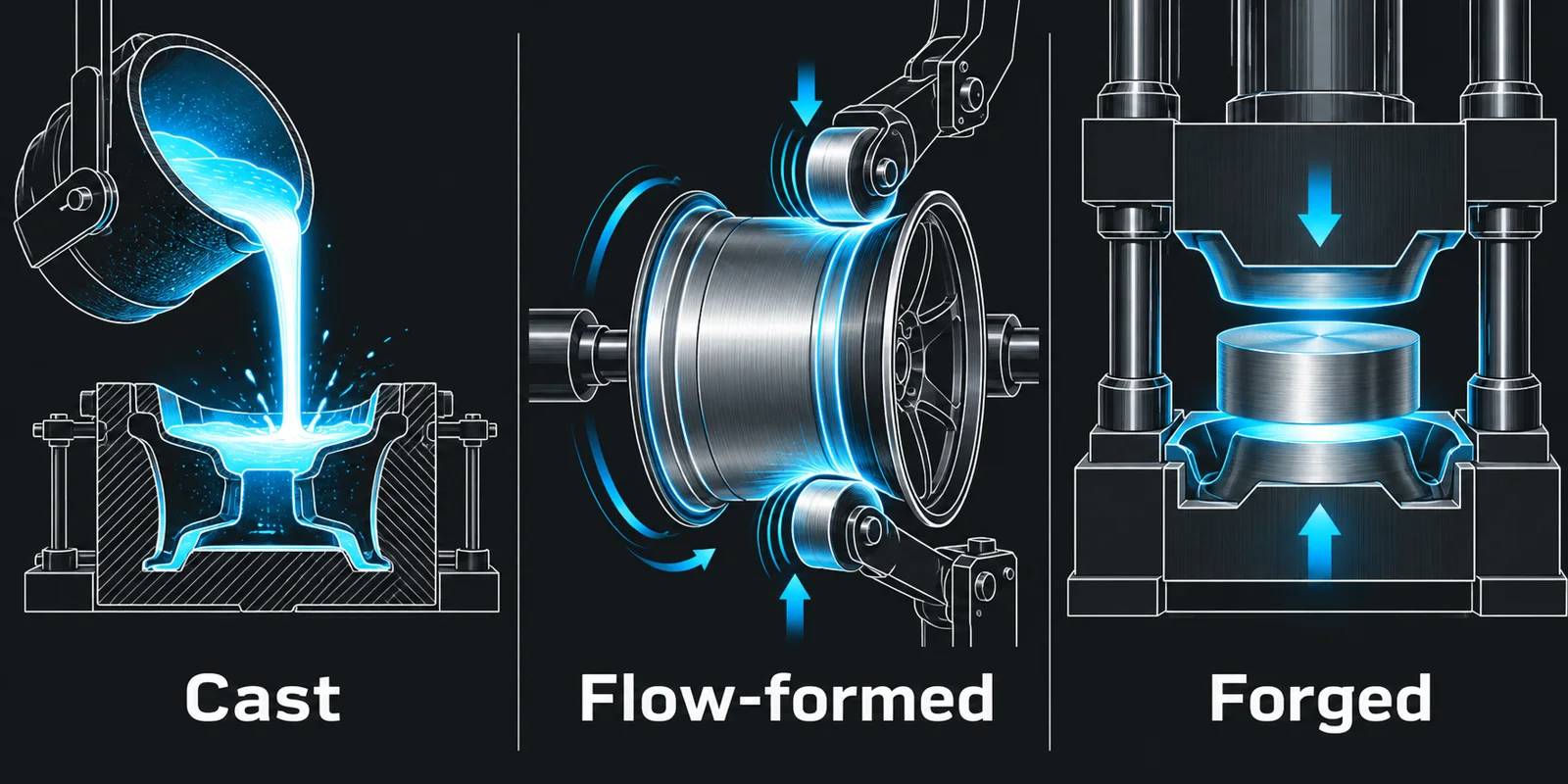
Forged vs cast vs flow-formed (where the difference comes from)
| Route | How the blank is made | What that usually means for buyers |
|---|---|---|
| Cast | Molten metal poured into a mold | Shape comes from the mold; widely used for volume wheels |
| Flow-formed | Typically a cast center; barrel rolled over a mandrel | Barrel is work-hardened; still not a full forging |
| Forged | Solid billet pressed in a closed die, then machined | Dense structure from pressure; design cut from the forging |
A cast wheel takes its shape from molten metal in a mold; a forged wheel takes its structure from pressure applied to solid metal. That is why forged designs can often meet a given load requirement with less material - final weight still depends on design, size and the load brief. Deeper comparison: forged vs cast wheels.
Step 1: Design and engineering
Production starts with the specification: vehicle, diameter, width, offset, PCD, center bore, seat type, load requirement, brake clearance, construction and design. A technical drawing is created and approved before any metal is cut. Engineers decide where material can be removed and where it must remain, which decides the forging blank shape and the machining program.
Step 2: Material selection
Forged aluminum wheels are commonly made from 6061 alloy, which forges well and reaches high strength in the T6 condition. Forged magnesium wheels use wrought magnesium alloys such as AZ80- or ZK60-type alloys. Material arrives as bar with batch documentation so it can be traced through production. More on the aluminum temper: 6061-T6 forged wheels.
Step 3: Cutting billets
Bar is sawn into billets. Billet mass is calculated from the forging blank plus losses, so each piece fills the die properly without excessive flash. Consistent billets mean consistent forgings.
Step 4: Heating
Billets are heated in furnaces to the forging temperature range of the alloy, below melting but hot enough for the metal to flow under pressure. Temperature is controlled because forging too cold can crack the material, and too hot can damage its structure. Magnesium's workable range is narrower than aluminum's.
Step 5: Closed-die hot forging
The hot billet is placed in a closed die and pressed by a large hydraulic press. Presses used for wheel forging in the industry are typically rated in thousands of tonnes. Under that pressure the metal fills the die cavity; internal voids are closed and the grain structure is compacted and aligned with the shape. Many processes use two stages: a pre-forge that spreads the billet into a disc, then a finish forge that forms the rough hub, spoke area and barrel.
Step 6: Spinning or flow forming (route dependent)
On some routes the barrel of the forged blank is then spun or flow-formed: the blank rotates while rollers press the barrel over a mandrel, stretching it to width and refining the lip profile. Others forge the barrel shape more fully and machine it directly. Both are used in the industry; the choice depends on design and construction.
Step 7: Heat treatment
Aluminum forgings are solution treated at high temperature, rapidly quenched and then artificially aged to the T6 temper. This sequence develops the strength and hardness used in the wheel design. Magnesium alloys are aged where the alloy calls for it. Heat treatment is done before final machining so that dimensions are cut on stable material.
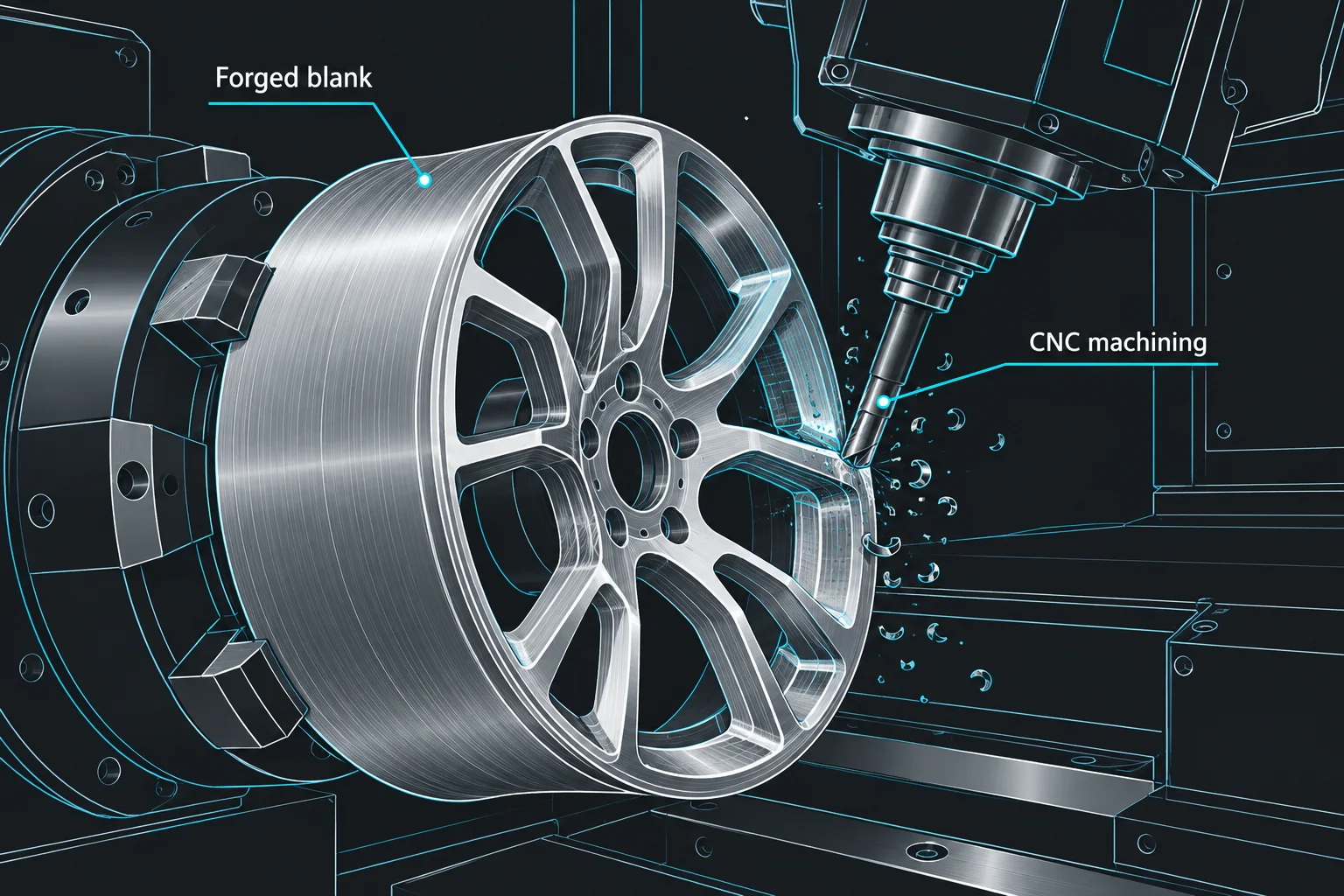
Step 8: CNC machining
Machining turns a rough forging into a wheel. Lathes rough-turn and then finish-turn the barrel, bead seats, lip and mounting face. Multi-axis machining centers mill the spoke windows and 3D spoke surfaces, then drill the bolt pattern, lug seats, center bore and valve hole. A complex custom design can take many hours of machine time. More detail: CNC machining of forged wheels.
Step 9: Inspection
Critical dimensions are measured against the drawing: offset, PCD, center bore, seat geometry and bead seats. Radial and lateral runout are checked, and balance is assessed according to the inspection plan. Project-specific tests or documents are agreed in writing.
Step 10: Finishing
Surfaces are cleaned and pretreated, then coated, brushed, polished or diamond cut, and sealed with clear coat. On magnesium wheels the finishing system is also the corrosion protection. See custom forged wheel finishes.
Step 11: Assembly (multi-piece wheels)
For 2-piece and 3-piece wheels, the forged center and barrels are assembled with hardware and sealed, or joined by the method specified. See 2-piece vs 3-piece forged wheels and 3 piece wheels.
Step 12: Packaging and delivery
Wheels are individually protected for international transit. Production typically takes approximately 20 days once the specification, drawings and finish are approved, confirmed per project. Shipping time varies by destination country. Where DDP (Delivered Duty Paid) is available for your country, orders ship DDP: import duties and taxes are handled and the wheels are delivered to your door.
Common misconceptions about forged wheels
- "Forged means every part was forged." Most of a forged wheel's final shape is created by machining; forging provides the material structure.
- "Flow formed is the same as forged." Flow forming usually refers to a cast wheel whose barrel is rolled; it is a different route from forging the whole wheel.
- "Forged wheels are always lighter." They often can be, but final weight depends on design, size and load requirement.
- "A forged wheel needs no inspection." Every wheel needs dimensional and runout checks.
What to ask a manufacturer about its process
- Which alloy and temper will my wheel use?
- Is the barrel forged and machined, or flow-formed after forging?
- How many forging stages are used for this blank?
- Which dimensions are measured on every wheel?
- How are runout and balance checked?
- What finishing and pretreatment system is used?
- How long is production after drawing approval?
Clear answers to these questions are a good sign of a well-controlled process.
Quality checkpoints along the chain
Good manufacturers check quality at several points, not only at the end: material documentation at incoming inspection, forging appearance and fill after pressing, properties after heat treatment, dimensions after machining, runout and balance, and finish appearance and coverage after coating. The specific checks for your wheel are part of the inspection plan agreed per project.
How long each stage takes
Forging and heat treatment are relatively quick per piece; CNC machining and finishing usually take the most time on a custom wheel, together with drawing approval at the start. For VEXORA, production is approximately 20 days after approval, confirmed per project. A complete brief, a fast drawing review and a clearly specified finish are the best ways to keep a project on schedule.
From process page to a custom set
New to the term itself? Start with what are forged wheels. Face geometry such as dish is covered in forged concave wheels. For vehicle-specific design directions, browse the builds hub - for example Nissan GT-R, Corvette, and Tesla Model 3.
VEXORA does not keep a stock catalog or ready-to-ship inventory. Every wheel is engineered and forged to your vehicle, dimensions and finish. Every VEXORA set is made to order, and custom orders start from a single pair. MOQ: 1 pair (2 wheels).
FAQ
How are forged wheels made?
A solid billet is heated, closed-die forged, heat-treated, CNC-machined to the drawing, inspected, finished, and - for multi-piece designs - assembled. Exact stages vary by maker and construction.
How long does it take to make a forged wheel?
For VEXORA, approximately 20 days production after approval, confirmed per project.
Are your wheels made from stock blanks?
Each set is machined to its own drawing; there is no catalog or ready-to-ship inventory. Custom orders start from a single pair. MOQ: 1 pair (2 wheels).
Is magnesium forged the same way?
The sequence is similar, with tighter temperature control and dedicated handling during machining.
Is flow-formed the same as forged?
No. Flow-formed usually means a cast center with a rolled barrel. A forged wheel starts from a solid billet pressed in a closed die.
Start your project: custom forged aluminum wheels, custom forged magnesium wheels, or request a quote. Email sales@vexoraforged.com or message WhatsApp +86 159 2056 8771.