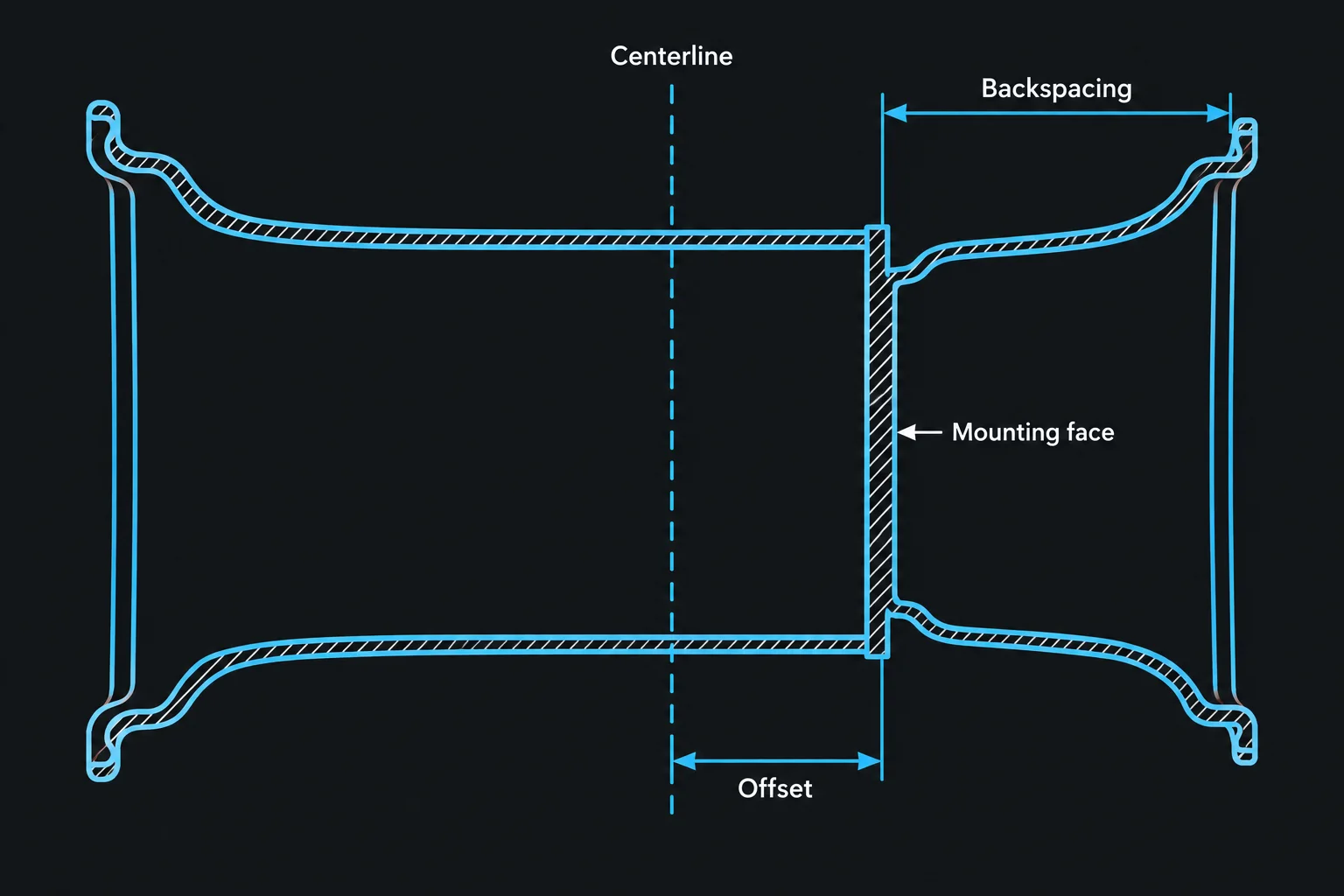
Want the numbers instantly? Use our interactive wheel offset calculator to compare current and new width and offset. This guide walks through the formulas behind it, plus PCD, center bore and seat type.
Why calculate before you order
With a fully custom forged wheel you can choose width and offset to the millimetre. That is powerful, but only if you know where the new wheel will sit compared with the old one. The formulas below let you predict how far a new wheel and tire will move outward (poke) and inward (inner clearance). They are standard geometry; your final values are still checked against the vehicle before the drawing is approved.
Key definitions
| Term | Meaning |
|---|---|
| Width (J) | Rim width between bead seats, in inches |
| Offset (ET) | Distance in mm from the wheel centerline to the mounting face; positive = face toward outside |
| Backspacing | Distance from the mounting face to the inner rim edge |
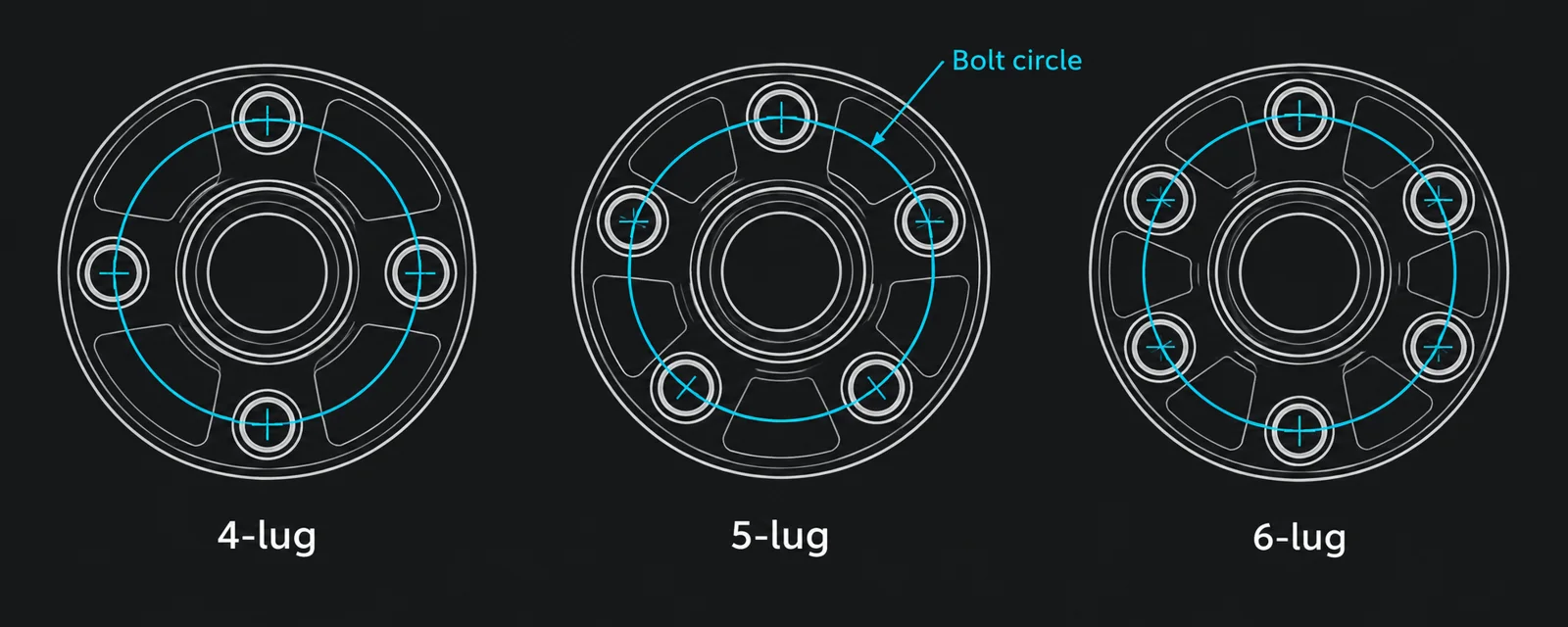
| PCD | Stud count x pitch circle diameter, e.g. 5x112 |
| Center bore | Hub-locating hole diameter, mm |
Formula 1: rim width in millimetres
Width (mm) = width (in) x 25.4. A 9.5J wheel is 241.3 mm between bead seats. Real overall width is slightly more because of the flanges; about 25 mm is a common allowance for the two flanges together.
Formula 2: backspacing
Backspacing (mm) = (overall width / 2) + offset. For a 9.5J ET35: (241.3 + 25) / 2 + 35 ≈ 168 mm.
Formula 3: change in outer position (poke)
Change outward = (new width mm − old width mm) / 2 − (new ET − old ET). Example: from 8.5J ET35 to 9.5J ET30: (241.3 − 215.9) / 2 − (30 − 35) = 12.7 + 5 = 17.7 mm further out.
Formula 4: change in inner position
Change inward = (new width mm − old width mm) / 2 + (new ET − old ET). Same example: 12.7 + (−5) = 7.7 mm closer to the suspension. Compare this with the space you measured between tire and strut.
Worked example: staggered rear
Old rear 9J ET40, new rear 10.5J ET35. Width change = (266.7 − 228.6)/2 = 19.05 mm per side. Outward = 19.05 + 5 = 24 mm. Inward = 19.05 − 5 = 14 mm. If your measured fender gap is 20 mm, this setup would poke unless ride height, camber or offset change; raise ET to around ET40 to reduce poke to about 19 mm. These numbers are illustrative.
Tire width matters too
Tire sidewalls often bulge beyond the rim. Use the actual section width of the chosen tire on the chosen rim when checking fender clearance.
How to measure PCD
For an even number of studs, measure center to center across opposite studs. For five studs, measure the distance between centers of adjacent studs (a) and use PCD = a / sin(36°) ≈ a x 1.701. Example: a = 65.8 mm gives about 112 mm, so 5x112.
Center bore and seat type
Measure the hub pilot diameter with calipers. On a custom forged wheel the bore is machined to your hub for hub-centric fit. Confirm seat type (conical, ball or flat) and thread for your bolts or nuts.
Brake clearance
Offset also changes how close the spokes sit to the caliper. Lower offsets move the face outward and generally increase spoke-to-caliper clearance; concave designs add more. Use a brake template for big brake kits.
Quick reference
| Change | Effect |
|---|---|
| Lower ET (same width) | Wheel moves out, more poke, more brake clearance |
| Higher ET | Wheel moves in, closer to suspension |
| Wider (same ET) | Moves out and in by half the added width each |
| Wider + higher ET | Extra width goes mostly inward |
Common PCD values by platform
Many modern European cars use 5x112; many Japanese and Korean cars use 5x114.3; some performance and older European models use 5x120 or 5x130; trucks and large SUVs often use six-stud patterns. Always confirm the exact PCD, center bore and thread for your specific vehicle and model year rather than relying on a platform list.
Measuring your current clearance
- With the car on the ground at normal ride height, measure from the outer tire sidewall to the fender lip (outer clearance)
- Measure from the inner tire sidewall to the strut or spring perch (inner clearance)
- Turn the steering to full lock and check the inner tire to suspension and liner
- Check at the front and rear separately
- Note camber settings; negative camber adds top clearance
Scrub radius and steering feel
Moving the wheel outward with a much lower offset changes the scrub radius, which can affect steering feel and stability under braking. Moderate changes are common; large changes should be considered carefully, especially on the front axle.
Using these numbers in your brief
Send your current wheel width and offset, tire sizes, measured clearances and the look you want (for example flush with the fender, or slightly tucked). With that information a width and offset can be proposed for each axle and checked against brake and suspension clearance before the drawing is issued. See how to spec custom forged wheels.
Hub-centric vs lug-centric
Hub-centric wheels locate on the hub pilot; the lug nuts or bolts clamp the wheel. Lug-centric wheels rely on the conical seats to center the wheel. Custom forged wheels can be machined hub-centric to your exact hub diameter, which avoids centering rings and supports smooth running.
Staggered vs square: calculation tips
Run the calculation separately for front and rear. Fronts must also clear the suspension and liners at full steering lock, so inner clearance at the front is often the limiting value. Rears on many performance cars have more room outward but are limited by the fender lip. If you plan to rotate tires, a square setup with identical sizes is required.
Common mistakes
- Mixing up offset sign: ET+ means the face is toward the outside
- Forgetting tire bulge beyond the rim
- Measuring at a different ride height than you will drive
- Ignoring camber changes after lowering
- Assuming a forum fitment works with different tires or brakes
Spacers vs correct offset
Spacers move a wheel outward, but they add parts to the joint between hub and wheel and can change thread engagement. With a custom forged wheel, the offset itself can be chosen so that spacers are unnecessary, which is cleaner and more predictable.
Wheel PCD and offset: common questions before you order
Most PCD and offset mistakes happen when numbers from a different car, a different tire, or a different ride height are copied without checking. Use your own measurements for wheel PCD and offset, then run the poke and inner-clearance formulas in this guide. If any value is unknown, leave it blank in your brief; a custom forged wheel can still be quoted while fitment is confirmed.
Can offset fix a tire rub?
Sometimes. Raising offset pulls the wheel in; lowering width or tire section width may also be needed. Never force clearance with unsafe spacers or shortened bolts.
Does a custom wheel need a new PCD?
Only if your hubs require it. Fully custom forged wheels are drilled to your vehicle’s PCD and center bore so adapters are usually unnecessary.
FAQ
Is backspacing the same as offset?
No. Offset is from the centerline; backspacing is from the inner edge. They are related by the formula above.
Can you machine any PCD?
PCD, center bore and seats are machined to your vehicle on every VEXORA custom wheel.
Do I need exact numbers to request a quote?
No. Send what you know; fitment is reviewed before the drawing is issued.
Related guides
Send your current setup and target look, and we will propose width and offset. Request a custom forged wheel quote. Email sales@vexoraforged.com or message WhatsApp +86 159 2056 8771.