Use the wheel offset calculator
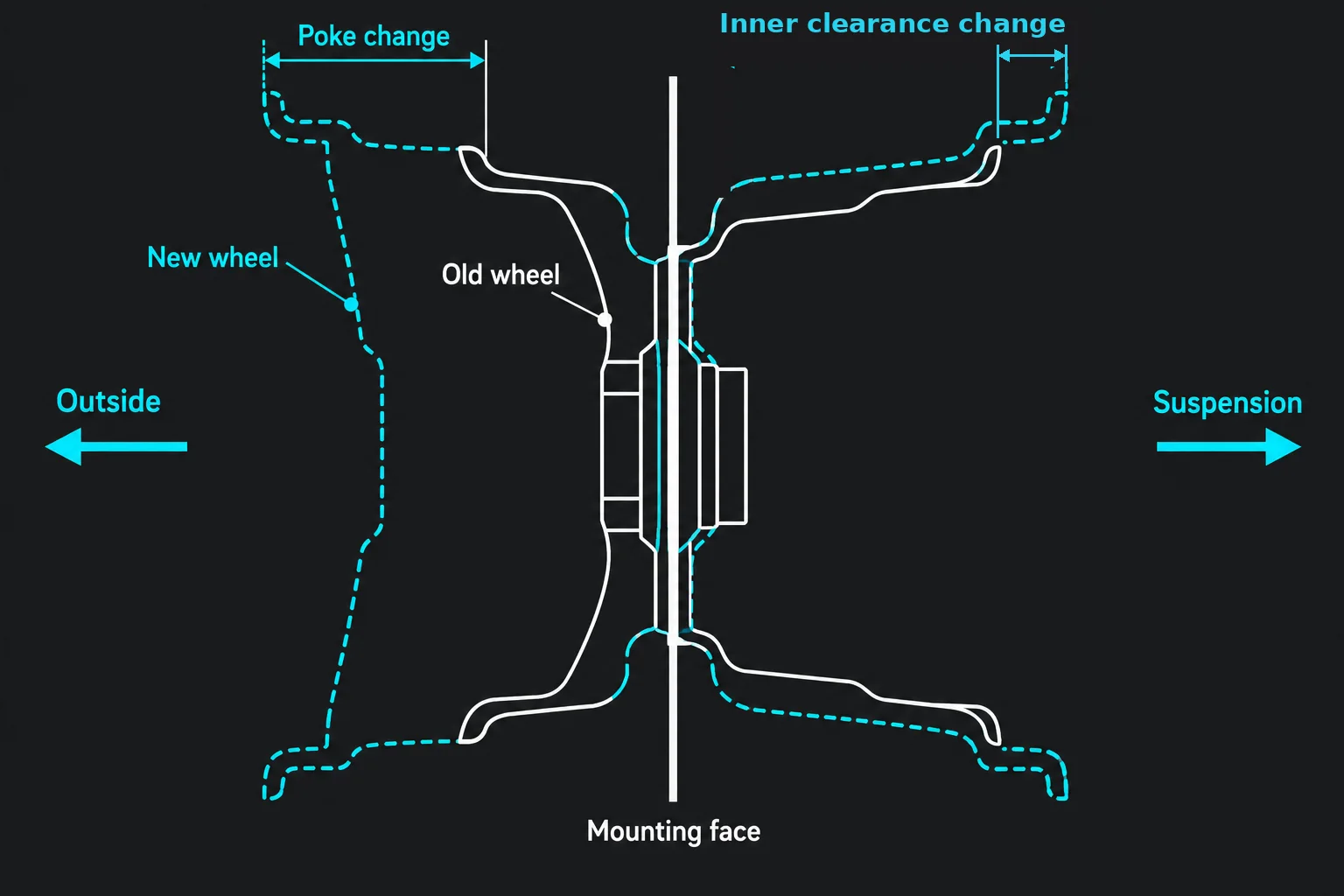
Enter the width and offset (ET) of your current wheel and the wheel you are considering. The results update as you type. The calculator compares where the outer rim edge and the inner rim edge sit relative to the hub mounting face, so you can see how much a new set will poke out or move toward the suspension before you order.
Results are geometry only. They do not know your tire, fender, suspension, brake caliper or camber. Treat them as a first check, then confirm clearance on the car.
What the results mean
| Output | What it measures | Why it matters |
|---|---|---|
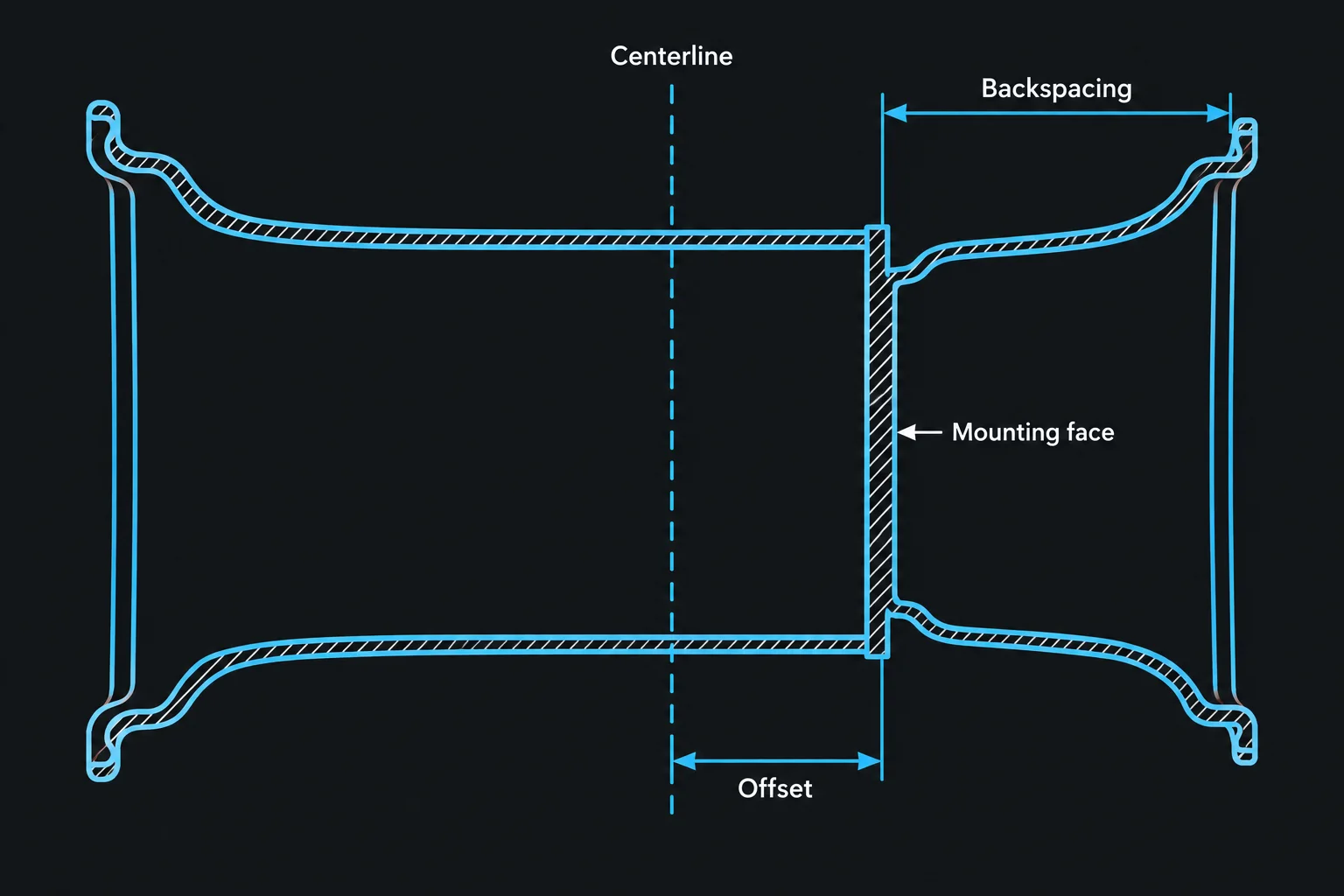
| Backspacing | Distance from the mounting face to the inner rim edge | Controls clearance to struts, springs, control arms and the inner arch |
| Frontspacing | Distance from the mounting face to the outer rim edge | Controls how far the wheel sits toward the fender lip |
| Outer face (poke) change | New frontspacing minus current frontspacing | Positive means the rim edge moves out toward the fender |
| Inner edge change | New backspacing minus current backspacing | Positive means the inner barrel moves closer to suspension parts |
The formulas behind the calculator
Every number comes from standard wheel geometry. Width is converted from inches to millimetres (1 in = 25.4 mm). Offset is the distance from the rim centerline to the mounting face, positive when the mounting face sits toward the outside of the car.
- Width in mm = width in inches × 25.4
- Backspacing = (width in mm ÷ 2) + offset
- Frontspacing = (width in mm ÷ 2) − offset
- Poke change = new frontspacing − current frontspacing
- Inner clearance change = new backspacing − current backspacing
Nominal wheel width (the number stamped on the wheel, such as 9.5J) is measured between the bead seats, not across the outer flanges. A tape measure across the flanges reads roughly an inch more. The comparison results (poke and inner change) are the same either way, because the flange allowance cancels out. Only the absolute backspacing and frontspacing values shift, which is why the calculator lets you choose the basis.
Worked example
Using the default values: a current 8.5 in wheel at ET35 and a new 9.5 in wheel at ET22. The new wheel is 25.4 mm wider and has 13 mm less offset.
- Current: half width 107.95 mm. Backspacing 142.95 mm, frontspacing 72.95 mm
- New: half width 120.65 mm. Backspacing 142.65 mm, frontspacing 98.65 mm
- Poke change: +25.7 mm (about +1.01 in) further out
- Inner edge change: −0.3 mm, essentially the same inner clearance
In other words, that change keeps the inside of the wheel where it was and pushes almost all of the extra width outward. Whether that works depends on fender clearance and tire choice, which you check on the car. Our flush fitment guide explains how width, offset and tire combine to set the look.
How to use the results when ordering custom wheels
With catalog wheels you pick from the offsets that exist. With custom forged wheels the offset is machined to the brief, so the calculator is most useful as a way to agree a target. Measure what you have, decide how much outer movement you want and how much inner clearance you can spare, then work back to a width and offset pair.
- Start from a known fitment: the current wheel and tire that clear today
- Measure the tightest inner point (strut, spring perch, control arm) and the fender gap
- Use the calculator to test candidate width and offset pairs against those limits
- Check brake caliper clearance separately (see our brake clearance guide)
- Confirm bolt pattern and center bore (see how to measure wheel bolt pattern and hub-centric vs lug-centric)
For the formulas worked through in more depth, with PCD measurement and seat type, read the PCD and offset guide. For the whole checklist, use the wheel fitment guide.
Wheel offset calculator FAQ
How do I calculate wheel offset change?
Convert both widths to millimetres, then compare frontspacing (half width minus offset) and backspacing (half width plus offset) for each wheel. The difference in frontspacing is the change in poke; the difference in backspacing is the change in inner clearance.
Does a lower offset push the wheel out?
Yes. At the same width, reducing offset by 10 mm moves both the outer and inner rim edges 10 mm toward the outside of the car.
Why does a wider wheel change clearance on both sides?
Extra width is split around the centerline. At the same offset, a wheel 1 in wider gains about 12.7 mm on the outside and 12.7 mm on the inside.
Can I use this for backspacing?
Yes. The calculator shows backspacing for both wheels. Choose the flange option if you want a figure close to what a tape measure reads on a real wheel.
Does the calculator account for tires or camber?
No. It is rim geometry only. Tire sidewall shape, camber and suspension travel all change real clearance, so confirm on the car.
Can you machine a custom offset for my car?
Yes. VEXORA custom forged aluminum and magnesium wheels are made to order with the width and offset in your brief. Every VEXORA set is made to order, and custom orders start from a single pair. MOQ: 1 pair (2 wheels). Production typically takes approximately 20 days once the specification, drawings and finish are approved, confirmed per project. Shipping time varies by destination country. Where DDP (Delivered Duty Paid) is available for your country, orders ship DDP: import duties and taxes are handled and the wheels are delivered to your door.
Turn your numbers into a custom set
Send us the current and target fitment, your bolt pattern, center bore and any brake kit details. We machine each set to that brief. Request a quote or read about custom forged wheels. Email sales@vexoraforged.com or message WhatsApp +86 159 2056 8771.