Hub-centric vs lug-centric: the short answer
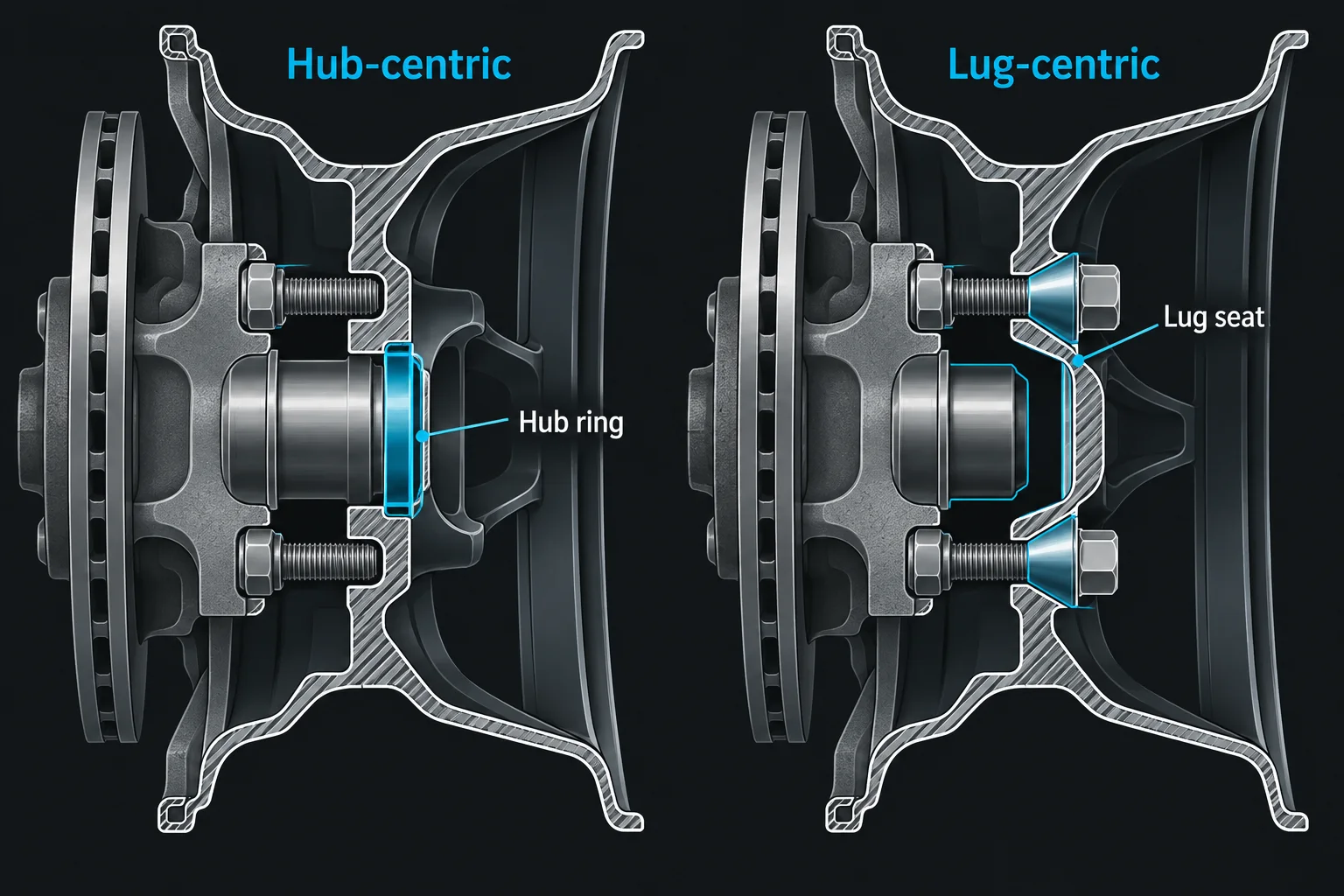
Hub-centric vs lug-centric describes how a wheel is centered on the vehicle. In a hub-centric fitment, the wheel’s center bore matches the hub diameter closely, so the hub centers the wheel before you fully torque the lugs. In a lug-centric fitment, the wheel bore is larger than the hub, and the lug seats and hardware are what pull the wheel into center as you tighten.
Both approaches exist in the aftermarket. Neither replaces a correct bolt pattern (PCD), seat type or load rating. Center bore is a separate specification from PCD: you can get PCD right and still have a centering problem if the bore and hardware do not match how the wheel is meant to sit. Our bolt-pattern guide and wheel fitment guide cover those other checks; this page focuses on centering.
| Topic | Hub-centric | Lug-centric |
|---|---|---|
| What centers the wheel | Hub pilot diameter + matching center bore (often with a ring) | Lug seats / nuts or bolts as they are torqued |
| Center bore vs hub | Bore matches hub (or ring reduces bore to hub size) | Bore is intentionally larger than the hub |
| Feel when mounting | Wheel usually drops onto the hub with little side play | Wheel may rock slightly until lugs are snugged in a star pattern |
| Common use | OEM wheels; many custom and quality aftermarket sets | Some aftermarket designs, multi-fit wheels, certain racing practices |
| Main risk if wrong | Bore too small will not mount; bore too large without a plan becomes lug-centric by accident | Uneven torque, wrong seat type, or cheap hardware can leave the wheel off-center |
“Hub-centric” is not a marketing badge by itself. What matters is whether the finished wheel is centered the way your hub and hardware expect, every time you remount it.
What center bore actually is
Center bore (CB) is the diameter of the hole in the middle of the wheel that goes over the hub’s pilot. It is measured in millimetres. OEM wheels are almost always bored to match that pilot closely. Aftermarket wheels may be bored to one hub size, bored oversize for multiple vehicles, or supplied with hub-centric rings that fill the gap between a larger bore and a smaller hub.
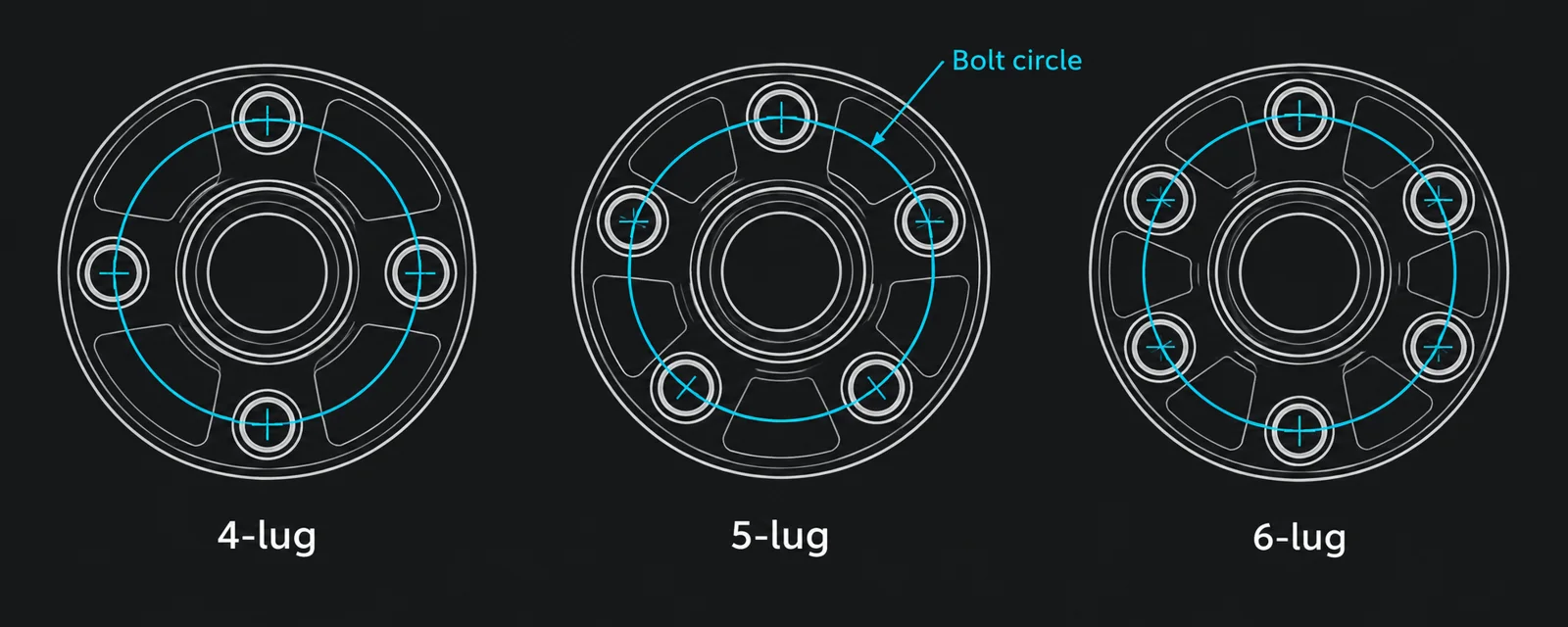
Center bore does not change PCD, offset or width. A wheel can have a perfect 5×114.3 pattern and still vibrate if it is not centered. Conversely, a correctly centered wheel with the wrong PCD will not mount safely at all. Treat CB as mandatory data in any custom brief, alongside PCD, offset, seat type and brake clearance.
How hub-centric fitment works
On a hub-centric setup, the hub pilot and the wheel bore (or ring ID) share the centering job. When you lift the wheel onto the hub, it should sit concentrically before final torque. The lugs then clamp the wheel to the hub face; they are primarily fasteners and clamp-load devices, not the only thing keeping the wheel round about the axle.
That is why OEM wheels rarely need rings: the bore is machined for that car’s hub. Custom forged wheels can be machined the same way — bore cut to the hub diameter you specify — so each set is hub-centric for that vehicle without relying on a multi-fit hole.
- Confirm hub pilot diameter from the vehicle or a trusted fitment source, then verify by measuring the hub if you can
- Specify that same center bore on the wheel drawing (or the ring ID if you deliberately use rings)
- Keep the hub face and pilot clean; dirt or rust under the bore can fake a “vibration” problem
- Torque lugs in a star pattern to the vehicle’s specification after the wheel is seated on the hub
How lug-centric fitment works
Lug-centric wheels use a center bore larger than the hub. There is clearance around the pilot. As you tighten the lugs evenly, the conical or ball seats (or the shank design, on some systems) pull the wheel into center. Done carefully, with the correct seat type and good hardware, this can run true.
Problems appear when torque is uneven, seats are the wrong shape, threads are dirty, or the wheel is only snugged on the ground on one side of the car. The wheel can end up slightly eccentric, which shows up as a vibration that may change with speed or after a tire rotation. Lug-centric is a design choice, not an excuse for sloppy installation.
Some multi-fit catalog wheels use a large bore so one SKU covers many hubs. That can be convenient for inventory. For a fully custom forged set built for one car, machining the correct bore is usually cleaner than shipping a loose multi-fit hole and hoping hardware alone centers it every remount.
Hub-centric rings: what they fix and what they do not
A hub-centric ring is a sleeve (plastic or metal) that sits between a larger wheel bore and a smaller hub pilot. The outer diameter matches the wheel bore; the inner diameter matches the hub. Rings are a valid way to convert an oversize bore into a hub-centric interface for a specific car.
Rings do not fix the wrong PCD, the wrong offset, the wrong seat type, or a bent wheel. They also do not increase load capacity. If a ring falls out, melts, or is the wrong size, you are back to incidental lug-centric fitment. For a permanent custom order, prefer machining the bore to the hub when you can; use rings when you intentionally keep a larger bore (for example a shared design across a few hubs) and specify the ring set in writing.
| Check | Why it matters |
|---|---|
| Outer diameter matches wheel CB | Loose OD lets the ring rattle or sit crooked |
| Inner diameter matches hub pilot | Wrong ID does not center |
| Material and temperature rating | Some plastics dislike sustained brake heat; metal rings are common for performance use — confirm per project |
| Installed orientation and seating | Ring must sit fully home before the wheel is clamped |
| Not a spacer substitute | Rings center; they do not change offset like a wheel spacer |
Vibration, runout and mis-centering
Owners often blame “bad tires” when the real issue is mounting. Classic symptoms of a centering problem include a vibration that appears after wheels were removed, a shake that changes after re-torque, or a wheel that visibly has uneven gap around the hub pilot before the lugs are tight.
Other causes still matter: tire balance, bent rim, cupped tires, warped rotors, loose hardware. Work through them systematically. If the bore is clearly larger than the hub and no ring is present, try a correct ring or a properly bored wheel before replacing tires. If the bore matches and vibration remains, look at balance and tire condition next.
- Mount on a clean hub; remove rust scale and old ring fragments
- Seat the wheel on the hub (or ring) before final torque
- Torque in star pattern to spec; re-check after a short drive when the manufacturer recommends it
- Confirm seat type: conical (taper), ball (radius), or flat with washers — mismatch can prevent true centering
- Do not paint or powder the hub mounting face so thick that the wheel cannot sit flat
Seat type is part of centering
Hub-centric vs lug-centric is about the pilot. Seat type is about the shape where the nut or bolt head meets the wheel. Using a conical nut in a ball seat (or the reverse) can leave the wheel poorly located even if the bore looks right. Custom forged wheels are drilled and seated to the hardware you specify for the vehicle. State OEM seat type in the brief, or send a photo of the OEM nut/bolt and the old wheel’s seat.
Thread size and length matter too short studs or the wrong bolt length are a safety issue, not a styling detail. Fitment review should confirm hardware along with PCD and CB.
Why custom forged wheels help here
VEXORA does not keep a stock catalog or ready-to-ship inventory. Every wheel is engineered and forged to your vehicle, dimensions and finish. That means PCD, center bore, offset, width and seat type are chosen for your hub, not borrowed from a multi-fit blank.
Every VEXORA set is made to order, and custom orders start from a single pair. MOQ: 1 pair (2 wheels). You do not need a warehouse MOQ to get a bore that matches the car.
Forged aluminum (typically 6061-T6) and forged magnesium can both be machined to the same centering specification. Material choice is about weight, use and care — not about whether hub-centric fitment is possible. Construction (monoblock, 2-piece, 3-piece) likewise does not remove the need for a correct CB; see monoblock vs 2-piece vs 3-piece.
Production typically takes approximately 20 days once the specification, drawings and finish are approved, confirmed per project. Shipping time varies by destination country. Where DDP (Delivered Duty Paid) is available for your country, orders ship DDP: import duties and taxes are handled and the wheels are delivered to your door. Approval includes the technical drawing where center bore is shown. Changing CB after machining is not a trivial tweak, so confirm hub diameter before you sign off.
How to measure and brief center bore
You do not need exotic tools for a first pass:
- Measure the hub pilot diameter with a caliper if accessible (clean the pilot first)
- Or read CB from the OEM wheel face marking when present, then verify against a fitment database
- Measure the aftermarket wheel’s bore the same way if you are comparing
- Note whether a ring is currently installed — measure hub and wheel separately
- Record seat type and whether the car uses bolts or studs + nuts
Put those numbers in the same brief as diameter, width, offset and brake kit. If you want flush fitment, say so, but lock centering and PCD first — flush geometry is useless on a wheel that does not center. Continue with flush fitment and the PCD and offset calculator guide once CB is settled.
Common mistakes
- Assuming any 5-lug wheel with the right PCD is automatically hub-centric
- Leaving a large bore empty “because the lugs will center it” without checking seat type and torque discipline
- Using the wrong ring size or stacking damaged rings
- Mixing seat types across corners after a hardware swap
- Painting the hub face or leaving thick corrosion under the mounting surface
- Ordering custom wheels from a photo only, without stating CB and seat type
Sizing a ring? Our hub centric rings guide covers measuring ring OD and ID, plastic vs aluminum and installation.
If you are weighing spacers against machining the correct offset and center bore, see hub centric wheel spacers.
Questions about hub-centric vs lug-centric
Is hub-centric better than lug-centric?
Hub-centric match to the OEM hub is the usual goal for street cars because the wheel is centered before final torque. Lug-centric can work when designed and installed correctly, but it depends more on hardware and technique.
Do I need hub-centric rings with custom forged wheels?
Often no: the bore can be machined to your hub. Rings are useful when the bore is left larger on purpose. Confirm per project.
Can the wrong center bore cause vibration?
Yes. A large unmatched bore, a missing or wrong ring, or uneven lug torque can leave the wheel off-center and feel like a balance problem.
Is center bore the same as bolt pattern?
No. Bolt pattern (PCD) is lug count and circle diameter. Center bore is the middle hole that fits the hub pilot.
Will forged magnesium change centering?
No. Centering is geometry and hardware. Magnesium vs aluminum is a material choice; CB is still specified to the hub.
Can I order one pair with the correct CB?
Every VEXORA set is made to order, and custom orders start from a single pair. MOQ: 1 pair (2 wheels). Email sales@vexoraforged.com or message WhatsApp +86 159 2056 8771.
Specify centering on your next set
Send vehicle year/model/trim, hub pilot or OEM CB, PCD, seat type and any big-brake kit. We machine custom forged aluminum and magnesium wheels to that brief. Request a quote for custom forged wheels, or review how to spec a custom set end to end. Email sales@vexoraforged.com or message WhatsApp +86 159 2056 8771.
')Related: Forged wheel brake clearance for big brake kits — how BBK caliper envelopes change custom forged inner profiles.