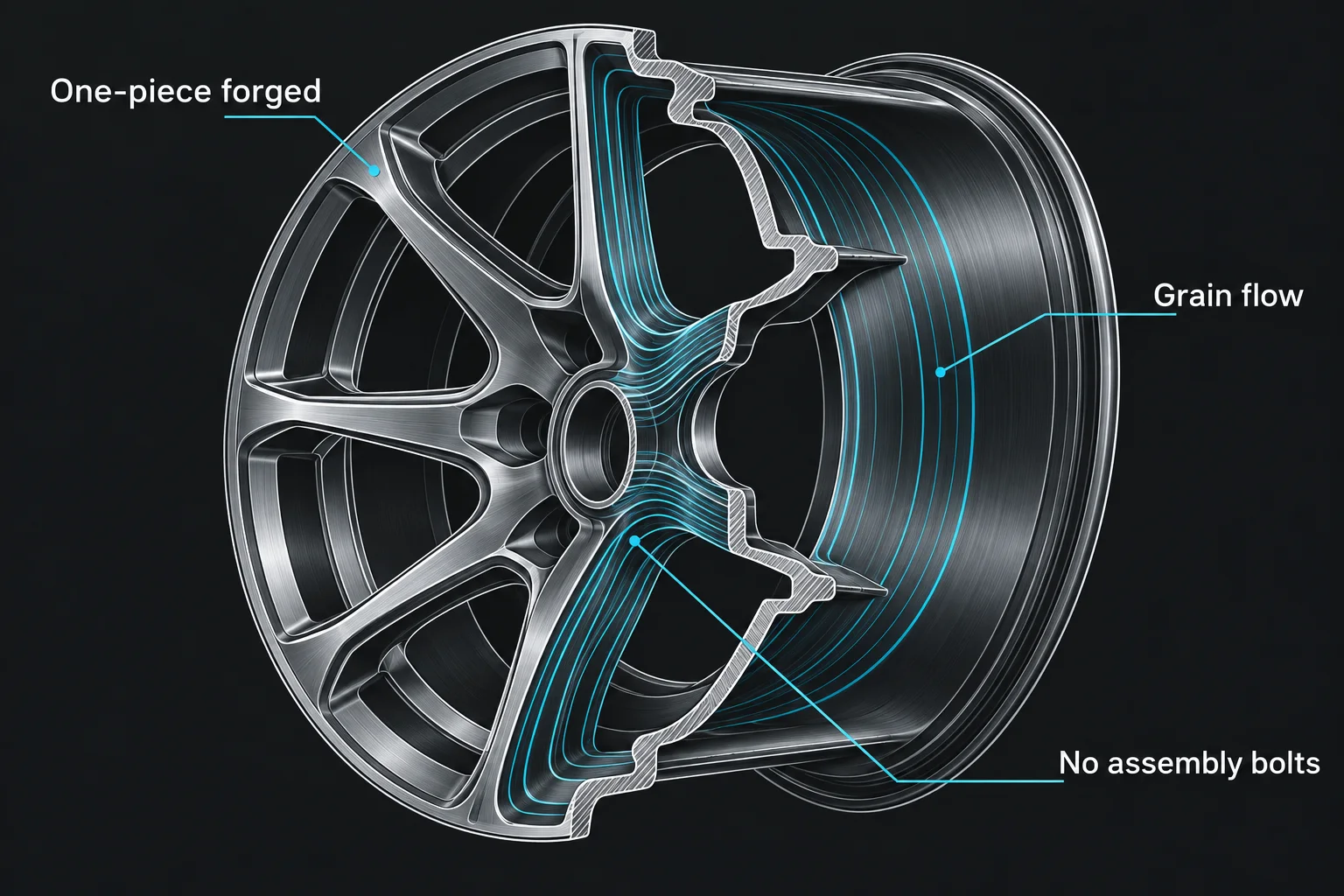
Monoblock wheels: the short answer
Monoblock wheels are made as a single piece: the face, spokes and barrel are one part, with no bolts or welds joining sections. “Monoblock” describes construction, not the manufacturing method, so a monoblock wheel can be cast, flow formed or forged. A forged monoblock, also called a 1 piece forged wheel, is machined from a single forged aluminum or magnesium blank.
The alternative is a multi-piece wheel: a 2-piece wheel joins a center to a barrel, and a 3-piece wheel bolts a center between an inner and outer barrel half. Our monoblock vs 2-piece vs 3-piece guide compares all three side by side.
| Topic | Monoblock | Multi-piece (2 or 3 piece) |
|---|---|---|
| Construction | One part | Center plus barrel section(s), bolted or welded |
| Assembly hardware | None | Assembly bolts and sealant on most designs |
| Air sealing | No assembly joint to seal | Joint must be sealed and maintained |
| Width and offset | Fixed when the blank is machined | Can be built from different barrel combinations |
| Repair of the barrel | Repair or replace the whole wheel | Damaged barrel section can often be replaced |
| Typical use | Daily, performance and track | Show, stance and very deep lip builds |
What “forged monoblock” means
Forged monoblock wheels start as a solid billet of aluminum (commonly 6061 series) or magnesium alloy that is pressed under very high force in a closed die. Forging aligns and compacts the grain structure, and then the forging is heat treated and CNC machined to its final face, spoke and barrel shape. Because it is a single forging, there is no joint between face and barrel.
Cast monoblock wheels are poured into a mold; flow-formed wheels start as a casting whose barrel is spun and rolled to compress it. Both are also one piece, so a product described only as “monoblock” does not tell you how it was made. Ask. Our how forged wheels are made and forged vs cast guides explain the differences.
1 piece forged wheels vs multi-piece
Why choose a 1 piece forged wheel
- No assembly bolts to torque-check and no joint sealant to age
- Fewer parts and simpler maintenance
- A continuous structure from spoke to barrel, which suits performance and track use
- Often lighter than a multi-piece wheel of the same size, because there is no flange joint or hardware, though exact weight depends on the design
When multi-piece makes sense
- Very deep lips or stepped lips that a one-piece design cannot package
- Builds where you expect to change width or offset later by swapping barrels
- Show cars where the look of exposed hardware is part of the design
Neither construction is automatically stronger in every case. Strength depends on alloy, forging, heat treatment, design and the load rating it is engineered for. Always ask for the load rating that applies to your vehicle.

Design freedom on a custom monoblock
On a custom forged monoblock, width, offset, concave depth and spoke shape are set during machining for your vehicle. That means you are not choosing from a few stock offsets; the offset is drawn to your fitment. The trade-off is that once machined, the width and offset are permanent, so the measurements in the brief matter.
Before ordering, check your numbers with the wheel offset calculator and confirm brake clearance with our BBK clearance guide. Concave depth depends on offset and width together, which flush fitment explains.
Aluminum or magnesium monoblock?
Both materials are forged as monoblocks. Forged aluminum is the common choice for road cars and offers a wide range of finishes. Forged magnesium is less dense and is chosen for weight-focused builds, but it needs a proper protective coating system and more care. Compare them in magnesium vs aluminum wheels, or see our forged magnesium wheels and custom forged aluminum wheels pages.
Questions about monoblock wheels
What are monoblock wheels?
Wheels made as one piece, with the face, spokes and barrel in a single part and no assembly joint. They can be cast, flow formed or forged.
Is monoblock the same as forged?
No. Monoblock describes one-piece construction. Forged describes how the metal was formed. A forged monoblock is both.
Are 1 piece forged wheels better than 3 piece?
They suit different goals. One-piece forged wheels have no joint or hardware and are simpler to maintain; 3-piece wheels allow deeper lips and barrel changes. Compare by load rating, weight and fitment, not label.
Can a monoblock wheel be repaired?
Minor cosmetic and some structural repairs are possible by specialists, but the barrel cannot be swapped like a multi-piece wheel. Serious damage usually means replacing the wheel.
Can you make a custom forged monoblock for my car?
Yes. VEXORA makes fully custom forged monoblock wheels in aluminum and magnesium. Every VEXORA set is made to order, and custom orders start from a single pair. MOQ: 1 pair (2 wheels). Production typically takes approximately 20 days once the specification, drawings and finish are approved, confirmed per project. Shipping time varies by destination country. Where DDP (Delivered Duty Paid) is available for your country, orders ship DDP: import duties and taxes are handled and the wheels are delivered to your door.
Where do I start a monoblock brief?
Email sales@vexoraforged.com or message WhatsApp +86 159 2056 8771.
Start a custom monoblock set
Send your vehicle, target size and offset, brake setup and finish, and we will draw a forged monoblock around it. Request a quote. Email sales@vexoraforged.com or message WhatsApp +86 159 2056 8771.
Deep face designs on one-piece structures are covered in forged concave wheels. Aluminum blank class: 6061-T6 forged wheels.
Model-specific monoblock notes: Mercedes monoblock wheels. Lip-focused designs: deep dish wheels. Single-nut hubs: center lock wheels.