The short answer
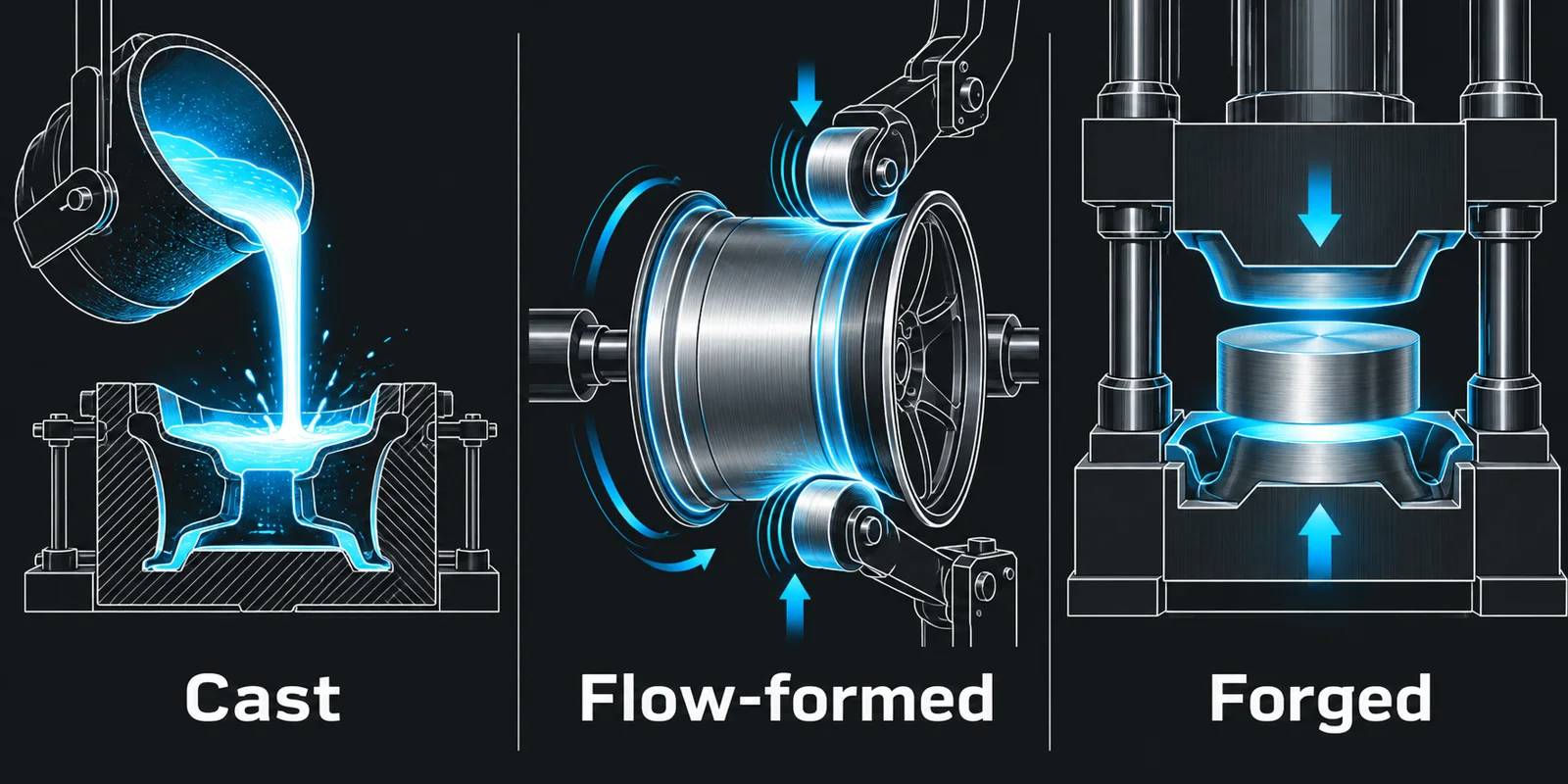
A flow-formed wheel usually starts as a cast wheel whose barrel is then stretched and compressed with rollers. A forged wheel starts as a solid billet forged under very high pressure, then machined. Flow forming improves the barrel of a cast wheel; forging changes the structure of the whole wheel. The terms are often blurred in marketing, so it pays to understand the processes.
How a flow-formed wheel is made
The wheel face and a short, thick barrel are cast in a mold. The casting is then mounted on a spinning machine, heated, and rollers press the barrel against a mandrel, stretching it to its final width and thinning the wall. The rolling compacts the barrel material and improves its properties compared with as-cast metal. The face and spokes remain cast. Names used for this include flow formed, flow forged, rotary forged, spun rim and similar trade terms.
How a forged wheel is made
A solid billet of forging-grade alloy (typically 6061 aluminum, or AZ80/ZK60-type magnesium) is heated and pressed in closed dies by a large hydraulic press. The whole blank, face and barrel, is formed from solid metal with compacted grain that follows the shape. Some forged routes also spin or flow-form the barrel of the forging. After T6 heat treatment for aluminum, the wheel is CNC machined to its final design. See how forged wheels are made.
Side-by-side comparison
| Cast | Flow formed | Forged | |
|---|---|---|---|
| Face and spokes | Cast | Cast | Forged |
| Barrel | Cast | Rolled (improved) | Forged, sometimes also spun |
| Porosity risk | Higher | Face only | Very low |
| Typical weight at same size and load | Heaviest | Lighter than cast | Lightest achievable |
| Design freedom | Limited by molds | Limited by molds | Fully custom via CNC |
| Small-quantity custom | Not practical | Not practical | Yes, e.g. from one pair |
| Cost | Lowest | Medium | Highest |
Strength and weight
Because the forged blank has a dense, consistent structure throughout, designers can use less material to meet the same load requirement, especially in the spokes and hub area where flow-formed wheels remain cast. Flow forming makes the barrel thinner and stronger than a plain cast barrel, which is why flow-formed wheels are often noticeably lighter than cast ones. Exact weights depend on design and load rating; compare documented weights at identical sizes.
Customisation
Flow-formed wheels need a casting mold for each design and size family, so they are sold as catalog products in fixed sizes and offsets. A forged blank can be machined to almost any spoke design, offset, PCD and center bore, which is why fully custom wheels are forged. Every VEXORA wheel is forged and machined to order; there is no stock catalog.
Cost and value
Flow-formed wheels offer good value for buyers who find a catalog design and size that fits. Forged wheels cost more but deliver custom fitment, lower weight potential and design freedom. If you need an offset or design no catalog offers, forged is the realistic route.
How to tell what you are buying
- Ask how the face and spokes are made, not just the barrel
- "Rotary forged" and "flow forged" normally mean flow formed, not fully forged
- Ask for the alloy and temper
- Ask whether sizes and offsets are made to order or chosen from a list
Which should you choose?
Choose flow formed if a catalog wheel fits your car and budget is the priority. Choose forged if you need exact fitment, minimum weight, a unique design, or magnesium. See custom forged aluminum wheels and custom forged magnesium wheels.
A closer look at grain structure
When molten aluminum solidifies in a mold, grains form in random orientations and small gas or shrinkage pores can occur. Rolling the barrel during flow forming breaks up and elongates the grains in that area and closes porosity, which is why the barrel gains strength. In a forged wheel, the entire blank is plastically deformed under pressure, so the grain structure across hub, spokes and barrel is compacted and follows the contours of the part. That consistency is what allows designers to thin sections confidently.
Impact behaviour and repair
Any wheel can be damaged by a severe pothole or curb strike. Cast material tends to be less ductile, so damage may show as cracking; forged material generally tolerates more deformation before cracking. In all cases, a wheel that has taken a hard impact should be inspected, and structurally damaged wheels should be replaced rather than straightened or welded.
Track and motorsport use
Motorsport has long favoured forged wheels, especially forged magnesium, because of weight and consistency. Many flow-formed wheels are also used successfully at track days. What matters is a load rating suited to the car and use, appropriate testing, and sound brake clearance.
Finishes on forged and flow-formed wheels
Both types can be powder coated or painted. Forged wheels, being machined, are also well suited to brushed, polished and diamond-cut details, because the machined surface is consistent and free of casting porosity that can show through bright finishes. See finishes.
Common marketing terms decoded
| Term | Usually means |
|---|---|
| Flow formed / flow forged | Cast face, rolled barrel |
| Rotary forged | Same as flow formed |
| Hybrid forged | Varies; ask exactly which parts are forged |
| Fully forged / monoblock forged | Whole wheel from a forged billet |
| Forged multi-piece | Forged center with separate barrels |
Weight comparison in practice
Published weights are only comparable at identical diameter, width, load rating and similar design. A light flow-formed wheel with a low load rating is not a fair comparison with a forged wheel rated for a heavy EV. When comparing, ask each supplier for the weight and load rating of the exact size you will run, and ideally compare designs with similar spoke counts and face profiles.
Lead time and availability
Catalog flow-formed wheels may ship from stock when your size exists. Custom forged wheels are made to order: for VEXORA, approximately 20 days production after approval, confirmed per project, plus shipping, which varies by destination. In return you get a wheel designed for your car rather than the nearest catalog size.
Summary
Flow forming is a clever way to make a cast wheel lighter and stronger in the barrel. Forging changes the whole wheel. If a catalog size fits and budget is key, flow formed is reasonable; if you want a wheel made for your car, choose forged.
Forged vs flow-formed wheels: which buyers choose which
Buyers who compare forged vs flow-formed wheels usually fall into two groups. Catalog shoppers who already know their diameter and offset often pick flow-formed for a strong balance of weight and price. Owners who need a unique spoke design, an uncommon PCD, a precise hub-centric bore, or forged magnesium almost always need a fully forged, made-to-order wheel.
If you are still deciding forged vs flow-formed wheels for a track or heavy EV build, put load rating and documented wheel weight next to each other on one sheet. The manufacturing label alone does not decide which set will feel better on your car.
Listings that say “rotary forged” or “flow forged” usually mean flow forming — see rotary forged wheels. For the basic forged definition, see what are forged wheels.
FAQ
Is flow formed the same as forged?
No. Flow forming rolls the barrel of a usually cast wheel; forging forms the whole wheel from a solid billet.
Are flow-formed wheels good for track use?
Many are designed for it; check load rating and documented testing for your use.
Can forged wheels also be flow formed?
Yes, some forged routes spin the barrel of the forging. That is still a forged wheel.
What is the MOQ for custom forged wheels?
Every VEXORA set is made to order, and custom orders start from a single pair. MOQ: 1 pair (2 wheels).
Related guides
Need a fully forged set made to your car? Request a custom forged wheel quote. Email sales@vexoraforged.com or message WhatsApp +86 159 2056 8771.
Forged vs Flow Formed Wheels: What Actually Changes?
Comparing forged vs flow formed wheels starts with understanding how each wheel is made—not simply reading the product name. Both can suit performance-focused buyers, but they differ in manufacturing process, customization potential, and how weight and strength should be evaluated.
The right choice depends on your vehicle, required load capacity, wheel dimensions, driving conditions, and budget. A manufacturing label alone cannot tell you whether a particular wheel is suitable.
“Flow Forged Wheels” and Other Marketing Names
Terms such as “flow forged wheels,” “rotary formed,” and “flow formed” may appear across wheel listings. Terminology varies by seller, so ask what manufacturing process sits behind the name.
Flow forming typically starts with a cast wheel blank. Rollers then shape the rotating barrel under controlled conditions, stretching and thinning that area. This does not turn the cast center into a fully forged structure.
A wheel marketed as “flow forged” should therefore not automatically be treated as a forged wheel. Ask whether the starting material is a cast blank or a forged billet, and whether the description applies to the barrel, center, or entire wheel.
How the Manufacturing Processes Differ
Flow-Formed Wheels
Flow forming works the barrel of a cast blank to achieve its final profile. Compared with a comparable conventional cast design, this can allow a thinner, lighter barrel while maintaining the required structural performance. The center remains based on the original casting, and available designs and dimensions depend on the manufacturer’s tooling and range.
Forged Wheels
Forged wheels begin with metal shaped under compressive force, followed by machining to create the wheel’s geometry and details. Forging changes the material structure and can support efficient designs, but finished performance still depends on material, geometry, manufacturing control, and application-specific validation.
For the broader manufacturing picture, read our forged vs cast wheels guide or compare all three approaches in our forged vs cast vs flow-formed wheels guide.
Flow Formed vs Forged: Weight and Strength Comparison
| Factor | Flow-formed wheels | Forged wheels |
|---|---|---|
| Starting structure | Typically a cast blank with a mechanically formed barrel | Forged material subsequently machined into the wheel design |
| Weight potential | Can reduce barrel weight versus comparable conventional cast designs | Can support lower-weight designs for comparable dimensions and load requirements |
| Strength considerations | Barrel forming does not forge the cast center | Forged structure offers design advantages, but does not guarantee every finished wheel is stronger |
| Meaningful comparison | Check exact size, offset, load rating, and finished weight | Check the same specifications rather than relying on the forged label |
| Impact damage | Can bend or crack depending on impact and design | Can also bend or crack; not immune to pothole damage |
There is no universal weight-saving percentage for forged vs flow formed. Comparing different widths, diameters, materials, or load capacities can produce misleading conclusions.
Who Should Buy Which?
- Daily drivers seeking a practical upgrade: flow-formed wheels can make sense when an available design meets the vehicle’s fitment and load requirements.
- Buyers needing specific dimensions: made-to-order forged wheels are worth considering when standard options do not meet offset, width, or brake-clearance needs.
- Track-focused buyers: prioritize documented suitability, load capacity, clearance, and inspection requirements—not the manufacturing name alone.
VEXORA FORGED offers 100% custom forged aluminum (6061-T6) and forged magnesium wheels, made to order with an MOQ of one pair. Production is approximately 20 days after approval. Shipping time varies by country, with DDP available where supported.
Frequently Asked Questions
Are flow forged wheels the same as forged wheels?
Not necessarily. “Flow forged” can describe flow forming applied to a cast blank. Confirm the starting material and manufacturing process before treating the product as a forged wheel.
Are forged wheels always lighter than flow-formed wheels?
No. Width, diameter, load requirements, material, and spoke design all affect weight. Compare finished weights for equivalent specifications.
Are flow-formed wheels suitable for performance driving?
They can be, provided the specific wheel suits the vehicle and intended use. Check load rating, brake clearance, tire compatibility, and the manufacturer’s usage guidance.
Questions