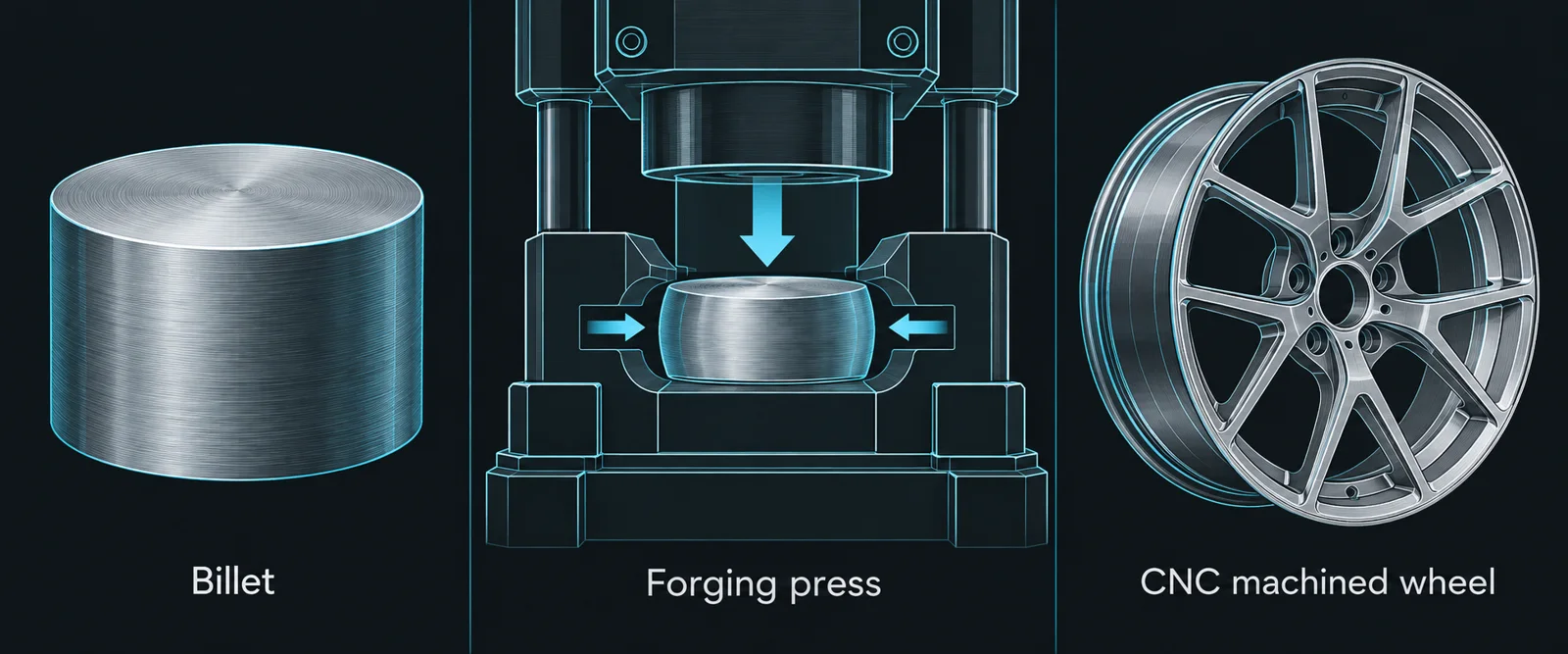
What are forged wheels? The short answer
Forged wheels are wheels whose metal starts as a solid billet (or blank) that is pressed under very high force in a die. That forging step aligns the grain of the alloy and densifies the material before the blank is CNC machined into the final face, barrel, bolt pattern and center bore. “Forged” describes how the metal was formed — not whether the finished wheel is one piece, two pieces or three.
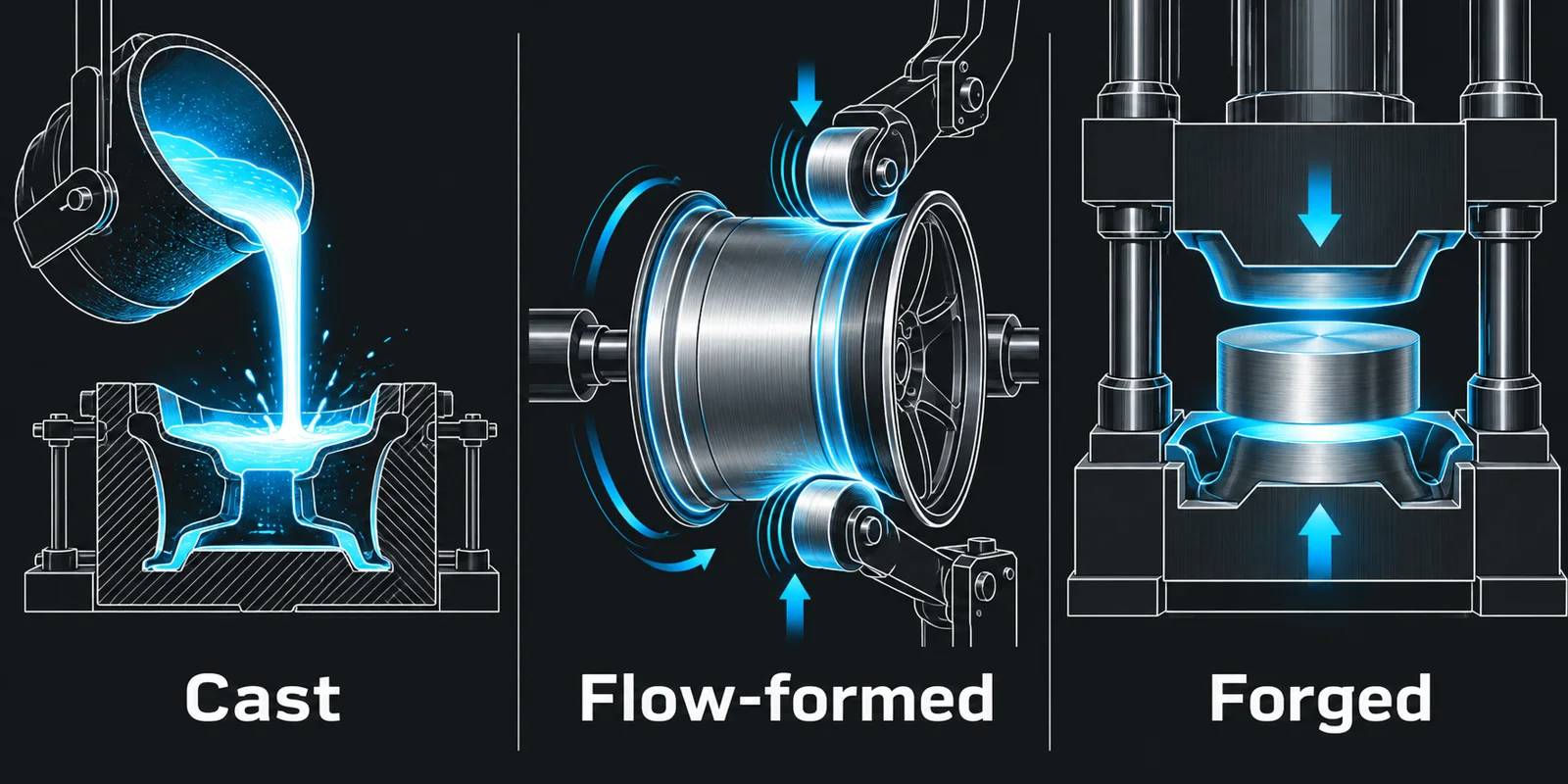
People also search “what does forged wheels mean,” “what is a forged wheel” and “what is forged rims.” Those phrases point to the same idea: the wheel was forged, not poured as a casting. Cast wheels start as molten metal in a mold. Flow formed (sometimes marketed as “rotary forged” or “flow forged”) wheels usually start as a casting and only the barrel is spun and rolled afterward. See forged vs cast and how forged wheels are made for the process detail.
| Topic | Forged wheel | Cast / flow formed |
|---|---|---|
| Starting form | Solid billet pressed in a die | Molten metal in a mold (flow formed then rolls the barrel) |
| Structure | Dense forged blank, then CNC machined | As-cast grain; flow formed hardens the barrel only |
| Construction options | Monoblock, 2-piece or 3-piece can all be forged | Often catalog cast or flow-formed sizes |
| Custom fitment | Width, offset, CB and PCD machined to a brief | Mostly stock sizes |
| What the label does not prove | Load rating still must match the vehicle | Same — process buzzwords are not a rating |
What does forged wheels mean in practice?
A true forged wheel blank is shaped by pressure, then heat-treated (often to a T6 temper on aluminum alloys such as 6061-T6) and machined. Spokes, lips, mounting pad, lug seats and the center bore are cut from that blank rather than cast into near-final shape. The result is a blank that can be lightened carefully while keeping the strength the designer intended for a given load rating.
“Forged rims” is informal language for the same product. Rim sometimes means only the outer barrel; in buyer talk it usually means the whole wheel. Always ask whether the face and the barrel were both forged, and whether the set is monoblock, 2-piece or 3-piece.
Forged vs cast vs flow formed (quick map)
- Cast — molten alloy poured into a mold; common for OEM and value aftermarket
- Flow formed / “rotary forged” / “flow forged” — cast blank with a spun, work-hardened barrel; see flow formed wheels and rotary forged wheels
- Forged — solid billet pressed, then CNC machined; covered here and in the making guide
Strength and weight still depend on design, alloy, heat treatment and the published load rating for your vehicle — not the marketing word alone. Use the three-way comparison in forged vs cast vs flow-formed when you are choosing a route.
Materials you will see on forged wheels
Most street and custom forged wheels use aluminum alloys such as 6061-T6. Lightweight forged magnesium options (AZ80/ZK60-type alloys) exist for builds that prioritize unsprung mass and accept magnesium’s coating and care needs. Material choice is separate from construction: you can forge aluminum or magnesium as monoblock, 2-piece or 3-piece when the brief calls for it.
VEXORA builds fully custom forged sets in aluminum and magnesium. VEXORA does not keep a stock catalog or ready-to-ship inventory. Every wheel is engineered and forged to your vehicle, dimensions and finish. Every VEXORA set is made to order, and custom orders start from a single pair. MOQ: 1 pair (2 wheels).
Construction: monoblock, 2-piece, 3-piece
Forging answers “how was the metal formed?” Construction answers “how many major parts?” A monoblock is one piece. A 2 piece forged wheel joins a center to a barrel. 3 piece wheels add a separate outer lip. Any of those can be forged — or cast. Ask for both answers when you compare quotes.
When forged wheels make sense
- You need a custom width, offset, center bore or brake clearance not available in a catalog
- You want a true forged structure rather than a cast or flow-formed barrel
- You are specifying magnesium or a one-off face design
- You prefer one supplier drawing the fitment around your car instead of forcing a stock size
If a catalog cast or flow-formed size already clears your brakes and hits your flush target, forged custom is optional. If the fitment is odd, the brakes are large, or you want magnesium / private-label design, forged custom is usually the clearer path — start at custom forged wheels.
What are forged wheels FAQ
What are forged wheels?
Wheels made from a solid billet pressed in a forging die, then CNC machined into the final shape.
What does forged wheels mean?
It means the metal was forged under pressure, not poured as a casting. It does not by itself mean monoblock or multi-piece.
What is a forged wheel vs a forged rim?
Same idea in buyer language. “Rim” often means the whole wheel in casual talk; ask what parts were forged.
Are forged wheels always lighter?
They can be engineered lighter for a given strength target, but weight depends on design and load rating — not the word “forged” alone.
Is “rotary forged” the same as forged?
Usually no — that phrase often means flow forming. See our rotary forged wheels guide.
Can VEXORA build custom forged wheels?
Yes — aluminum (including 6061-T6) and magnesium (AZ80/ZK60-type), monoblock / 2-piece / 3-piece. Every VEXORA set is made to order, and custom orders start from a single pair. MOQ: 1 pair (2 wheels). Production typically takes approximately 20 days once the specification, drawings and finish are approved, confirmed per project. Shipping time varies by destination country. Where DDP (Delivered Duty Paid) is available for your country, orders ship DDP: import duties and taxes are handled and the wheels are delivered to your door.
Brief a forged set
Send vehicle, target sizes, PCD, offset, center bore, brake package and finish. Request a quote or start from the VEXORA home page and custom forged wheels. Email sales@vexoraforged.com or message WhatsApp +86 159 2056 8771.