Rotary forged wheels: the short answer
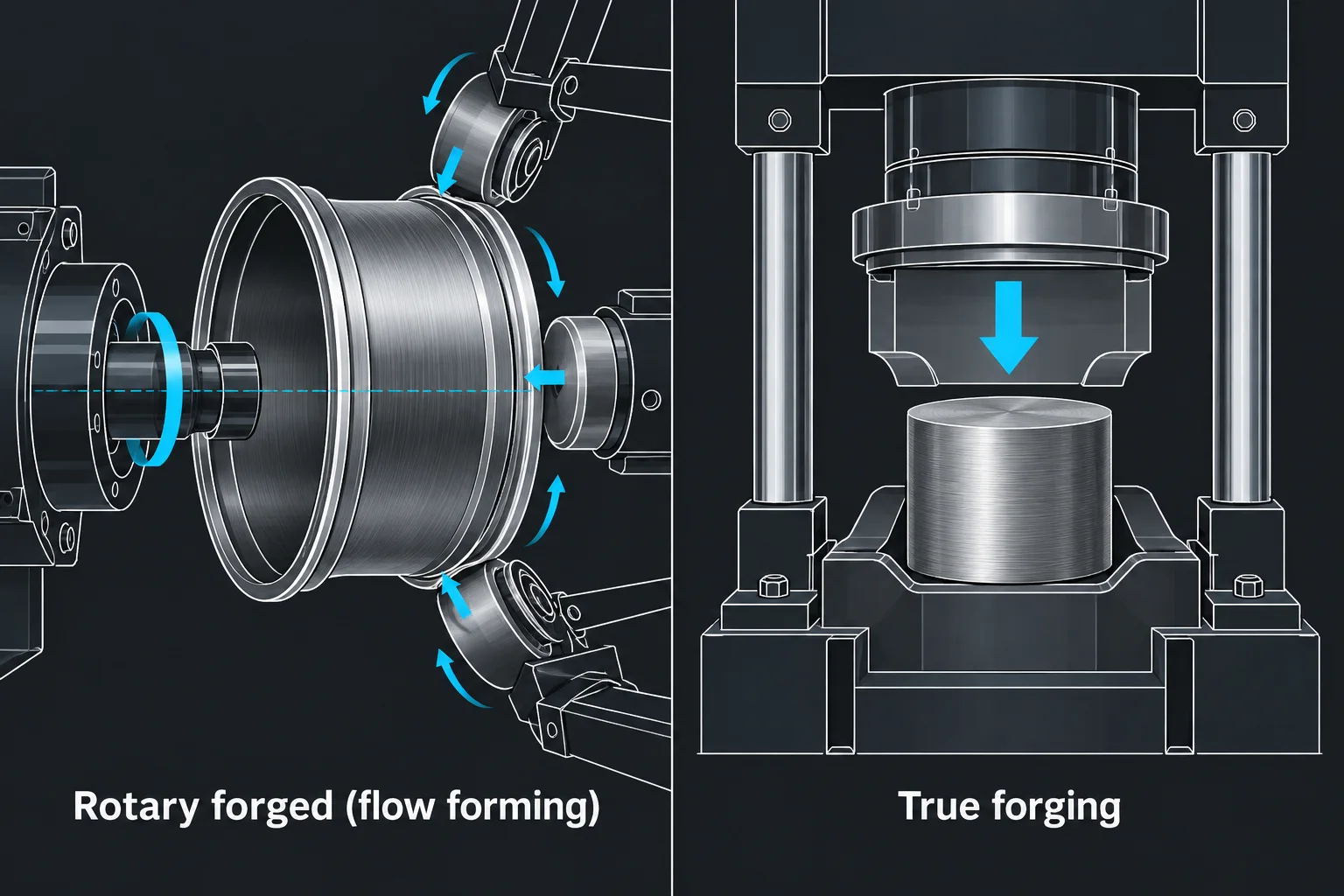
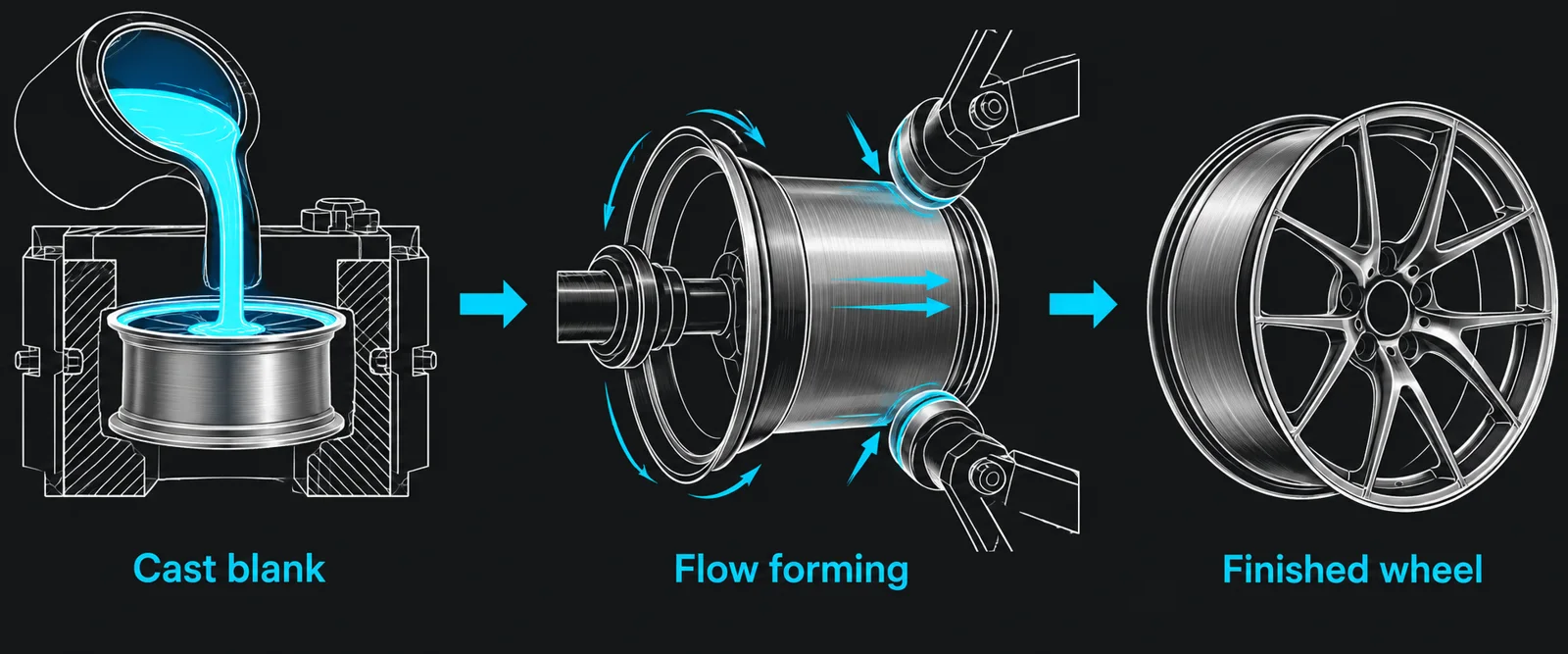
“Rotary forged wheels” is almost always a marketing name for flow forming — not true billet forging. A flow formed (rotary forged / flow forged) wheel starts as a cast aluminum blank. After casting, the barrel is heated and spun while rollers press and stretch the rim wall. That work-hardens and thins the barrel. The face is usually still a casting.
True forged wheels start as a solid billet pressed in a forging die, then CNC machined. If a listing says “rotary forged,” ask whether the blank was cast or forged, and which parts were spun. Our flow formed wheels guide covers the process; forged vs flow-formed is the head-to-head.
| Rotary forged / flow forged (typical) | True forged | |
|---|---|---|
| Starting form | Cast blank | Solid billet |
| Barrel | Spun / rolled and work-hardened | Machined from forging |
| Face / spokes | Usually still cast | Forged and CNC machined |
| Also called | Flow formed, flow forged, rotary forged | Forged, billet forged, die forged |
| Custom one-off sizes | Mostly catalog | Fully custom when made to order |
What “flow forged wheels” usually means
“Flow forged” and “rotary forged” are used interchangeably by many sellers. Both phrases usually describe flow forming of a cast barrel. They are not a guarantee that the entire wheel was forged from a billet. Read the product sheet: process steps, load rating and whether the face was cast or forged.
Flow forming can improve barrel strength-to-weight versus a soft cast barrel of similar design. That is useful on catalog performance wheels. It is still a different route from a custom forged monoblock drawn around one car’s brakes and offset.
How the rotary / flow-forming step actually works
After the blank is cast and prepared, the barrel section is spun on a machine while rollers apply pressure. The wall stretches axially and thins, which work-hardens the rim. Designers use that to target a lighter barrel than a thick cast section of similar stiffness. The spoke face, unless separately forged, remains a casting with cast grain.
That is why a rotary forged wheel can feel “stronger than cast” in the barrel while still not matching a fully forged blank through the spokes and mounting pad. Process honesty matters more than the adjective on the box.
How to read marketing terms
- Rotary forged / flow forged / flow formed → usually cast blank + spun barrel
- Forged / billet forged / die forged → solid blank pressed, then machined
- Hybrid claims → ask which parts were cast, flow formed or forged
If the seller cannot explain the starting form and which parts were formed how, treat the label as marketing until proven otherwise. Load rating and fitment still come first. For the definition of true forging, see what are forged wheels and how forged wheels are made.
When flow formed (rotary forged) is enough
Catalog rotary forged / flow formed sizes work well when a published size clears your brakes, matches PCD and hub bore, and meets the load rating for your vehicle. They sit between plain cast and full custom forged for many street and light performance builds.
Choose true custom forged when you need odd widths or offsets, a machined center bore, magnesium, private-label design, or brake packages that catalog barrels will not clear. Start at custom forged wheels.
Fitment still beats the buzzword
Whether the listing says rotary forged or forged, you still need bolt pattern, offset, center bore, seat type and brake clearance. Use the wheel offset calculator, confirm centering with hub-centric vs lug-centric, and check calipers with the BBK clearance guide.
Buying checklist
- Ask: cast blank or forged billet? Which parts were flow formed?
- Confirm load rating for your vehicle mass and use
- Check PCD, offset, CB and brake clearance
- Ignore the buzzword if the sheet does not describe the process
- Compare apples-to-apples on construction (monoblock vs multi-piece) separately from process
Rotary forged wheels FAQ
What are rotary forged wheels?
Usually flow formed wheels: a cast blank with a spun, work-hardened barrel. Not the same as billet forging.
Are flow forged wheels the same as rotary forged?
In marketing, yes — both typically mean flow forming. Confirm with the seller.
Is rotary forged the same as forged?
No. True forging presses a solid billet. Rotary forged almost always means flow forming.
Are rotary forged wheels strong enough for track use?
Some catalog flow formed wheels are used in performance street and light track roles, but you must check the load rating and maker guidance for your car.
Does VEXORA make rotary forged wheels?
No. VEXORA makes fully custom forged aluminum and magnesium wheels. Every VEXORA set is made to order, and custom orders start from a single pair. MOQ: 1 pair (2 wheels). Production typically takes approximately 20 days once the specification, drawings and finish are approved, confirmed per project. Shipping time varies by destination country. Where DDP (Delivered Duty Paid) is available for your country, orders ship DDP: import duties and taxes are handled and the wheels are delivered to your door.
Where is the deeper process comparison?
See flow formed wheels and forged vs flow-formed.
Need true forged instead?
Request a quote for a custom forged set. Email sales@vexoraforged.com or message WhatsApp +86 159 2056 8771.