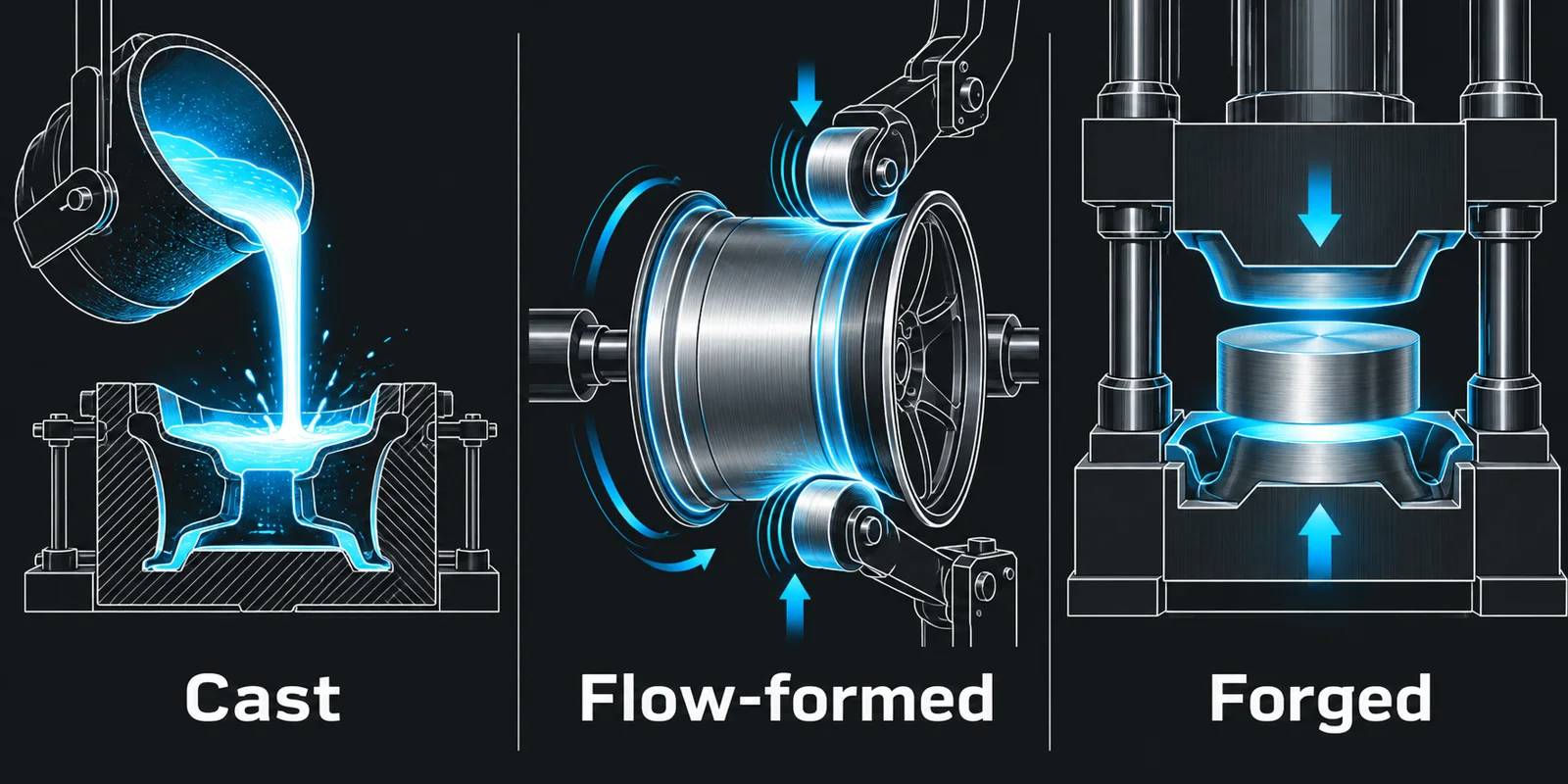
Why buyers source forged wheels from China
China has a deep supply chain for aluminum and magnesium forging, heat treatment, multi-axis CNC machining and finishing. For buyers that means access to fully custom forged wheels in small quantities, but supplier capability varies widely. The questions below help separate a real custom manufacturer from a reseller of stock designs.
1. Custom manufacturer or catalog reseller?
Ask whether wheels are drawn and machined to your specification or picked from an existing catalog. A custom manufacturer works from your vehicle data, issues a technical drawing for approval and machines PCD, offset and center bore to order. VEXORA is fully custom: every set is made to order, with no stock catalog.
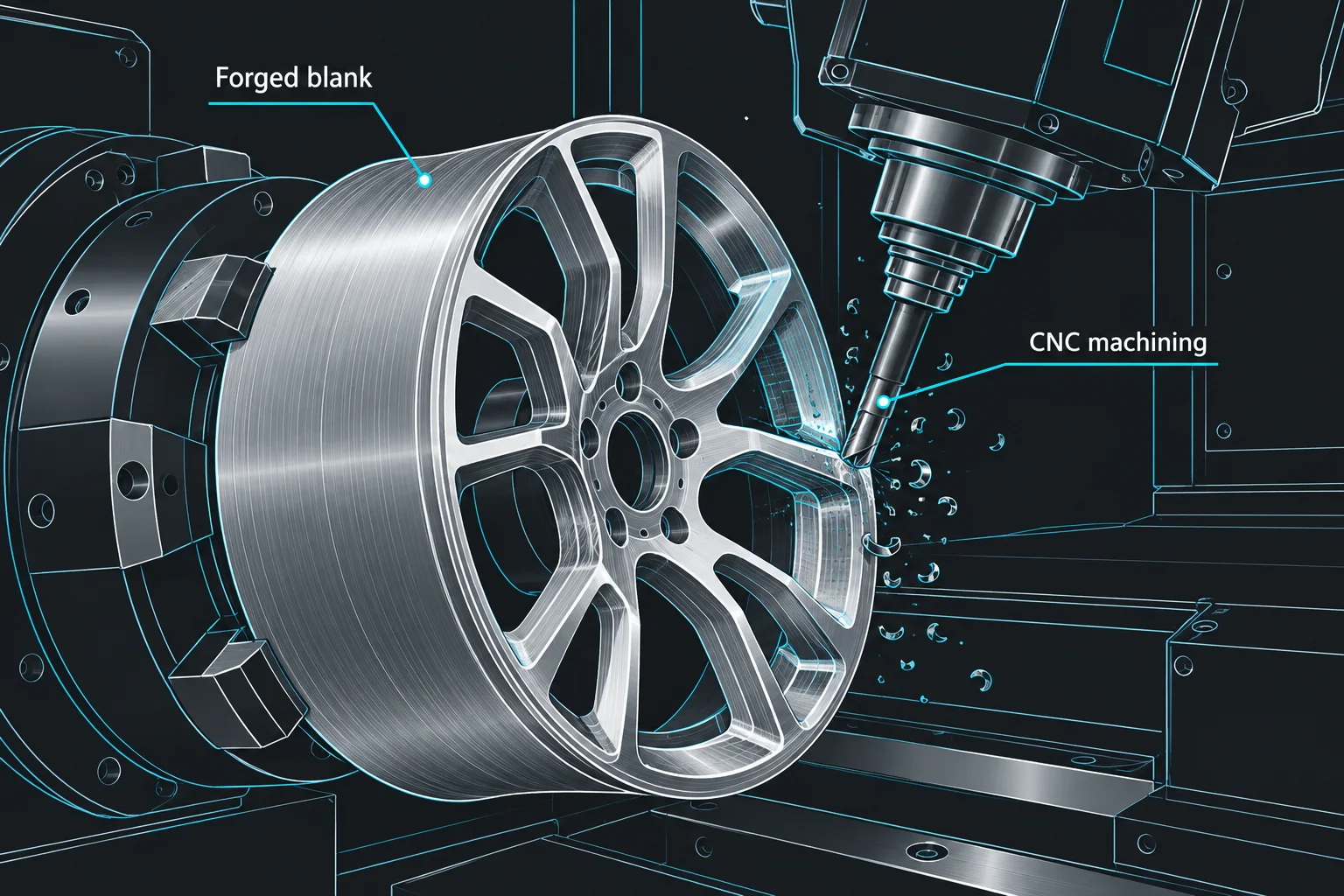
2. Materials and process
Ask for the exact alloy and temper (commonly 6061-T6 for forged aluminum; AZ80- or ZK60-type alloys for forged magnesium), the forging route (closed-die forging, with or without flow-formed barrel), and the construction offered: monoblock, 2-piece or 3-piece.
3. Engineering and validation
Ask how load rating is determined for your application and which tests or documents can be provided for your market. Be wary of generic certificate claims not tied to your specification; request documents that name the design and size you are buying.
4. MOQ, lead time and samples
Custom forged wheel MOQs range from one set to large production runs. At VEXORA, MOQ is 1 pair (2 wheels). Production typically takes approximately 20 days once the specification, drawings and finish are approved, confirmed per project. Ask suppliers to state lead time from drawing approval, not from inquiry.
5. Finishing and corrosion protection
Specify finish in writing: type, color, gloss, coverage zones and clear coat. For magnesium, ask what protective system is used. See custom wheel finishes.
6. Shipping, duties and DDP
Shipping time varies by destination. Under DDP (Delivered Duty Paid) terms the supplier handles import duties and taxes and delivers to your door, which simplifies landed cost. VEXORA ships DDP where it is available for your country.
7. Communication and paperwork
A good quotation lists specification, quantity, finish, price basis, shipping scope, payment and warranty terms. Approve the drawing and finish before production.
Supplier checklist
- Fully custom drawings, not catalog designs
- Stated alloy, temper and construction
- Load rating for your vehicle
- Approved drawing before machining
- Written finish specification
- Clear MOQ, lead time and Incoterms (e.g. DDP)
- Responsive technical contact
Understanding the Chinese forged wheel supply chain
Behind most forged wheels is a chain of specialised steps: alloy billet supply, forging (closed-die presses), heat treatment, CNC machining, finishing and inspection. Some companies own every stage; others coordinate specialist partners; and many online sellers simply resell catalog wheels from someone else. None of these models is automatically good or bad, but you should know which one you are dealing with, because it decides who is accountable for the specification.
Ask directly: who forges the blank, who machines it, who finishes it, and who signs off the final inspection? A credible supplier answers clearly and puts the agreed specification in writing.
Fully custom vs semi-custom vs catalog
| Model | What you get | Watch for |
|---|---|---|
| Catalog / stock | Existing designs in fixed sizes, sometimes with limited offset options. | Fitment compromises; "custom" may only mean color. |
| Semi-custom | Existing design adapted with new PCD, offset or finish. | Load rating may not be re-checked for the new size. |
| Fully custom | Design drawn for your vehicle, dimensions, brakes and finish, machined to order. | Needs a clear brief and drawing approval. |
VEXORA works only in the fully custom model: no stock catalog and no ready-to-ship inventory. Every set is drawn and produced for its order, from one pair.
What a strong inquiry looks like
Suppliers quote faster and more accurately when the brief is complete. Include vehicle details, required material (forged aluminum or forged magnesium), construction, front and rear dimensions if known, brake setup, design references, finish, quantity and destination country. For a structured checklist, see how to spec custom forged wheels.
Evaluating quotations side by side
Low headline prices often hide differences in specification. Compare like for like: same alloy and temper, same construction, same dimensions and load requirement, same finish system and the same delivery terms. A quote that ships EXW leaves freight, customs clearance, duties and last-mile delivery to you; a DDP quote includes them. Check what hardware, center caps and packaging are included, and what the warranty covers.
Forged magnesium: extra questions
If you are sourcing forged magnesium wheels, ask which alloy family is used (AZ80- and ZK60-type alloys are common for forging), how the protective finish is built up, and how galvanic contact with steel hardware is managed. Magnesium has a narrower forging window than aluminum and rewards suppliers with good process control.
Red flags
- Certificates or test reports that do not name the design or size you are buying
- "Forged" used for flow-formed or cast wheels
- No drawing for approval before production
- Vague finish descriptions such as "custom color" with no reference
- Lead times quoted from inquiry with no reference to approvals
- Reluctance to state alloy, temper or load rating
Building a long-term program
For dealers and brands, the best supplier relationships are built on a repeatable specification process: a consistent brief format, drawing approval, finish references and written terms. Because VEXORA starts from one pair, a shop can test a new design on a single client car before scaling. See trade terms.
How the manufacturing process affects your sourcing decision
Ask a supplier to walk you through its chain: billet source and alloy documentation, forging route (closed-die, pre-form and finish forge), whether the barrel is flow-formed, heat treatment to T6 for aluminum, CNC turning and multi-axis milling, inspection of runout and critical dimensions, and finishing. A supplier that can explain each step, and state which are done for your wheel, is far easier to work with. Read how forged wheels are made and CNC machining of forged wheels for the detail behind these questions.
Also confirm which constructions are offered for your design: monoblock, 2-piece or 3-piece. See the construction comparison.
Communication and time zones
Working with an overseas manufacturer is easier with a clear communication rhythm. Agree one technical contact on each side, keep the brief, drawing revisions and finish references in one thread, and confirm every change in writing. Photos of your vehicle's hub, brakes and current wheels help resolve fitment questions quickly. VEXORA works by email and WhatsApp, so drawings and references can be reviewed wherever you are.
FAQ
Is it safe to buy forged wheels from China?
It can be, if the supplier works to an agreed specification, load requirement and documentation. Judge the supplier, not the country.
Can I order a sample pair?
Every VEXORA set is made to order, and custom orders start from a single pair. MOQ: 1 pair (2 wheels).
Can you produce under my brand?
Private-label and OEM programs are reviewed per project; see trade.
Start a trade inquiry, or explore custom forged aluminum and forged magnesium wheels. Email sales@vexoraforged.com or message WhatsApp +86 159 2056 8771.