Key takeaways
- PCD is a pass/fail check: a close measurement is a reason to verify, not permission to order.
- Bolt pattern is written as lug count x circle diameter in millimeters. Both parts must match the required specification.
- A 5-lug pattern has no directly opposite hole. An adjacent hole-center measurement is a chord, not the PCD itself.
- Center bore, PCD and offset describe different dimensions. Confirming one does not confirm the other two.
- Verify the full specification with a suitable gauge and authoritative application information before approving a custom order.
What a wheel bolt pattern is
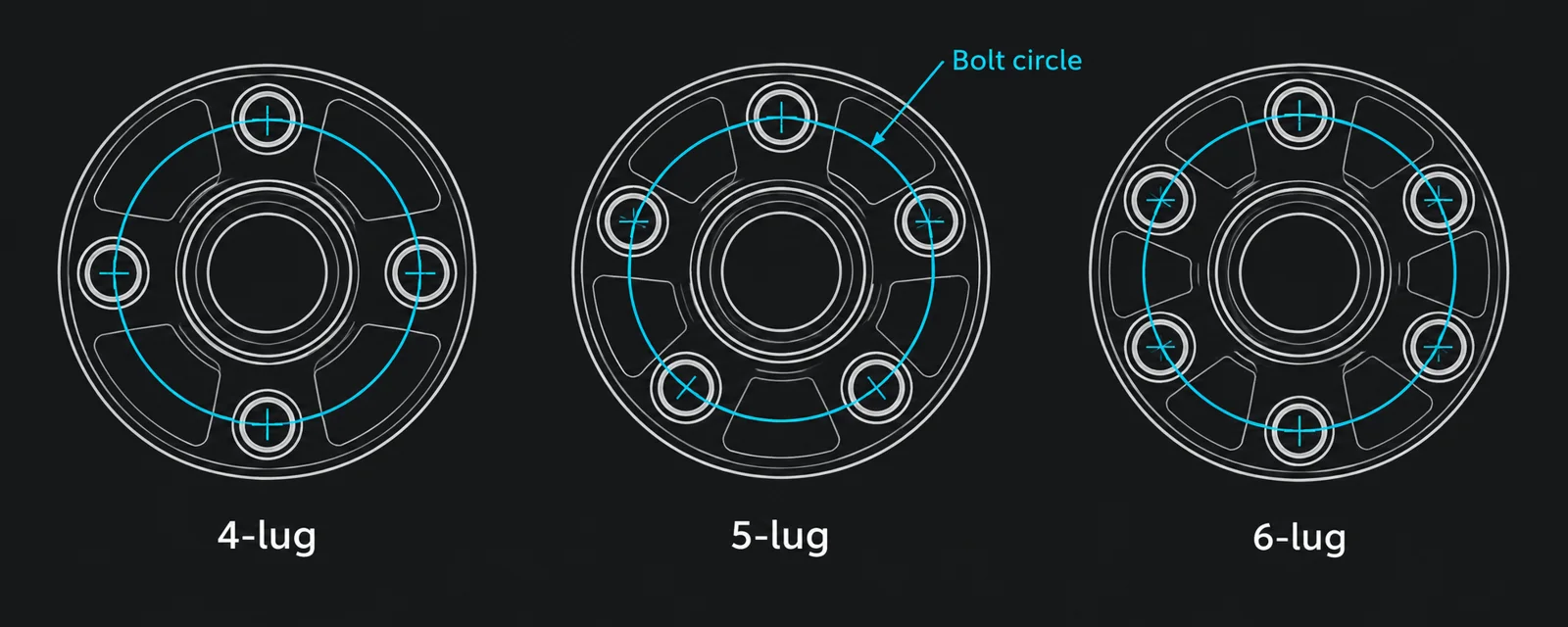
A wheel bolt pattern (also called PCD — pitch circle diameter) describes how many lug holes a wheel has and the diameter of the circle those holes sit on. It is written as lug count × diameter, for example 5×114.3 or 5×120. If the bolt pattern does not match the hub, the wheel will not mount safely — no amount of offset adjustment fixes that.
This guide shows how to identify and measure bolt pattern, how to treat five-lug shortcuts as approximations, and what to put in a custom brief. For offset formulas and poke math, use the PCD and offset calculator guide. For the full checklist, see the wheel fitment guide.
Bolt pattern notation
| Example | Lug count | Pitch circle diameter | Notes |
|---|---|---|---|
| 4×100 | 4 | 100 mm | Common on many smaller cars |
| 5×112 | 5 | 112 mm | Common on many VW/Audi and some Mercedes applications |
| 5×114.3 | 5 | 114.3 mm (4.5 in) | Very common across Japanese and some US platforms |
| 5×120 | 5 | 120 mm | Common on many BMW and some GM applications |
| 6×139.7 | 6 | 139.7 mm (5.5 in) | Common on many trucks and SUVs |
These examples are well-known public standards. They are not a fitment chart for your car. Always confirm the pattern for your exact year, model, trim and market — or measure the hub and the wheel you are replacing — before ordering custom forged wheels.
How to measure wheel bolt pattern
Step 1: Count the lugs
Count the wheel studs on the hub or the lug holes on the wheel. Typical passenger cars use 4 or 5; many trucks and SUVs use 6 or 8. The count is the first number in the pattern.
Step 2: Measure the pitch circle diameter
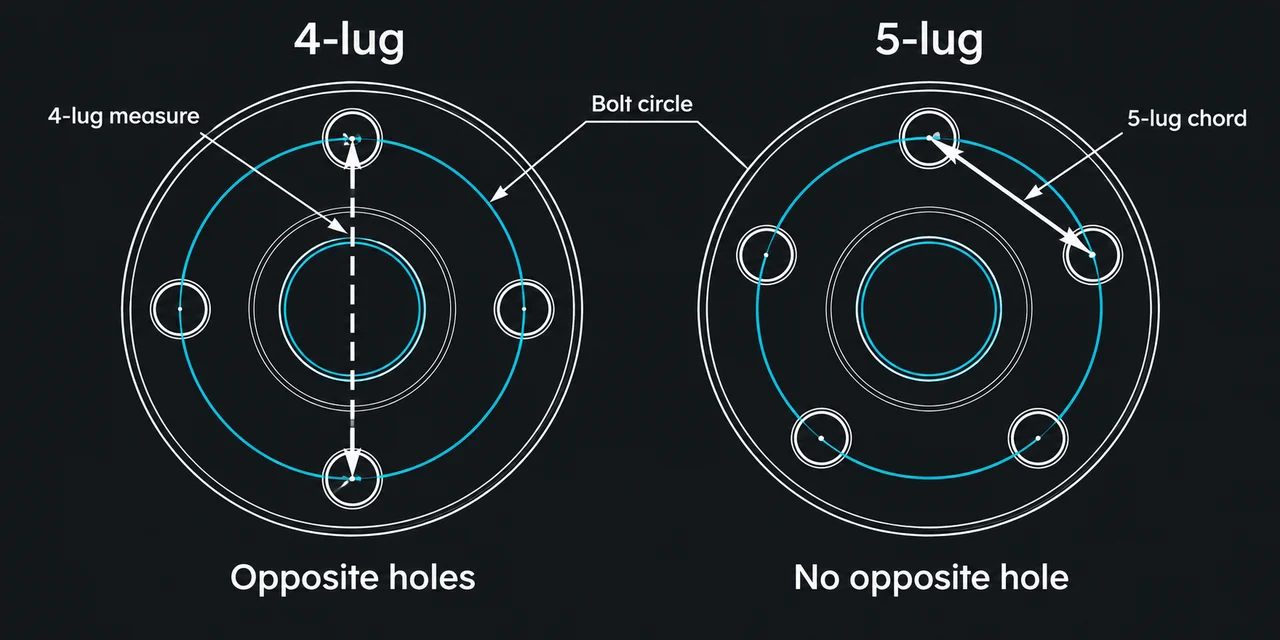
The pitch circle is the imaginary circle that passes through the centers of the lug holes. How you measure it depends on lug count:
| Lugs | Practical method | Detail |
|---|---|---|
| 4 | Center-to-center of opposite holes | Measure from the center of one hole straight across to the center of the hole opposite. That distance is the PCD. |
| 5 | Adjacent-center chord + geometry, or a PCD gauge | No opposite hole. See the worked example below. A bolt-pattern gauge is the easiest reliable tool. |
| 6 | Center-to-center of opposite holes | Same idea as 4-lug: opposite hole centers give the PCD. |
| 8 | Center-to-center of opposite holes | Opposite hole centers give the PCD. |
Five-lug measurement without a gauge
Five-lug patterns have no hole directly opposite another, so you cannot read PCD as a straight center-to-center across the hub. The reliable field method measures the adjacent hole-center chord and converts with geometry.
For five equally spaced hole centers, if c is the straight-line distance between the centers of two adjacent holes:
PCD = c / sin(36°)
Illustrative calculation only (not a vehicle fitment claim): if c = 65.83 mm, then sin(36°) ≈ 0.5878, so PCD ≈ 65.83 / 0.5878 ≈ 112.0 mm. Extra decimal places in the calculator do not make an uncertain tape reading more accurate.
Measure centers carefully (calipers help). A common hole-edge field shortcut used on some five-lug wheels is an approximation — hole size, chamfers and tool placement change the reading. Treat shortcuts as preliminary identification, then confirm with a PCD gauge, a known-good wheel that already fits, or OEM application data before approving a custom order.
Close patterns such as 5×114.3 vs 5×115, or 5×120 vs 5×120.65, are easy to confuse. Do not round a fuzzy reading to the pattern you hoped for.
Is this reading accurate enough to order?
A repeatable measurement is useful screening. It is not the same as a confirmed specification for a custom forged order.
- Clean the surfaces and check that your tool zeros correctly
- Record the raw measurement, units, tool and method — do not round to the pattern you expect
- Repeat across several hole pairs; for five lugs, compare adjacent chords measured the same way
- Confirm with a PCD gauge and/or OEM application data for that year, model, trim and market
- If an adapter or hub swap is present, verify the actual mounting interface
- Resolve conflicting results before drawings are approved
Step 3: Confirm units
Most of the world quotes PCD in millimetres. Some US sources still write inches (for example 5×4.5 in = 5×114.3 mm). Convert carefully: 1 inch = 25.4 mm. Mixing inch and millimetre readings is a frequent ordering error.

PCD, center bore and offset are three different checks
| Spec | What it controls | If wrong |
|---|---|---|
| PCD / bolt pattern | Lug count and the diameter of the circle through lug-hole centers — whether the wheel lines up with the hub fasteners | The wheel will not mount safely. Do not force installation. Offset will not fix it. |
| Center bore (CB) | How the wheel centers on the hub pilot (hub-centric) or whether rings are needed | Too-small bore may not seat; oversize bore needs a correct centering plan. Matching PCD alone does not fix centering. |
| Offset (ET) | Where the wheel sits inboard/outboard relative to the hub face | Inner or outer clearance problems (suspension, fender, caliper package). Review with width and the full application. |
Matching these three still does not automatically clear tires, brakes or suspension. For flush vs poke after PCD is locked, see flush fitment. For centering detail, see hub-centric vs lug-centric.
Common bolt pattern mistakes
- Measuring outer hole edges instead of centers — adds roughly one hole diameter and yields a false PCD
- Treating a five-lug shortcut as exact — label approximations as approximations
- Assuming the pattern from the brand alone — platforms change; always verify year/model
- Confusing close PCDs — 5×114.3 vs 5×115, 5×120 vs 5×120.65, 5×112 vs 5×110
- Ignoring dual-drill wheels — some aftermarket wheels have two patterns; the hub still has one
- Mixing mm and inches — write the unit on your brief
- Forgetting seat type — conical, ball (radius) or mag seat must match the hardware even when PCD is correct
Seat type and hardware torque belong in the same brief as PCD.

Why custom forged wheels still need exact PCD
VEXORA does not keep a stock catalog or ready-to-ship inventory. Every wheel is engineered and forged to your vehicle, dimensions and finish. Lug holes are machined to the bolt pattern you approve on the drawing. That is an advantage — you get the pattern your hub needs — not a reason to be vague.
Custom does not mean “universal.” A forged wheel ordered with the wrong PCD will not mount. Flush fitment and aggressive offsets only matter after the wheel bolts on correctly.
Every VEXORA set is made to order, and custom orders start from a single pair. MOQ: 1 pair (2 wheels). Production typically takes approximately 20 days once the specification, drawings and finish are approved, confirmed per project. Shipping time varies by destination country. Where DDP (Delivered Duty Paid) is available for your country, orders ship DDP: import duties and taxes are handled and the wheels are delivered to your door.
How to put bolt pattern in your custom brief
Copy this checklist into your enquiry so measured values stay separate from confirmed specs:
- Vehicle: year, make, model, trim, market; any hub, brake or suspension changes
- Lug count and seat type (conical / ball / mag); bolts vs studs+nuts
- Raw measurement (mm), which hole pair, tool and method — label it unconfirmed if needed
- Confirmed PCD (for example 5×114.3 mm) and confirmation source (OEM data, gauge, dealer)
- Center bore if known, or ask to machine to a hub measurement
- Target diameter, width and offset (or flush/poke goal)
- Photos of the hub face and current wheel markings
- Never send only “5-lug Japanese pattern” without the millimetre figure
Pair this with how to spec custom forged wheels.
Bolt pattern vs adapters
Bolt-pattern adapters change the pattern the wheel sees, and sometimes the effective offset. They add another machined interface, stack height and load path. For a one-off custom forged set, machining the correct PCD into the wheel is usually the cleaner long-term answer. If adapters are already part of a build, say so up front.
Questions about wheel bolt pattern
What does a wheel bolt pattern tell me?
It tells you the number of lug holes and the diameter of the circle through their centers. The usual format is lug count x PCD in millimeters. It does not identify center bore, offset or complete vehicle compatibility.
How do I measure a five-lug bolt pattern?
Measure the center-to-center chord c between two adjacent holes, then calculate PCD = c / sin(36°). Because there is no directly opposite hole, a straight measurement between two hole centers is not the PCD. Confirm the result with a suitable gauge and OEM specification information before ordering.
Is the five-lug center-to-edge shortcut exact?
No. Measuring from one hole's center to the outer edge of a far, nonadjacent hole is a field approximation. Hole diameter, chamfers and tool placement influence the result. Use it for preliminary identification, not final custom-order approval.
Can I round my measurement to the nearest bolt pattern?
Do not approve an order by rounding to a nearby pattern. Repeat the measurement, check your method and confirm the specification independently. A close reading can indicate measurement uncertainty rather than a match.
Does matching PCD mean the wheel fits?
No. PCD confirms only the fastening pattern. Center bore, offset, wheel dimensions, load requirements, fastener and seat compatibility, brake clearance and tire clearance also need review for the actual application.
What should I send VEXORA for a custom wheel enquiry?
Send your application details, confirmed PCD and center bore, requested wheel dimensions and offset, load requirements, quantity, finish and delivery destination. Include measurement photos and details of any modifications. Enquiries start at 1 pair, with approximately 20 days after approval and DDP where available. Use request a quote or WhatsApp +86 159 2056 8771.
Measure once, then specify custom
Confirm lug count, PCD, center bore and seat type before you talk about flush, concave or finish. Every VEXORA set is made to order, and custom orders start from a single pair. MOQ: 1 pair (2 wheels). Production typically takes approximately 20 days once the specification, drawings and finish are approved, confirmed per project. Shipping time varies by destination country. Where DDP (Delivered Duty Paid) is available for your country, orders ship DDP: import duties and taxes are handled and the wheels are delivered to your door. Request a quote for custom forged wheels, or continue with the offset formulas, flush fitment, and vehicle pages like Mustang / BMW. Email sales@vexoraforged.com or message WhatsApp +86 159 2056 8771.