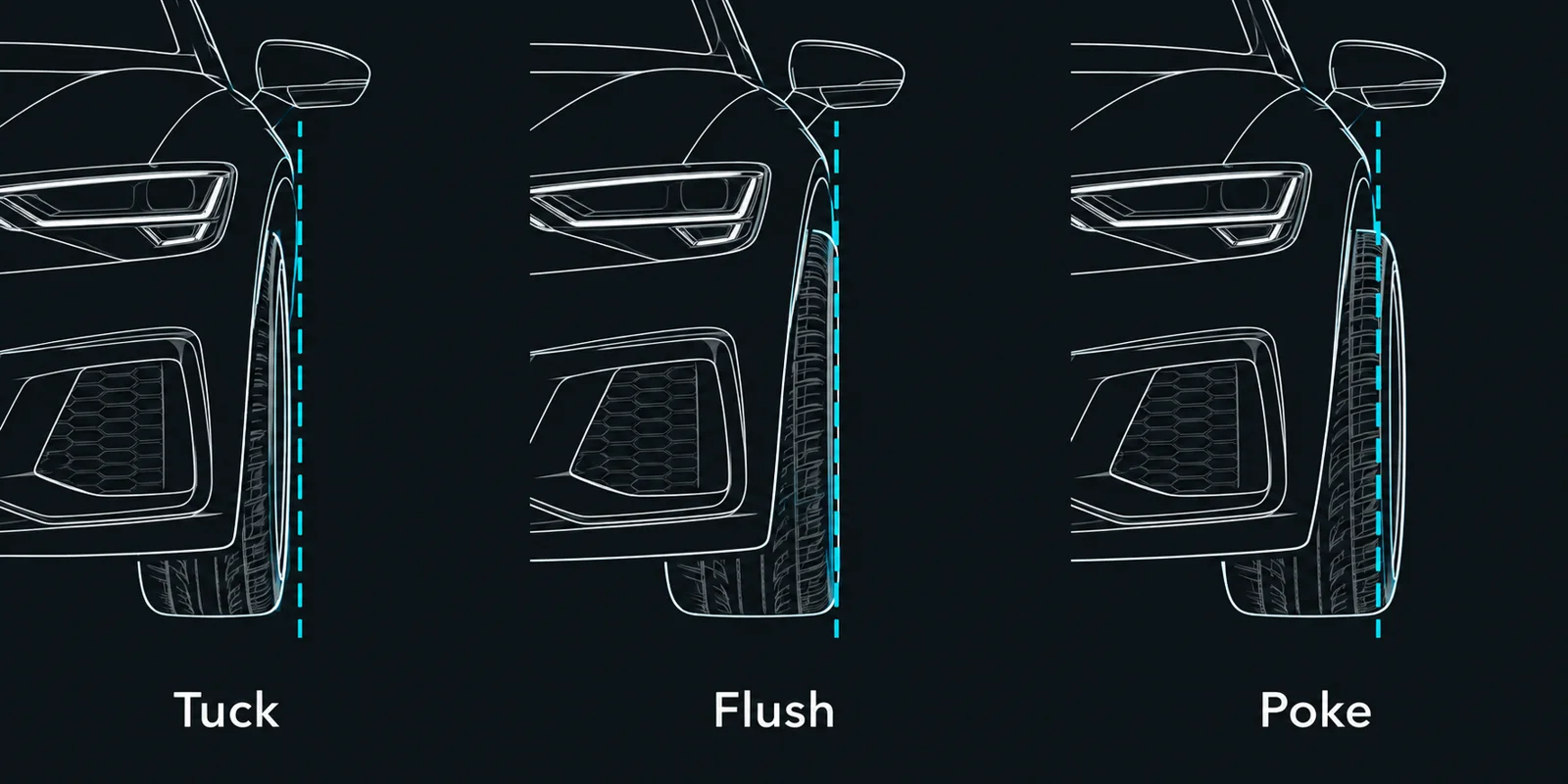
What flush fitment actually means
Flush fitment is the look where the outer face of the tire (or the wheel lip) lines up with the fender edge when you stand behind or beside the car. It is a visual goal, not a single offset number. Two cars can both look flush with very different diameters, widths and offsets, because tire sidewall, fender shape and suspension height all change where the rubber sits relative to the body.
People often confuse flush with poke (wheel sticking past the fender), tucked (wheel inside the fender), and slammed (ride height). Flush is about lateral alignment with the fender opening. Getting there safely means treating offset, width and tire as one system, then checking clearance to fenders, suspension and brakes. Our wheel fitment guide covers the full checklist; this page focuses on the flush goal itself.
| Look | What you see | What usually changes |
|---|---|---|
| Flush | Tire or lip roughly even with the fender edge | Offset, width and tire chosen together |
| Slight poke | Tire sits a little outside the fender | Lower (more aggressive) offset and/or wider tire |
| Tucked | Tire sits inside the fender opening | Higher offset and/or narrower tire, or raised ride height |
| Staggered | Rear wider than front (common on RWD) | Different rear width/offset; flush can still be the goal on each axle |
There is no universal “flush offset” for a given wheel size. Catalog wheels advertise a fixed offset; whether that is flush on your car depends on tire choice, camber and how the fender is shaped. That is why custom forged wheels are useful when flush is a hard requirement rather than a lucky coincidence.
The geometry behind flush fitment
Offset (ET)
Offset is the distance from the wheel’s mounting face to the centerline of the rim, in millimetres. Higher offset pulls the wheel inward toward the car; lower offset pushes it outward. If you only change offset and keep diameter, width and tire the same, each millimetre of offset change moves the outer tire face by about one millimetre.
So if a setup sits 10 mm tucked, you need roughly 10 mm less offset (or a combination of width/tire change that adds the same outer position) to approach flush. Exact results still depend on tire brand and inflation. Use the formulas in our PCD and offset calculator guide when you want to quantify poke and inner clearance before you order.
Width
Wheel width changes both the outer and inner position of the tire when offset is held constant. A wider rim with the same offset typically adds tire toward both the fender and the suspension. Many builders keep the outer flush look and “add width inward” by raising offset as width goes up, or they accept more poke. Either way, width is not free: brake clearance, control-arm clearance and fender lip all move.
Tire size and sidewall
The tire is what you actually see against the fender. A 10 mm wider tire section, a different brand’s shoulder shape, or a stretched vs stuffed mount can move the visual edge even when the wheel’s offset is unchanged. Always plan flush with a specific tire size in mind, not “whatever fits the rim.” If tire choice is still open, say so in the brief so fitment advice can stay conservative.
Ride height, camber and fenders
Lowering the car changes how the tire arcs through the fender opening. Negative camber tucks the top of the tire inward, so a setup that looks flush at stock height can look tucked or poke unevenly when lowered. Rolled or pulled fenders change the reference edge. Flush fitment on a slammed show car and flush on a lightly lowered daily are different engineering problems that happen to share a name.
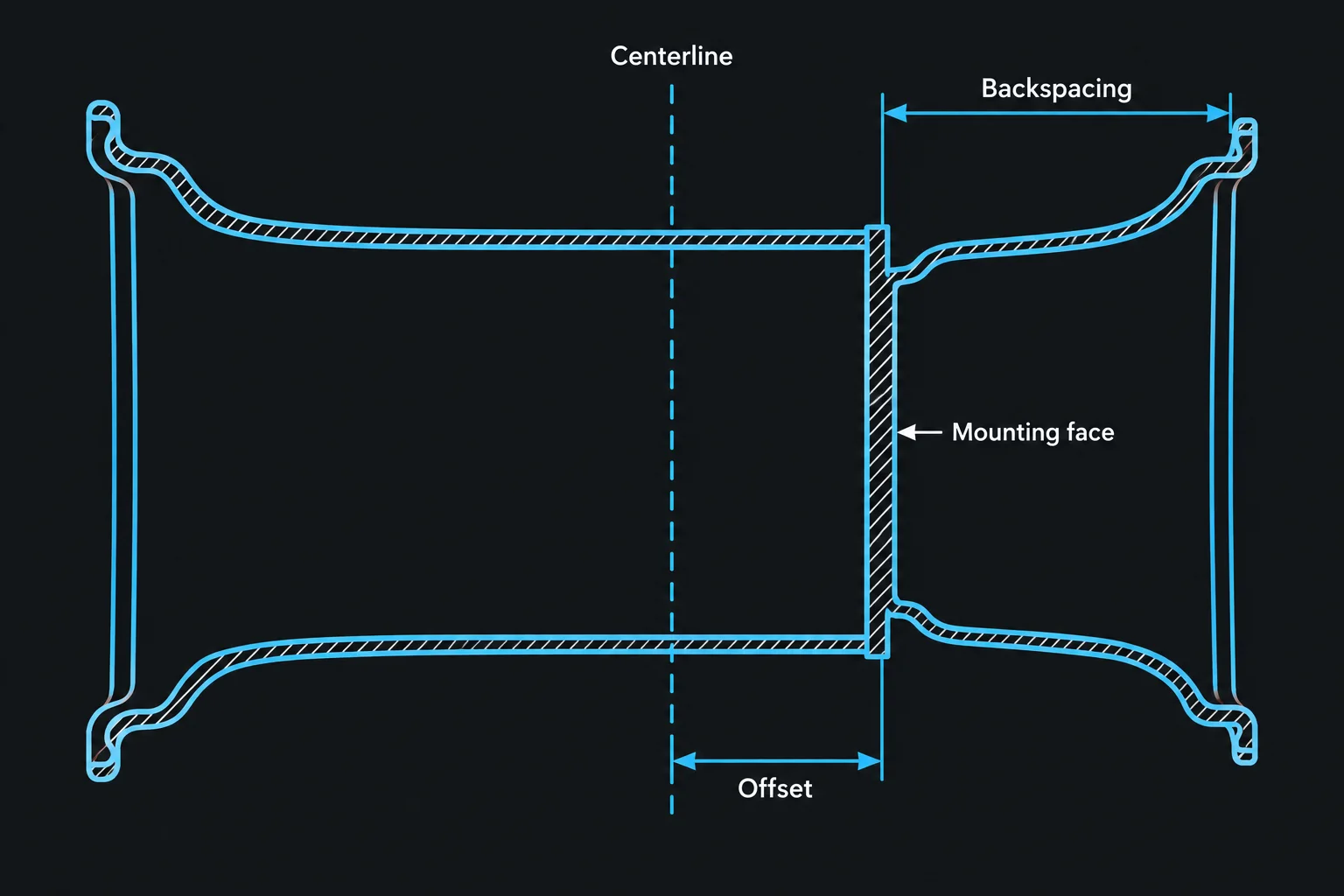
How offset, width and tire work together
Think in terms of outer position and inner position, not a single magic ET:
- Outer position controls the flush / poke / tuck look against the fender
- Inner position controls clearance to struts, control arms, leaf springs, bags and the inner fender
- Brake clearance is a third axis: caliper, dust shield and spoke design must clear regardless of flush
- Changing width without adjusting offset moves both outer and inner; changing offset mainly slides the whole package in or out
| Change | Typical outer effect | Typical inner effect | Flush implication |
|---|---|---|---|
| Lower offset by 10 mm (same width/tire) | Moves ~10 mm out | Moves ~10 mm out from hub/arms | More flush or poke if you were tucked |
| Wider rim + higher offset (common street approach) | Outer can stay similar | More tire toward suspension | Flush preserved while adding dish/width |
| Wider tire only | Shoulder may sit farther out | Shoulder may sit farther in | Visual flush can change without changing ET |
| More negative camber | Top edge tucks in | Contact patch shifts | Flush at ride height must be re-checked |
These rows are teaching patterns, not prescriptions. Suspension layout differs by platform. Measure or mock up before you commit to a custom set.
Risks of chasing flush with the wrong offset
Incorrect offset is one of the fastest ways to turn a good-looking wheel into a clearance or handling problem:
- Fender contact: poke plus lowering or cornering load can rub paint, crack liners or cut tire sidewalls
- Inner suspension rub: too much width inward hits struts, arms or bags at full lock or full compression
- Bearing and scrub changes: large outward moves change scrub radius and can affect steering feel and load on hub bearings — especially on MacPherson-strut fronts
- Brake interference: deep concave or wrong spoke profile can hit calipers even when fender flush looks perfect
- Load and hardware: adapters and cheap spacers used as an offset shortcut add interfaces that must be rated and torqued correctly; they are not a substitute for a correctly specified wheel
If a catalog wheel is “almost flush” but not quite, spacers are sometimes used as a temporary experiment. For a permanent custom forged set, it is better to machine the correct offset than to stack adapters. See seat type and load notes in the fitment guide.
Why custom forged wheels make flush easier
VEXORA does not keep a stock catalog or ready-to-ship inventory. Every wheel is engineered and forged to your vehicle, dimensions and finish. That matters for flush because you choose diameter, width and offset together for each axle, then approve a drawing before production.
With a catalog wheel you pick from fixed ET values and hope the tire you want still clears. With a custom forged set you can target a measured outer position, keep brake clearance in the spoke design, and still order from a single pair. Every VEXORA set is made to order, and custom orders start from a single pair. MOQ: 1 pair (2 wheels).
Monoblock, 2-piece and 3-piece constructions can all be specified for flush; the construction choice is more about lip depth, repairability and design than about whether flush is possible. Compare options in monoblock vs 2-piece vs 3-piece.
Material is independent of flush: forged aluminum (typically 6061-T6) and forged magnesium can both be machined to the same PCD, center bore and offset. Choose material for weight, use case and care — not for fitment geometry.
How to brief a flush fitment set
- Exact vehicle: year, model, trim, market (LHD/RHD), and any big-brake kit
- Current wheel and tire sizes with measured offsets (or photos of tire-to-fender gap)
- Target look: flush at the lip, flush at the tire shoulder, slight poke, or axle-specific goals
- Ride height and camber: stock, mild drop, coilovers, bags; approx. camber if known
- Fender work: stock, rolled, pulled, widebody
- Tire model and size you want — or ask for a recommendation that stays flush
- Photos straight-on from the rear/side of each corner help more than adjectives
A complete brief shortens drawing revisions. Our how to spec custom forged wheels checklist pairs well with this list. Production typically takes approximately 20 days once the specification, drawings and finish are approved, confirmed per project. Shipping time varies by destination country. Where DDP (Delivered Duty Paid) is available for your country, orders ship DDP: import duties and taxes are handled and the wheels are delivered to your door.
Flush fitment on staggered setups
Many RWD and some AWD cars run a wider rear wheel. Flush can still be the goal on both axles, but the rear often needs a different offset than the front because width and fender shape differ. Do not copy the front ET to the rear on a staggered set and expect the same look.
Square setups (same size all around) are simpler to keep visually consistent, but flush still depends on front vs rear fender geometry. Either way, confirm PCD and center bore are correct for every corner before discussing flush — wrong bolt pattern cannot be fixed by offset. Start with how to measure wheel bolt pattern if you are unsure.
To test a flush target, compare current and new fitment in the wheel offset calculator, and see wheel offset vs backspacing for inner clearance.
Questions about flush fitment
What does flush fitment mean?
The outer tire or wheel lip sits roughly even with the fender edge. It is a visual alignment goal, not one universal offset number.
Is there a standard flush offset for 19-inch wheels?
No. Offset must be chosen with width, tire, camber, ride height and fender shape. Two 19-inch setups can both look flush with different ETs.
Can I get flush without rubbing?
Often yes if outer and inner clearances are planned together. Lowering, wide tires and aggressive camber raise the risk — measure or mock up.
Are spacers a good way to make catalog wheels flush?
They can be a temporary test. For a permanent custom forged set, specifying the correct offset is cleaner than relying on adapters.
Does forged vs cast change flush geometry?
No. Flush is about dimensions. Forged vs cast affects strength, weight and customization options — see forged vs cast wheels.
Can I order one flush pair?
Every VEXORA set is made to order, and custom orders start from a single pair. MOQ: 1 pair (2 wheels). VEXORA does not keep a stock catalog or ready-to-ship inventory. Every wheel is engineered and forged to your vehicle, dimensions and finish.
Plan a flush custom set
Send corner photos, current sizes and your flush target, and we will review fitment before drawings. Request a quote for custom forged aluminum or magnesium, or read the full fitment guide and PCD/offset formulas first. Email sales@vexoraforged.com or message WhatsApp +86 159 2056 8771.
Centering is separate from flush: confirm hub-centric vs lug-centric and PCD before chasing outer position.
Related: Forged wheel brake clearance for big brake kits — how BBK caliper envelopes change custom forged inner profiles.
Building a staggered set? Read staggered forged wheels fitment for how front and rear width and offset work together with flush or poke goals.