Hub centric rings: the short answer
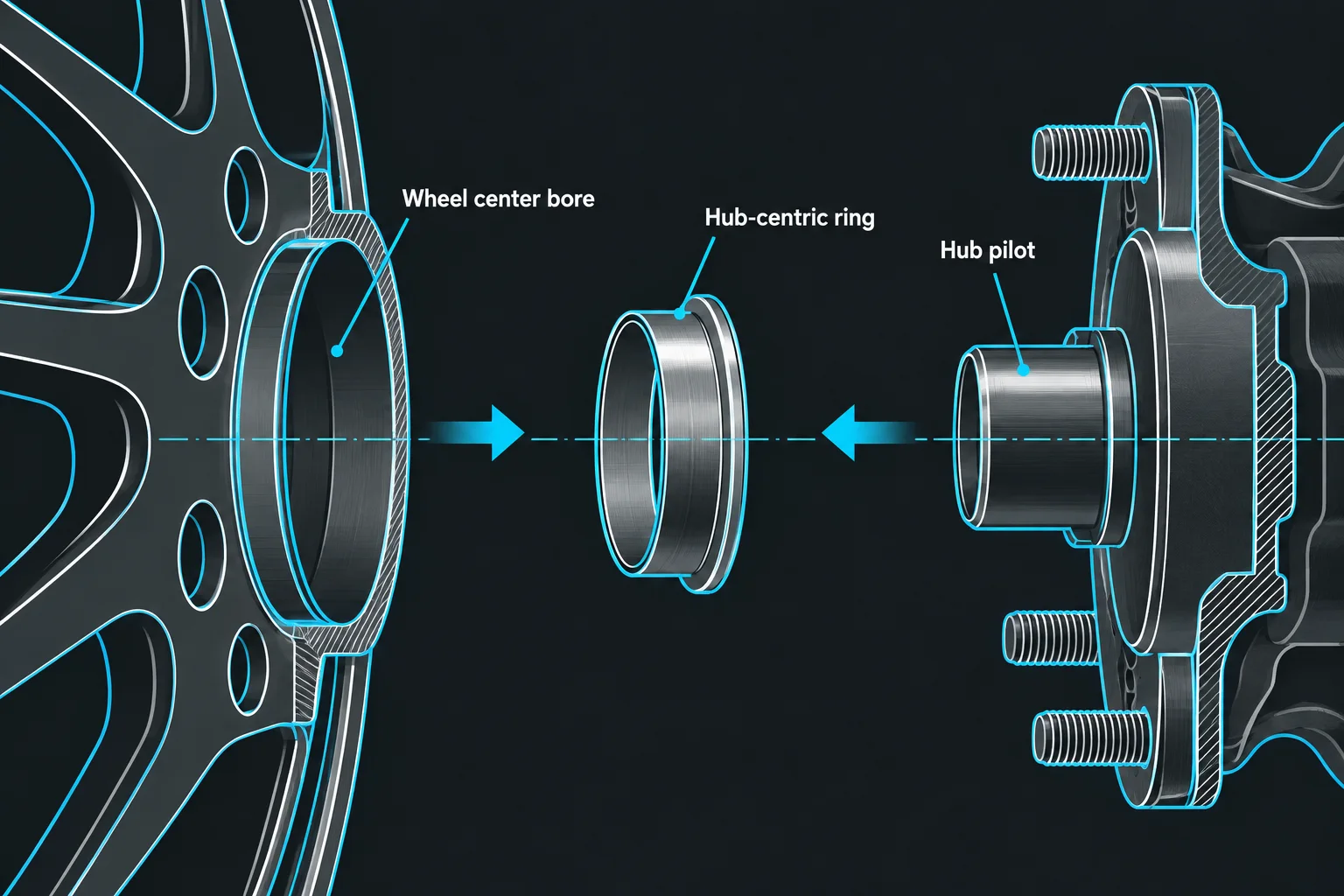
Hub centric rings are spacer rings that fill the gap between a wheel’s center bore and the vehicle’s hub pilot. Many aftermarket wheels are made with a large center bore so one design can fit many cars. On a specific car that leaves a gap around the hub. A ring with an inner diameter matching the hub and an outer diameter matching the wheel bore closes that gap, so the wheel sits centered on the hub while you torque the lugs.
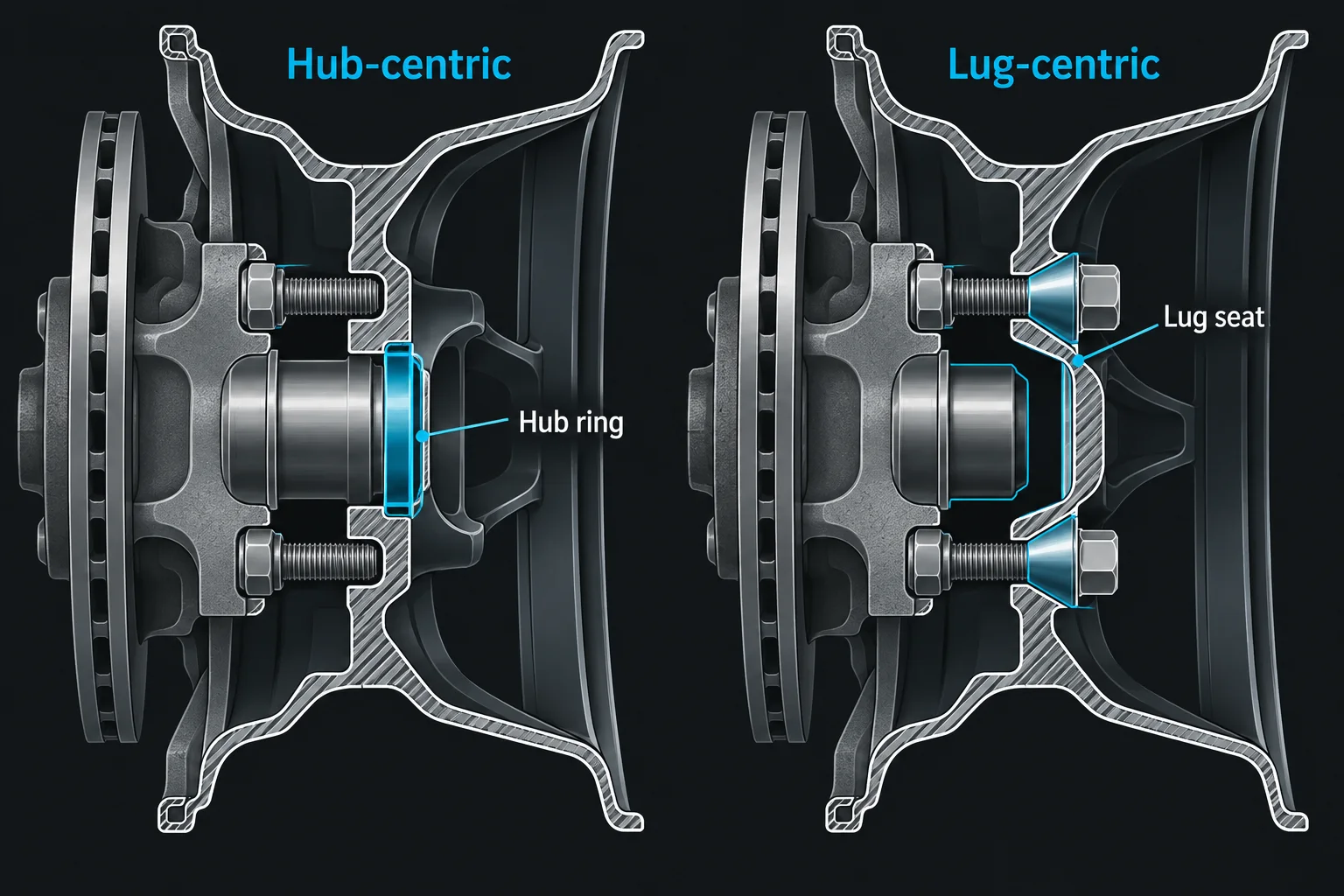
Rings do not hold the wheel on and they do not carry the car’s weight in normal use. Clamp force from correctly torqued lug nuts or bolts does that. The ring’s job is to center the wheel during mounting so the lug seats pull it down concentric, which is why a missing or wrong ring is a common cause of vibration after fitting new wheels.
| Question | Answer |
|---|---|
| What size do I need? | Ring ID = hub pilot diameter; ring OD = wheel center bore diameter |
| How do I write the size? | Usually as OD × ID in millimetres, for example wheel bore to hub |
| Plastic or aluminum? | Both are used; see the materials section below |
| Do I need them on every wheel? | Only where the wheel bore is larger than the hub. If the bore already matches the hub, no ring is needed |
| Do rings fix wrong PCD or seat type? | No. Those are separate specifications |
Why the center bore gap exists
Catalog wheels are produced for as many vehicles as possible. The maker drills a common bolt pattern, picks a center bore large enough to clear the biggest hub in the range, and relies on rings to adapt the wheel to smaller hubs. That is a reasonable manufacturing choice, but it moves part of the fitment responsibility to the installer.
A lug-centric wheel with conical or ball seats can center itself on the studs if the hardware is tightened evenly. In practice, uneven tightening, worn seats or an impact gun used out of sequence can leave the wheel a fraction off center. A ring removes that variable. Our hub-centric vs lug-centric guide explains the two centering methods in detail.
How to measure for hub centric rings
You need two numbers, both in millimetres. Use a digital caliper rather than a tape measure; the difference between a good ring fit and a loose one can be a fraction of a millimetre.
- Hub pilot diameter: remove a wheel, clean any rust from the pilot lip and measure its outside diameter at several points
- Wheel center bore: measure the inside diameter of the bore on the back of the wheel, or use the bore stated by the wheel maker
- Check whether the wheel bore has a step or chamfer; measure where the ring will actually seat
- Confirm the ring depth suits the pilot length so the ring is supported and does not bottom out
Write the result as ring OD × ring ID. If you are also checking bolt pattern at the same time, our bolt pattern guide covers measuring PCD by lug count.
Plastic vs aluminum hub centric rings
| Material | Strengths | Watch for |
|---|---|---|
| Plastic (polycarbonate or similar) | Will not corrode or bond to the hub; easy to fit and remove | Can deform if damaged or exposed to heavy brake heat; replace if cracked |
| Aluminum | Rigid and heat tolerant | Can corrode against the hub and stick in the bore; keep surfaces clean |
Both materials center the wheel when the size is right. The ring is not a structural load path once the lugs are torqued, so a correct, undamaged ring matters more than the material. Inspect rings whenever the wheels come off.
How to install hub centric rings
- Clean the hub pilot, the hub face and the wheel bore; corrosion and debris stop the wheel seating flat
- Press the ring into the wheel bore or onto the hub pilot, with any flange or lip oriented as the ring maker shows
- Lift the wheel on so the ring engages the hub before the studs or bolts carry the wheel
- Snug the hardware by hand in a star pattern with the wheel just touching the ground
- Torque to the vehicle maker’s specification in a star pattern, then re-check after a short drive
If the wheel will not sit flat, stop. A ring that is too thick, a pilot that is too long for the bore or a stepped bore can hold the wheel off the hub face. Never tighten a wheel that is not flat on the hub.
Do custom forged wheels need hub centric rings?
Usually not. When a wheel is made to order for one vehicle, the center bore can be machined to that vehicle’s hub diameter, making the wheel hub-centric without a ring. VEXORA custom forged aluminum and magnesium wheels are machined to the PCD, center bore and seat type in your brief, so the ring question is settled at the drawing stage.
Rings still make sense in a few cases: when one set is shared between cars with different hubs, when a hub adapter or spacer changes the pilot, or when a wheel was deliberately bored larger to suit a future car. Put that in the brief so the bore is chosen on purpose.
Common hub centric ring mistakes
- Buying by vehicle model only, without measuring the hub or the wheel bore
- Fitting rings with the flange the wrong way so the wheel does not seat flat
- Reusing cracked or heat-deformed plastic rings
- Expecting rings to cure vibration caused by unbalanced tires, bent wheels or wrong seat type
- Using rings to hide a bolt pattern mismatch; wobble bolts and adapters are a different decision
- Forgetting rings when spacers are added; a hub-centric spacer needs its own pilot match
Spacers are different from rings: rings fill a bore gap; spacers add thickness and change effective offset. Read hub centric wheel spacers (educational — VEXORA does not sell spacers).
Questions about hub centric rings
Are hub centric rings necessary?
They are recommended whenever the wheel center bore is larger than the hub pilot. They help the wheel mount centered, which reduces the chance of vibration from mis-centering. If the bore matches the hub, no ring is needed.
Do hub centric rings carry the weight of the car?
Not in normal use. The clamping force of correctly torqued lug hardware holds the wheel against the hub face. The ring centers the wheel during mounting.
What size hub centric rings do I need?
Measure the hub pilot diameter and the wheel center bore in millimetres. The ring inner diameter matches the hub; the outer diameter matches the wheel bore.
Plastic or aluminum hub centric rings?
Either works when correctly sized. Plastic rings do not corrode; aluminum rings resist heat but can stick in the bore. Inspect and replace damaged rings.
Can hub centric rings stop steering wheel vibration?
If the vibration comes from a wheel mounted off center, yes. Vibration from tire balance, a bent wheel, worn suspension or incorrect seat type needs a different fix.
Do VEXORA wheels need rings?
Custom sets can be machined to your hub diameter, so most do not. Tell us if you plan to share wheels between cars or use spacers. Every VEXORA set is made to order, and custom orders start from a single pair. MOQ: 1 pair (2 wheels).
Specify the bore once, correctly
Send your vehicle, hub diameter, bolt pattern and seat type with your size and offset targets, and we will machine the bore to match. Request a quote for custom forged wheels, or check fitment numbers first with the wheel offset calculator. Email sales@vexoraforged.com or message WhatsApp +86 159 2056 8771.