Wheel offset vs backspacing: the short answer
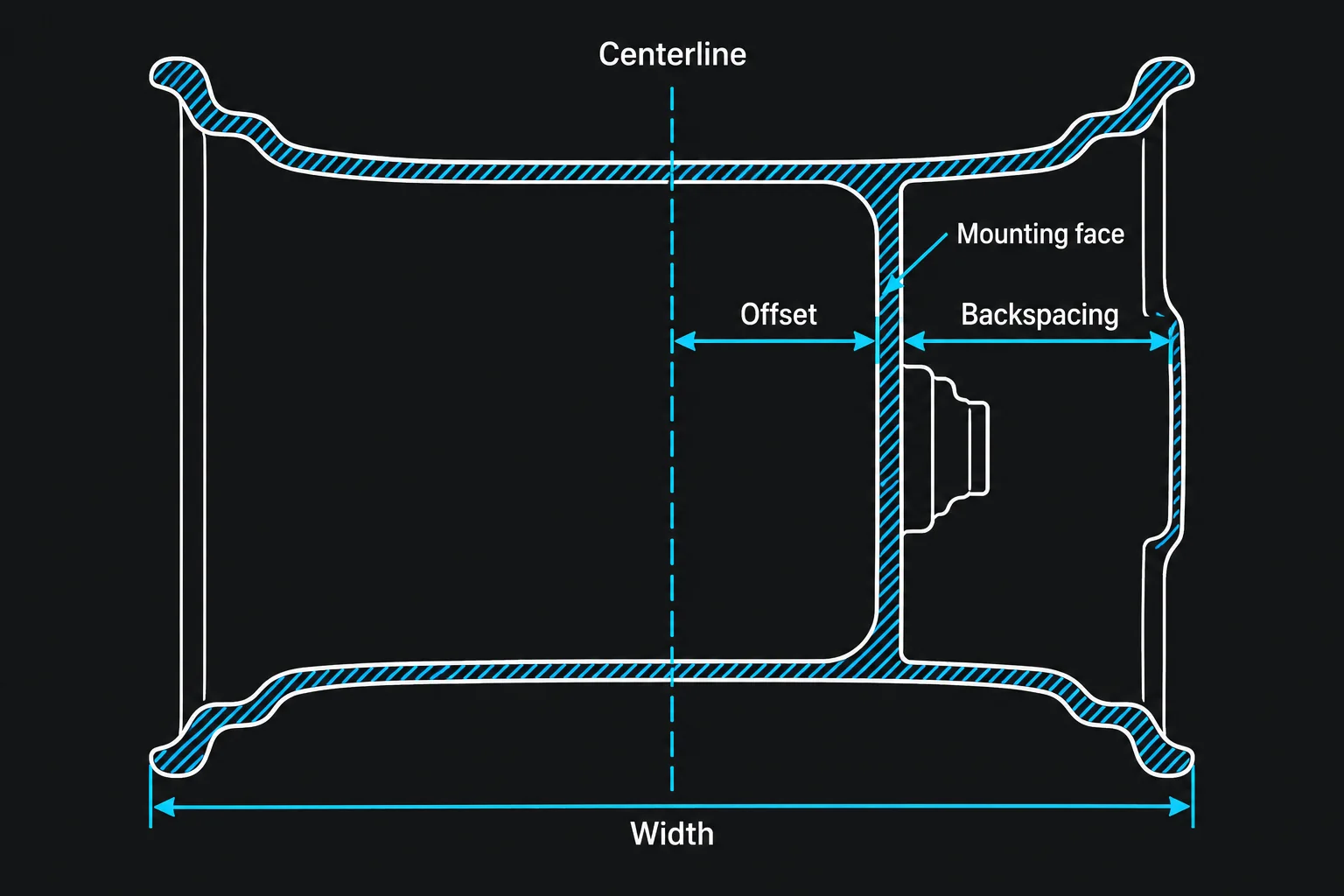
Wheel offset and backspacing both describe where the hub mounting face sits inside the wheel, measured from different references. Offset is the distance from the rim centerline to the mounting face, in millimetres, positive toward the outside. Backspacing is the distance from the mounting face to the inner rim edge, usually quoted in inches in the US truck and off-road market.
Because both point at the same mounting face, one converts to the other when you know the width: backspacing = (width ÷ 2) + offset. The key difference is that backspacing changes with width while offset does not, which is why the same offset on a wider wheel can still hit suspension parts.
| Offset (ET) | Backspacing | |
|---|---|---|
| Measured from | Rim centerline | Inner rim edge |
| Measured to | Hub mounting face | Hub mounting face |
| Usual units | Millimetres | Inches (US), sometimes mm |
| Sign | Positive, zero or negative | Always a positive distance |
| Depends on width? | No | Yes |
| Best for | Comparing wheels of any width; outer position | Inner clearance to suspension |
How to convert offset to backspacing
Work in one unit. Convert width to millimetres (inches × 25.4), halve it, then add the offset. Convert back to inches by dividing by 25.4 if needed.
- Backspacing = (width ÷ 2) + offset
- Offset = backspacing − (width ÷ 2)
- Frontspacing = (width ÷ 2) − offset
| Width | Offset | Backspacing (nominal) |
|---|---|---|
| 8 in (203.2 mm) | +35 mm | 136.6 mm (5.38 in) |
| 9 in (228.6 mm) | +35 mm | 149.3 mm (5.88 in) |
| 9 in (228.6 mm) | 0 mm | 114.3 mm (4.50 in) |
| 10 in (254 mm) | −12 mm | 115.0 mm (4.53 in) |
These use nominal width. Backspacing measured on a real wheel with a tape across the flange reads more, roughly half an inch, because the flange extends past the bead seat. Either is fine as long as you compare like with like. Our how to measure wheel offset guide covers the measuring side.
Why the same offset can fit differently
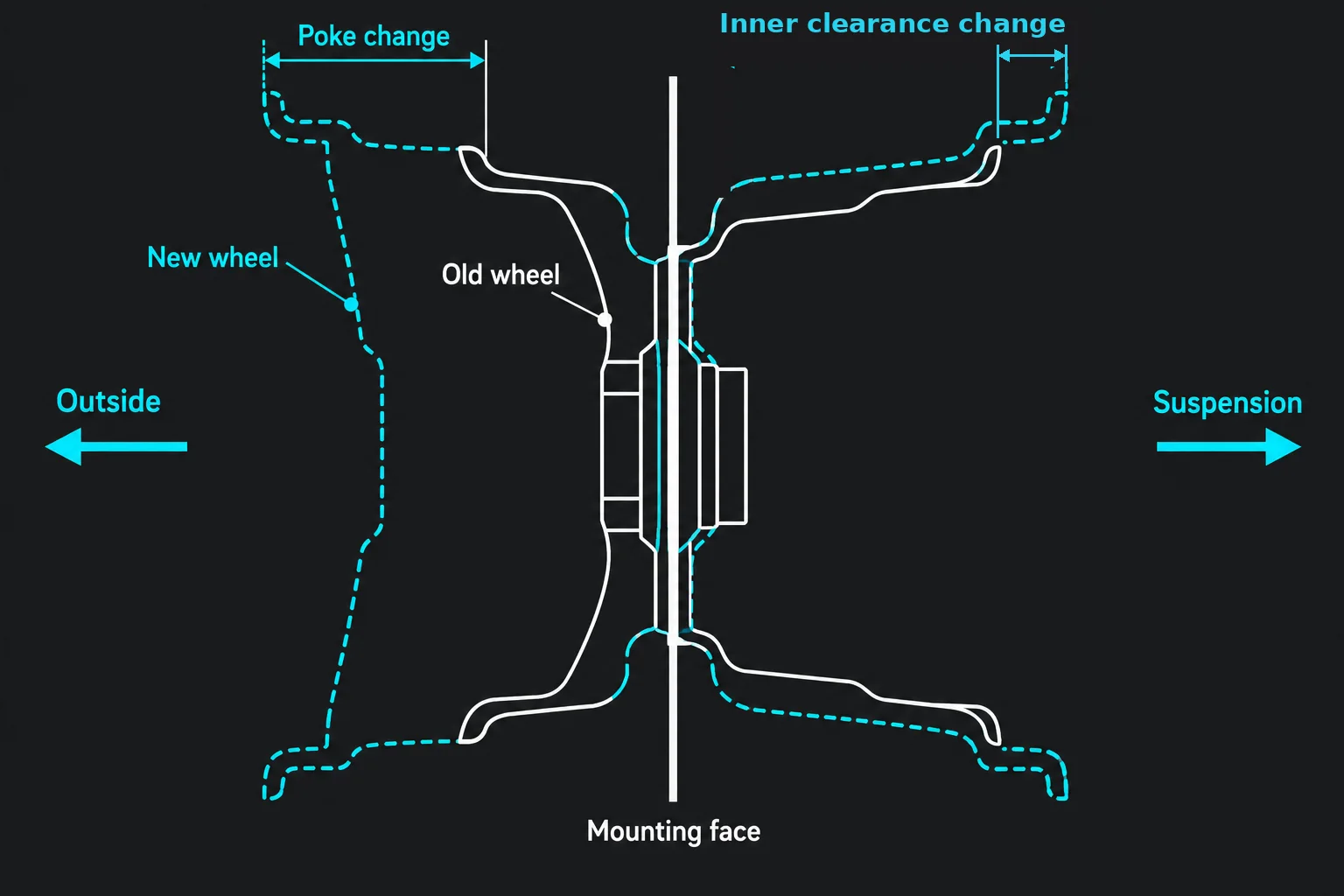
Look at the 8 in and 9 in rows above. Both have +35 mm offset, but the 9 in wheel has 12.7 mm more backspacing and 12.7 mm more frontspacing. The extra width is split evenly around the centerline. If your current wheel barely clears the strut, the wider wheel at the same offset will not.
This is where backspacing is the more intuitive number. Inner clearance is set by backspacing, so truck and off-road builders who fight suspension and frame clearance tend to quote it. Outer position is set by frontspacing, which falls when offset rises. Offset ties the two together, so you need offset and width together to describe a fitment completely.
Which should you use?
- Use offset (ET) when comparing wheels of the same or different widths for outer position and when ordering from most wheel makers
- Use backspacing when your limit is inner clearance: struts, springs, control arms or frame
- Use both, plus width, in a custom brief so nothing is ambiguous
The fastest way to compare is the wheel offset calculator: enter the current and new width and offset and it shows backspacing, frontspacing and how far each edge moves.
Where spacers fit in
A wheel spacer moves the mounting face outward by its thickness. That reduces effective offset and effective backspacing by the same amount. A 10 mm spacer on a +35 wheel behaves like +25. If you need spacers to clear a caliper or to get the stance you want, a custom offset is usually the cleaner fix. Spacers also need correct hub centering; see hub centric rings.
Offset and backspacing on custom forged wheels
On a custom set, offset and width are drawn to your vehicle, so you can specify the inner clearance (backspacing) you need and the outer position (frontspacing) you want, and the maker machines the mounting face to suit. Pair that with bolt pattern, center bore and brake clearance; the wheel fitment guide lists them in order and flush fitment covers the look.
Questions about offset vs backspacing
What is the difference between offset and backspacing?
Offset measures from the rim centerline to the mounting face; backspacing measures from the inner rim edge to the mounting face. Both locate the same face from different references.
How do I convert offset to backspacing?
Backspacing = (width ÷ 2) + offset, with width and offset in the same unit. Convert inches to millimetres by multiplying by 25.4.
Does more backspacing mean more offset?
At the same width, yes: each millimetre of extra offset adds a millimetre of backspacing. Between different widths it is not that simple, because width also changes backspacing.
Is 0 offset the same as half the width in backspacing?
Yes. At zero offset the mounting face sits on the centerline, so backspacing equals half the width.
Which matters more for clearance?
Backspacing sets inner clearance to suspension parts; frontspacing sets outer position toward the fender. Offset and width together set both.
Can VEXORA build to a specific backspacing?
Yes. Give us the backspacing or offset and width you need, and we machine the custom forged wheel to it. Every VEXORA set is made to order, and custom orders start from a single pair. MOQ: 1 pair (2 wheels). Production typically takes approximately 20 days once the specification, drawings and finish are approved, confirmed per project. Shipping time varies by destination country. Where DDP (Delivered Duty Paid) is available for your country, orders ship DDP: import duties and taxes are handled and the wheels are delivered to your door.
Put the numbers in your brief
Send width, offset or backspacing, bolt pattern, center bore and brake details. Request a quote for custom forged wheels. Email sales@vexoraforged.com or message WhatsApp +86 159 2056 8771.