Forged wheel brake clearance: the short answer
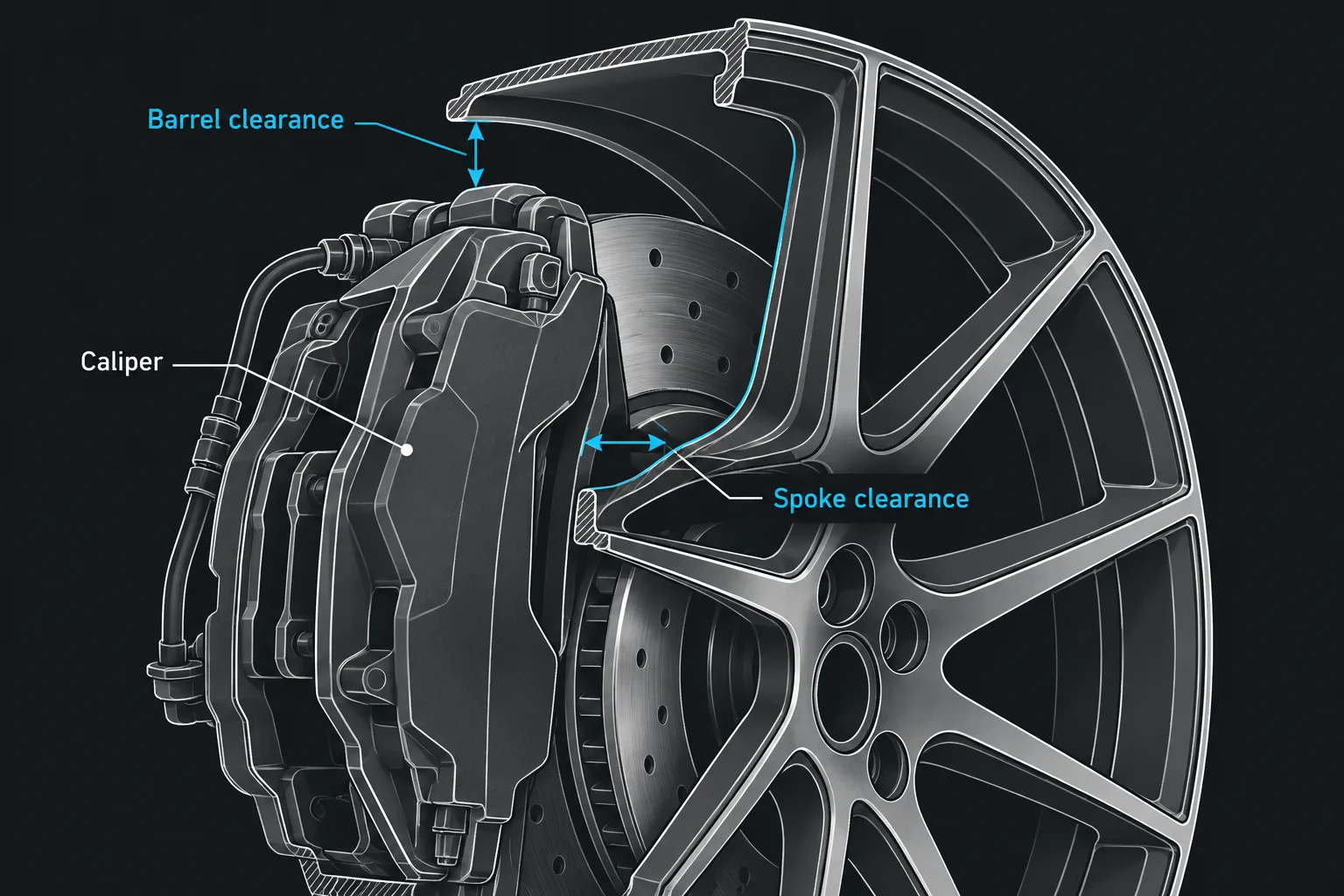
Forged wheel brake clearance is the space between the inner face of a wheel (spokes, barrel and mounting pad) and the brake caliper, rotor hat and any splash shield. Aftermarket big brake kits (BBK) push calipers and rotors farther out or make them larger than OEM, so a wheel that cleared the stock brakes can hit the new hardware.
Custom forged wheels help because spoke package, concave depth and inner barrel shape can be machined around a known caliper envelope. Catalog multi-fit wheels often cannot. This guide covers how to check clearance, what to put in a brief, and common mistakes — without inventing kit dimensions or claiming a certification for any specific car.
| Check | Why it matters | What to capture |
|---|---|---|
| Caliper to spoke / barrel | Primary rub risk on BBK and deep concave designs | Photos from front and behind the wheel, caliper brand/model if known |
| Rotor diameter vs wheel ID | Large rotors need room inside the barrel | Rotor diameter (mm) and whether the kit is front-only or axle set |
| Caliper radial height | Tall calipers can hit the rim drop or spoke root | Radial clearance with a straightedge or cardboard template |
| Axial (inboard) depth | Caliper body thickness toward the hub | Distance from hub mounting face to outermost caliper point |
| Dust shield / ABS ring | OEM shields sometimes remain and foul a new spoke package | Note if shields are modified, trimmed or removed |
Clearance is separate from PCD, center bore and offset. You can get bolt pattern and flush look right and still hit a caliper. See our wheel fitment guide, flush fitment and hub-centric vs lug-centric pages for those other checks.
Why big brake kits change the problem
OEM wheels are designed around OEM brakes. A BBK typically increases rotor diameter, uses a different caliper body, and often moves the caliper outward (axially) or upward (radially). Multi-piston calipers are bulkier than many single-piston OEM sliders. Track-oriented kits add ducting, hats and hardware that steal clearance a street wheel used to have.
That is why “it fit my friend” is a weak guarantee. Same car generation, different brake option, different rotor size, different hub thickness after a conversion — any of those can change the envelope. Treat the kit on the car as the truth, not a forum post.
- Front BBK is the usual clearance fight; rear kits still matter on staggered setups
- Larger rotors need more inner barrel diameter, not just more concave
- Some kits keep OEM-ish envelopes; others do not — verify the actual parts
- Spacers move the wheel out and can create caliper clearance while creating other fitment risks — do not use spacers as a substitute for a correct inner profile
What “clearance” actually means in a wheel drawing
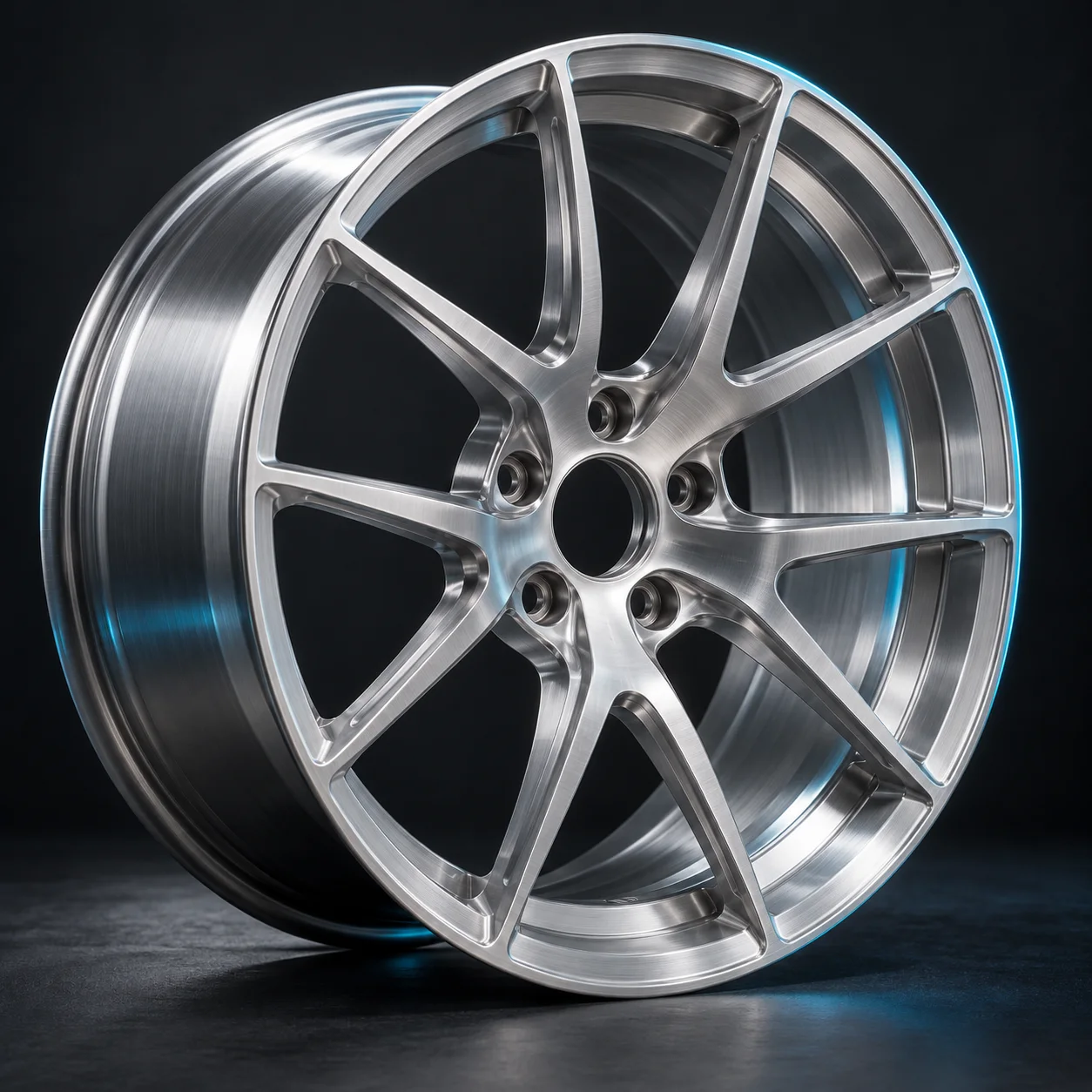
On a custom forged drawing, brake clearance is controlled by several geometry choices at once: face design (spoke count and thickness), pad thickness behind the mounting face, inner barrel diameter, and how aggressively the wheel drops into concave. Offset (ET) moves the whole wheel inboard or outboard relative to the hub; it is not a free “fix” for a caliper clash without also checking fender and suspension clearance.
A wheel manufacturer reviewing a BBK brief is usually checking whether the proposed inner contour clears the caliper envelope you documented. If you only send a car model and “BBK,” they cannot responsibly sign off. Photos and a few measurements turn a guess into a review.
| Lever | Effect on brakes | Side effect to watch |
|---|---|---|
| More concave / deeper dish | Often opens spoke-to-caliper room on some designs | Can push lip toward fender; changes look and mass |
| Higher (more positive) offset | Pulls wheel inboard — can reduce axial caliper gap | Inner arch / suspension rub risk |
| Lower (more negative) offset | Moves wheel outboard — can increase axial gap | Fender poke, scrub radius, stance legality |
| Wider barrel | More room for large rotors if ID grows | Tire width and fender clearance change |
| Thinner spoke package (within structure rules) | Can clear tall calipers | Must still meet load and fatigue requirements — never chase thinness alone |
How to check brake clearance on the car
You do not need a CMM for a useful first pass. You do need patience and clean photos.
- Mount the wheel (or a test wheel / cardboard template of the same inner profile) with the correct center bore or hub ring and torque hardware in a star pattern
- Rotate the wheel slowly through a full turn while watching the closest caliper point — check at lock if the car will see parking-lot steering
- Use a plastic feeler, folded paper or a soft ruler to estimate the minimum gap at the tightest point; note where it is (spoke root, barrel, pad)
- Photograph from the outside looking in and from behind the wheel looking out, with a scale (ruler) in frame when possible
- Repeat for the other side of the axle; left and right calipers are not always mirrored identically after installs
- If the kit is not yet installed, ask the kit maker for a template, envelope drawing or known wheel chart — still verify after install
A common shop method is a cardboard or plastic silhouette of the proposed inner face taped to the hub, then trimmed until it clears. That silhouette, plus photos of the real caliper, is often enough for a machinist to review. For custom forged orders, send that package with the rest of the brief.
What to put in a custom forged BBK brief
Bundle brake data with the usual fitment fields so nothing is assumed:
- Vehicle year / make / model / trim and whether it is left- or right-hand drive
- Bolt pattern (PCD), center bore, seat type — see how to measure bolt pattern
- Desired diameter, width, offset target (or “flush” goal with tire size)
- Brake kit brand and model, rotor diameter, caliper type (e.g. fixed multi-piston), front/rear
- Clear photos of calipers on the hub with and without a reference wheel if available
- Known minimum clearance you measured, or a template photo
- Track vs street use — aggressive track offsets and wide tires change fender risk even when calipers clear
- Any hub-centric rings, spacers or extended studs already planned (prefer to avoid spacers for clearance alone)
VEXORA does not keep a stock catalog or ready-to-ship inventory. Every wheel is engineered and forged to your vehicle, dimensions and finish. That includes machining the inner profile around your documented brake envelope rather than hoping a multi-fit blank clears.
Every VEXORA set is made to order, and custom orders start from a single pair. MOQ: 1 pair (2 wheels). You can order a single pair for a front BBK conversion without a warehouse quantity.
Production typically takes approximately 20 days once the specification, drawings and finish are approved, confirmed per project. Shipping time varies by destination country. Where DDP (Delivered Duty Paid) is available for your country, orders ship DDP: import duties and taxes are handled and the wheels are delivered to your door.
Track vs street: same caliper, different risk
Street cars usually care about everyday steering lock, speed bumps and winter curb clearance as much as caliper gap. Track cars add heat, ducting and sometimes larger kits. A wheel that clears in the garage can still be a problem if brake ducts or temp sensors occupy the same pocket as a spoke.
Magnesium and aluminum both need the same geometric clearance; material choice does not shrink a caliper. Forged magnesium is often chosen to cut unsprung mass on track-leaning builds — still specify the BBK envelope the same way. See forged magnesium wheels and magnesium vs aluminum.
Spacers, adapters and “just run more negative offset”
Wheel spacers can move the barrel away from a caliper, which sometimes “solves” a rub. They also change load path, stud engagement, hub centering and scrub radius. Adapters that change PCD add another interface. Neither replaces a correct inner profile on a custom set.
If a quote relies on a thick spacer to clear brakes, ask for a redesign instead. Custom forged wheels exist specifically so offset, width and inner contour can be chosen together. Flush stance goals belong after brake and hub geometry are safe — not before.
Load, standards and what we will not claim
Brake clearance is a fitment geometry problem. Separately, wheels are designed and tested against load and fatigue expectations that vary by market and program. Industry markings you may see discussed publicly include systems such as JWL and VIA (common in discussions of Japanese aftermarket practice) and other regional or program-specific tests. Those are general industry topics — not a claim that any particular VEXORA set carries a named certificate unless that is confirmed in writing for that order.
Do not treat a blog table of “safe gaps” as a substitute for checking your kit. Minimum gaps depend on flex, heat, and how the wheel was designed. When in doubt, measure on the car and keep a documented margin your builder agrees to.
Common mistakes
- Ordering by photo of a finished car without stating the brake kit
- Assuming OEM clearance after a caliper upgrade
- Checking only one side of the car
- Ignoring dust shields and ABS tone rings
- Using spacers as the primary clearance strategy
- Locking flush offset before confirming caliper envelope
- Forgetting that tire sidewall and fender clearance are separate from caliper clearance
Questions about forged wheel brake clearance
Will any forged wheel clear my BBK?
No. Forged construction does not automatically clear a caliper. The inner profile, concave and offset must be designed around the kit you actually run.
How much gap do I need?
There is no single universal millimetre number that fits every kit and design. Measure the tightest point on your car, photograph it, and agree a margin with the wheel maker for that design.
Can custom forged wheels be made for a specific caliper?
Yes — when you provide kit identity and photos or a template. That is a normal part of a custom brief.
Do I need a full set if only the fronts have a BBK?
Every VEXORA set is made to order, and custom orders start from a single pair. MOQ: 1 pair (2 wheels). Many customers start with the axle that changed; confirm vehicle balance and staggered sizing in the brief.
Does magnesium help with brake clearance?
No. Clearance is geometry. Magnesium changes mass and care requirements, not caliper shape.
Where do I send the brief?
Email sales@vexoraforged.com or message WhatsApp +86 159 2056 8771.
Next step: brief the brakes with the wheels
Send vehicle details, PCD, center bore, target size/offset, and your BBK photos or template. We machine custom forged aluminum and magnesium wheels to that brief. Request a quote for custom forged wheels, or read how to spec a custom set end to end. Email sales@vexoraforged.com or message WhatsApp +86 159 2056 8771.
Staggered front/rear packages still need caliper clearance on both axles — pair this guide with staggered forged wheels fitment.
BBK clearance belongs in the vehicle brief — see Corvette, Mustang, BMW and Porsche 911.