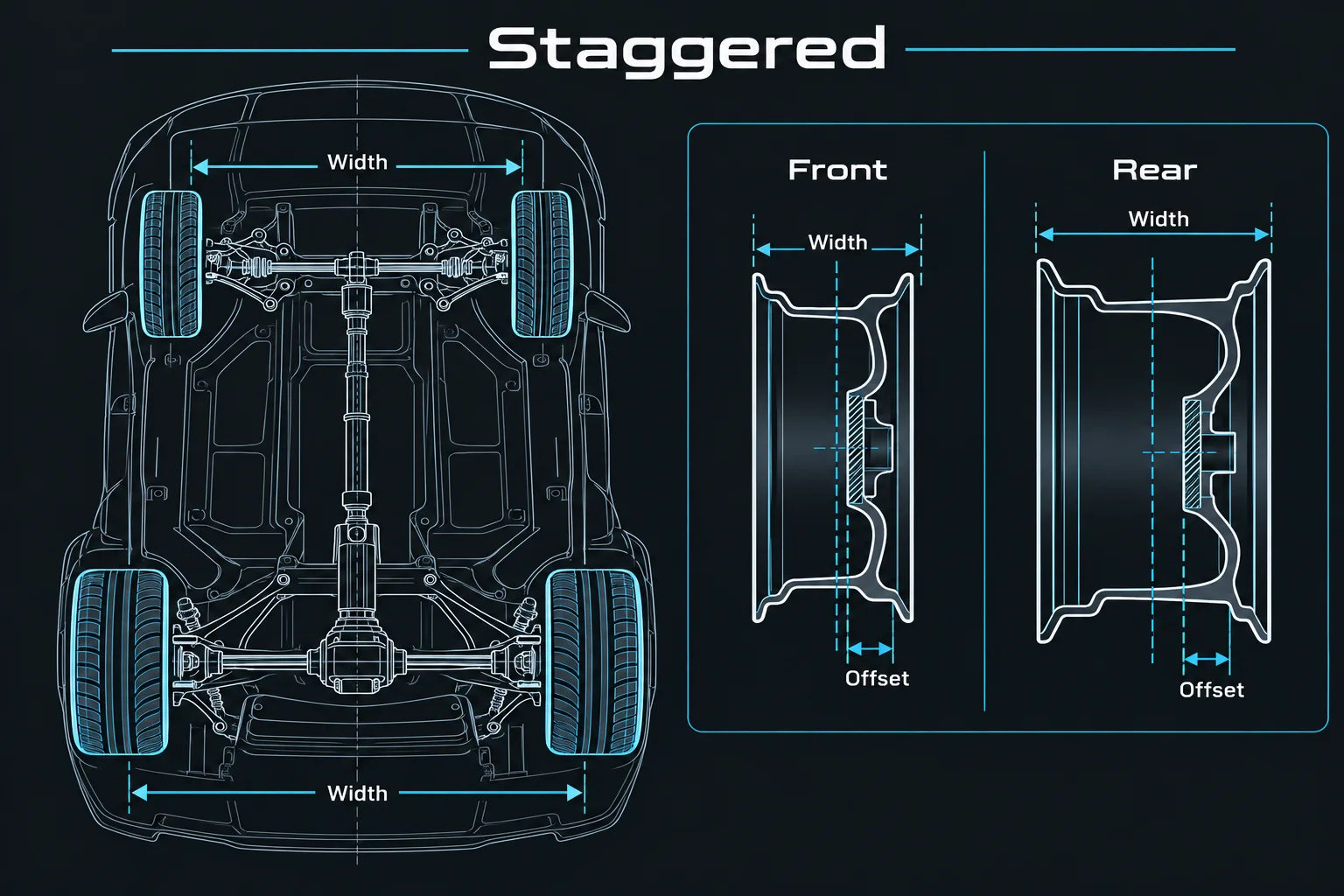
Staggered forged wheels fitment: the short answer
Staggered forged wheels fitment means the front and rear wheels are not the same size. Most staggered setups use a wider rear wheel (and often a different offset) than the front. The goal is more rear contact patch for traction and stance, while keeping the front narrower for steering feel and clearance.
Because width and offset both move the tire relative to the fender and suspension, staggered setups need careful math on each axle. Use the wheel offset calculator, the offset measurement guide, and our flush fitment overview before you lock a brief. Custom forged wheels shine here: front and rear can be machined to exact widths and offsets instead of forcing catalog pairs.
| Topic | Square setup | Staggered setup |
|---|---|---|
| Front / rear width | Same width front and rear | Rear usually wider than front |
| Offset | Often similar ET front and rear | Often different ET so each axle sits flush or poke-controlled |
| Tire sizes | Same size all around (or close) | Rear tire usually wider section |
| Typical goal | Balanced handling, simple rotation | Rear traction / look; front steering clearance |
| Fitment risk | One set of clearances to check | Two axles to clear — fenders, arches, brakes, arms |
| Custom forged advantage | One size pair repeated | Independent front and rear specs in one order |
What “staggered” actually means
In wheel speak, staggered usually means different front and rear rim widths. A common street example is 19×8.5 front and 19×10 rear, or 20×9 / 20×10.5. Diameter can stay the same while width changes, or both can change on track-oriented builds.
Offset is the second half of staggered forged wheels fitment. A wider rear rim with the same offset as the front will poke farther out and push farther in. Most builders lower rear offset (more negative, or a smaller positive ET) carefully so the outer face stays flush while the inner barrel still clears suspension. That is why copying a friend’s “+35 all around” rarely works on a staggered set.
Width changes outer and inner clearance
Wider rims move the tire shoulder outward for a given offset and also move the inner sidewall toward control arms and struts. Always check both directions.
Offset sets where that width sits
Offset (ET) is the distance from the rim centerline to the mounting face. Positive ET tucks the wheel; lower ET pushes it out. See what is wheel offset and offset vs backspacing.
Tire section width finishes the look
A 275 rear on a 10.5″ rim behaves differently than a 255 on a 9.5″ rim. Stretch and bulge change poke and rub risk even when ET matches a spreadsheet.
How offset and width interact on staggered setups
Treat each axle as its own fitment problem. Front: steering lock, strut clearance, and whether you want tuck, flush, or mild poke. Rear: fender lip, camber, and how much inner barrel room the trailing arms or multi-link need.
A practical workflow: measure stock width and offset (or the wheels you already run), decide target outer position with the flush guide, then use the calculator to see how a wider rear changes backspacing and poke. Our general wheel fitment guide covers PCD, center bore and seats; this page focuses on the staggered width/offset pair.
| Axle | Example width | What to verify |
|---|---|---|
| Front | Narrower than rear | Steering lock, BBK spoke clearance, fender at full lock |
| Rear | Wider than front | Inner suspension clearance, outer fender at ride height and squat |
| Both | Matched diameter (typical) | Overall diameter vs speedo / gearing if you also change diameter |
Never treat an online “fitment gallery” as a substitute for measuring your car. Ride height, fender rolling, camber kits and brake upgrades all change what works.
Flush vs poke: front and rear are different jobs
Flush fitment means the tire sidewall roughly aligns with the fender lip. Poke means the tire sits outside the lip. On staggered cars, people often run flush front and slightly more aggressive rear — or flush all around with different ET to match different widths.
Because the rear is wider, matching the same outer flush line usually requires a different offset than the front. If you copy front ET to the rear on a wider rim, the rear will typically poke more. Decide the look per axle, then reverse-engineer ET. Details and risks are in flush fitment.
Measuring before you order staggered forged wheels
- Confirm PCD and seat type — how to measure bolt pattern
- Measure or read current offset and width — measure offset, measure backspacing
- Note center bore and whether you need hub-centric rings or a bored-to-hub custom CB
- Photograph and measure brake packages; use the BBK clearance guide
- Measure fender-to-tire gap front and rear at ride height, then estimate poke change with the calculator
- List tire sizes you intend to run with each rim width
Bring those numbers into a custom brief. Every VEXORA set is made to order, and custom orders start from a single pair. MOQ: 1 pair (2 wheels). Front and rear can be different widths and offsets in the same order.
Common staggered fitment mistakes
- Using one offset for both axles on different widths and expecting the same poke
- Ignoring inner clearance because the outer look looked right in a mockup
- Forgetting steering lock on the front with a wider lip or deep concave face
- Pairing aggressive stretch with maximum poke so the tire kisses the fender under load
- Assuming spacers will “fix” a bad staggered brief — spacers change effective offset and load path; they are not a substitute for correct ET
- Skipping load rating and brake clearance while chasing width
Why custom forged helps staggered specs
Catalog wheels sell fixed front/rear pairs. If your car needs 8.5 / 10.5 with uncommon ET, or a center bore and spoke package for a big brake kit, catalog options shrink quickly. Fully custom forged aluminum or magnesium wheels are drawn around those numbers: monoblock, 2-piece or 3-piece as the brief requires.
VEXORA builds 100% custom forged aluminum and magnesium wheels. Every VEXORA set is made to order, and custom orders start from a single pair. MOQ: 1 pair (2 wheels). Production typically takes approximately 20 days once the specification, drawings and finish are approved, confirmed per project. Shipping time varies by destination country. Where DDP (Delivered Duty Paid) is available for your country, orders ship DDP: import duties and taxes are handled and the wheels are delivered to your door. Start from custom forged wheels or go straight to request a quote.
Staggered forged wheels fitment FAQ
Staggered packaging on a vehicle brief: Corvette · Mustang · Porsche 911.
What is staggered wheel fitment?
A setup where front and rear wheels differ — usually a wider rear rim and often a different offset — instead of a square (same size) setup.
Do staggered wheels need different offsets front and rear?
Often yes. Different widths shift poke and inner clearance; matching a flush outer line usually means different ET per axle.
Is staggered only for RWD sports cars?
No. Staggered setups appear on many performance and stance builds. Always confirm the vehicle maker’s guidance and your load rating needs.
Can I run staggered forged wheels with a big brake kit?
Yes if the spoke and barrel clear the calipers. Brief the BBK early — see the brake clearance guide.
Will staggered wheels hurt tire rotation?
Different front/rear sizes usually prevent rotating tires in a normal square pattern. Plan tire budgets accordingly.
Can VEXORA build different front and rear specs?
Yes. Custom orders can specify independent front and rear width, offset, construction and finish. Every VEXORA set is made to order, and custom orders start from a single pair. MOQ: 1 pair (2 wheels). Production typically takes approximately 20 days once the specification, drawings and finish are approved, confirmed per project. Shipping time varies by destination country. Where DDP (Delivered Duty Paid) is available for your country, orders ship DDP: import duties and taxes are handled and the wheels are delivered to your door.
Brief your staggered set
Send vehicle, target front/rear width and offset, tire sizes, brake kit, and whether you want tuck, flush or poke on each axle. Request a quote. Email sales@vexoraforged.com or message WhatsApp +86 159 2056 8771.
Staggered build examples: Chevrolet Camaro and Toyota Supra.
Staggered build examples: Nissan GT-R and Toyota Supra.
Staggered muscle examples: Dodge Challenger and Chevrolet Camaro.