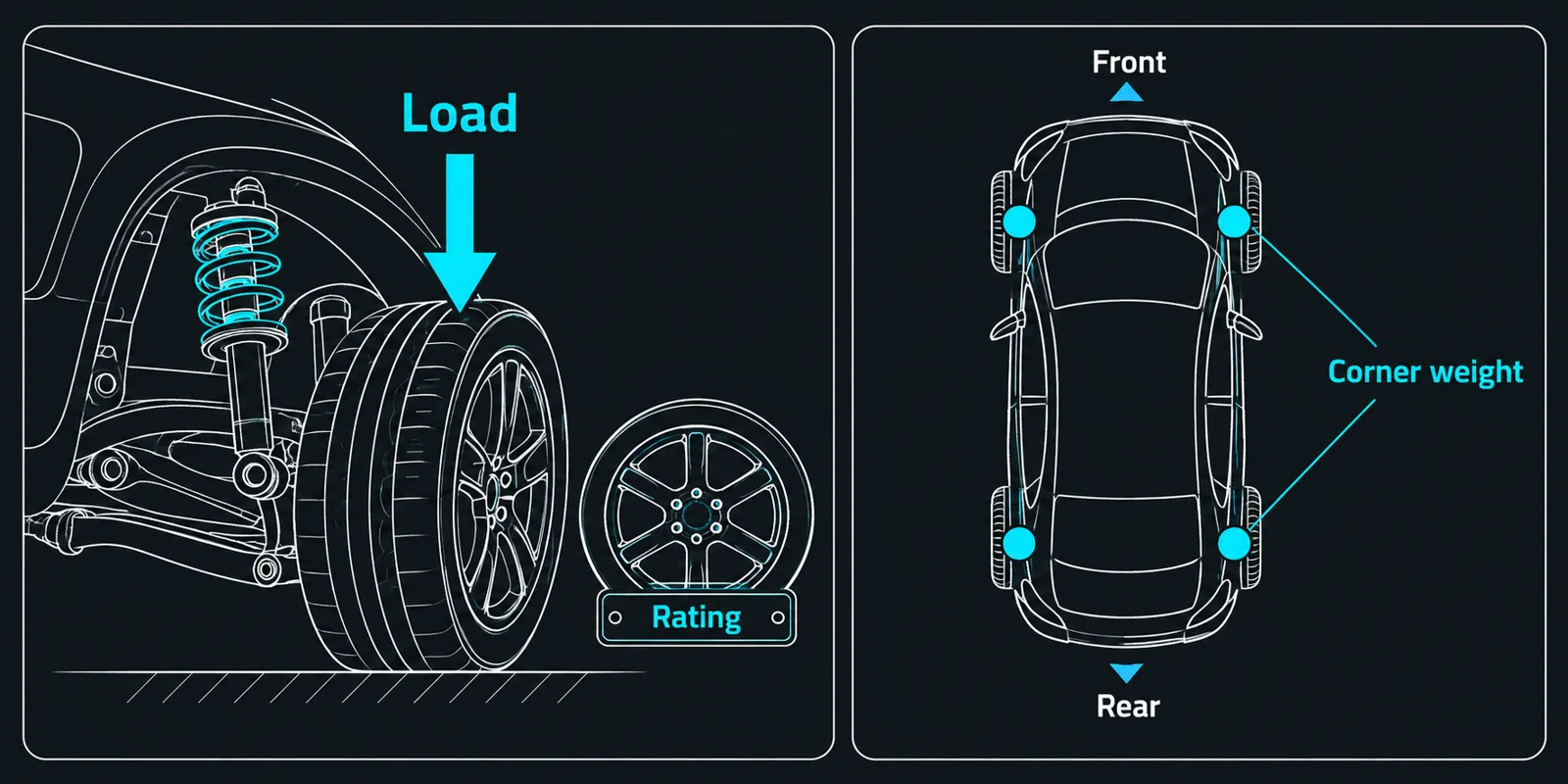
Forged wheel load rating: the short answer
A forged wheel load rating is the maximum load each wheel is designed to carry under the maker’s stated conditions. It is not a style number and it is not the same as tire load index. For street and performance cars, the rating must cover the heaviest corner of the vehicle with a sensible margin for passengers, cargo and dynamic loads.
This guide explains what load ratings mean, why corner weight matters, and how industry education often references public standards such as JWL and VIA. It does not publish VEXORA-specific kilogram or pound ratings, and it does not claim any certification for VEXORA products. When you brief a custom set, ask for a load rating appropriate to your vehicle and use case. Start with how to spec custom forged wheels and the wheel fitment guide.
| Term | What it means | Buyer takeaway |
|---|---|---|
| Wheel load rating | Max load the wheel is designed for (per wheel), under maker conditions | Must cover your heaviest corner with margin |
| Vehicle corner weight | Weight on one wheel position (LF/RF/LR/RR) | Use measured or estimated corner weights, not just curb weight ÷ 4 |
| Tire load index | Tire’s capacity, separate from the wheel | Wheel and tire must both be adequate |
| Dynamic loads | Extra force from bumps, braking, cornering | Street ratings assume normal use; track/heavy use needs honest discussion |
| Standards (e.g. JWL/VIA) | Common industry test/mark references in many markets | Useful education — do not assume every custom wheel carries every mark |
What a load rating is (and is not)
The load rating is a capacity claim for the wheel structure: material, design, manufacturing and test method. Forged construction — a billet pressed and then CNC machined — is often chosen when buyers want high strength-to-weight, but “forged” alone does not replace a stated rating. Two forged designs can have very different capacities.
Load rating is also not offset, not PCD, and not a guarantee for overload, impact damage or improper torque. Fitment, hardware, tires and vehicle use still matter. See what are forged wheels for process context.
Why vehicle corner weight matters
Dividing curb weight by four underestimates the heaviest corner on most cars. Engines, batteries, fuel and passengers bias weight forward or rearward. A heavy EV or SUV corner can sit well above a light sports-car corner even when overall mass looks similar on paper.
Practical approach: use corner weights if you have them from a scale session; otherwise estimate from curb weight, weight distribution and expected load (passengers, tools, track fuel). Then choose wheels whose stated per-wheel rating clears the worst corner with margin your maker recommends for the use case.
Street vs track vs towing
Higher speeds, kerbs and sustained lateral load raise demands. Towing or heavy cargo raises static load. Tell the maker how the car is used.
Spare and winter setups
If you run a second set, each set still needs an adequate rating for that vehicle.
Spacers and adapters
Extra hardware changes leverage and is not a free upgrade to capacity. Prefer correct offset and hub bore when possible.
JWL, VIA and similar references (general education)
In many markets, buyers see references to public standards or test marks such as JWL (Japan) and VIA. Those marks relate to defined test procedures and labeling practices used by many mass-market and aftermarket wheels. They are useful as industry background when you read a catalog sheet.
Important limits for this page: VEXORA does not claim JWL, VIA or any other certification here. Custom one-off forged wheels are specified per project. Do not assume a marketing phrase equals a specific mark. Ask your supplier which tests, calculations or documentation apply to your order, and keep vehicle-maker guidance in view.
How to brief load rating on a custom forged order
- Vehicle make, model, year and drivetrain (and battery pack if EV)
- Known curb weight and weight distribution, or measured corner weights
- Intended use: daily, canyon, track days, show, light off-road, etc.
- Tire sizes and expected passenger/cargo load
- Wheel size, construction preference (monoblock / 2-piece / 3-piece) and material (aluminum or magnesium)
- Any big brake kit — clearance and structure interact; see BBK clearance
VEXORA makes 100% custom forged aluminum and magnesium wheels. Every VEXORA set is made to order, and custom orders start from a single pair. MOQ: 1 pair (2 wheels). Production typically takes approximately 20 days once the specification, drawings and finish are approved, confirmed per project. Shipping time varies by destination country. Where DDP (Delivered Duty Paid) is available for your country, orders ship DDP: import duties and taxes are handled and the wheels are delivered to your door. Request the load rating that matches your vehicle and use when you request a quote. We do not publish a stock catalog of ratings because every set is made to order — see custom forged wheels.
Common load-rating mistakes
- Buying on looks and ignoring the stamped or quoted rating
- Comparing forged marketing claims without asking for the number that applies to your size and design
- Matching tire load index but underspecifying the wheel
- Assuming magnesium or forged automatically means “unlimited” capacity
- Using a light sports-car wheel design on a heavy SUV or EV without a new rating discussion
Load rating vs other numbers on the wheel
Wheels carry several markings that buyers mix up. Diameter and width describe size. Offset (ET) describes position. PCD and center bore describe mounting. The load rating describes capacity. None of those replace each other.
If a listing advertises forged construction, lightweight design or a famous style name but never states capacity, ask before you buy. A custom brief should list the target rating or the vehicle data needed to choose one. Pair this with fitment checks in the wheel fitment guide so you do not clear the fender and fail the scale.
Aluminum vs magnesium and capacity conversations
Forged aluminum (commonly 6061-T6 class alloys in custom work) and forged magnesium are both used for light, strong wheels. Density and coating needs differ — magnesium needs careful corrosion protection — but neither material is a blank check for unlimited load. Design thickness, spoke layout, pad section and validation set the rating.
If you are comparing materials for weight, read magnesium vs aluminum and weight savings. Bring load and use-case into that conversation early so the design is not optimized only for grams.
Documentation buyers can reasonably request
- Stated per-wheel load rating for the exact size and design being ordered
- Clarification of test method or engineering basis in plain language (without assuming a specific mark)
- Guidance for street vs occasional track use if that matches your plan
- Hardware torque and seat-type requirements that keep the rated joint working as designed
- Confirmation that brake clearance and load were reviewed together on deep-concave or BBK designs
Forged wheel load rating FAQ
What is a forged wheel load rating?
The maximum load each wheel is designed to carry under the maker’s stated conditions. It is separate from tire load index.
How do I know what rating I need?
Start from the heaviest vehicle corner (measured or estimated), add use-case margin, and ask the wheel maker to confirm a suitable rating for that brief.
Does forged always mean higher load rating?
Forging is a manufacturing route. Capacity still depends on design, size, alloy and validation. Ask for the rating on your specific wheel.
Are JWL or VIA required everywhere?
Markets differ. Those names are common industry references; they are not a substitute for confirming what applies to your order and region.
Does VEXORA publish fixed kg/lb ratings on this site?
No. Ratings are discussed per custom project for your vehicle and use. This page is educational and does not list product certifications.
Where do I start a custom brief?
Use how to spec custom forged wheels, then request a quote. Email sales@vexoraforged.com or message WhatsApp +86 159 2056 8771.
Next step
Share vehicle data and intended use so load rating can be aligned with fitment and design. Request a quote. Email sales@vexoraforged.com or message WhatsApp +86 159 2056 8771.
Heavier EVs make load rating a first-line spec — example brief: Tesla Model Y forged wheels.