Key takeaways
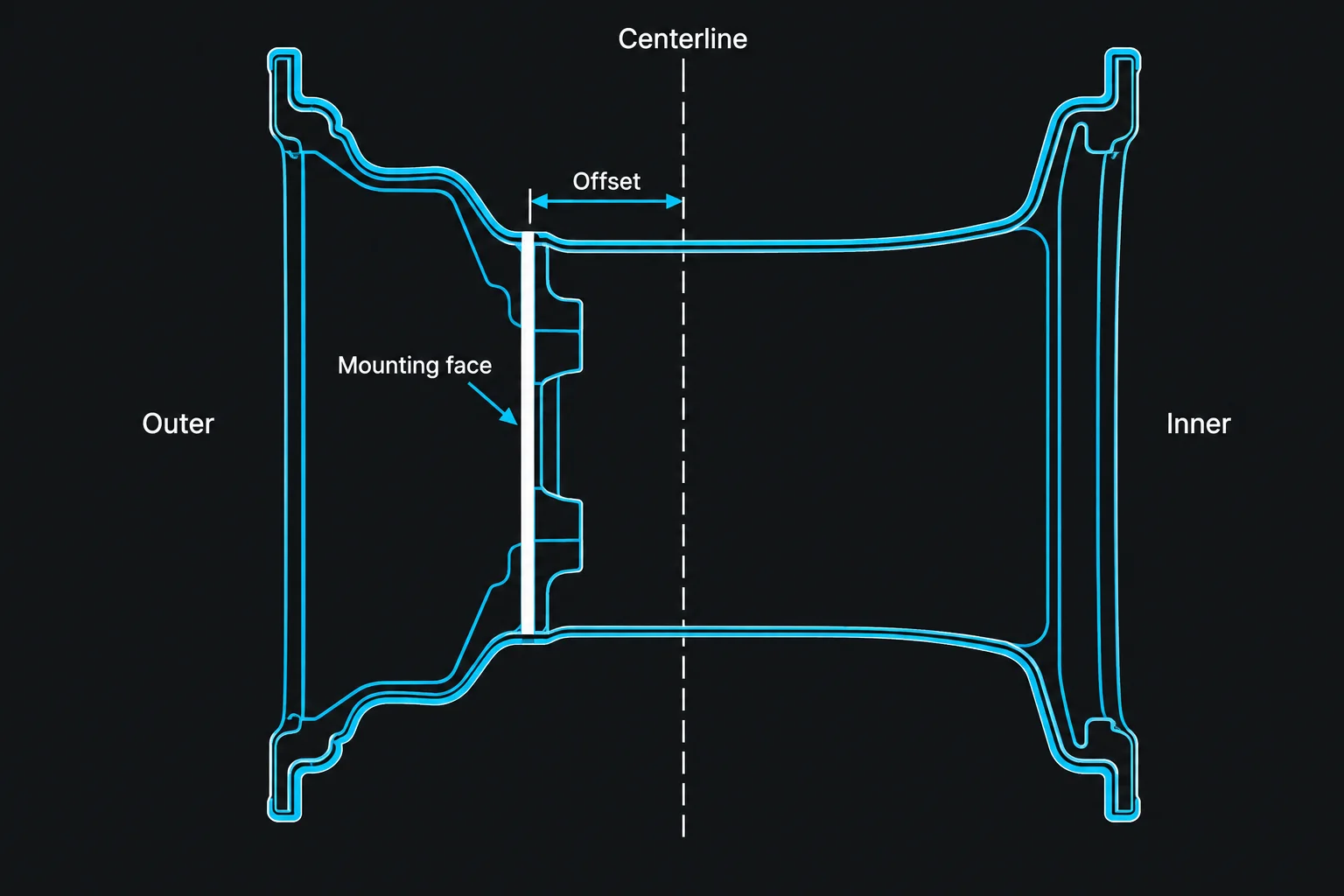
- Wheel offset (ET) is the distance in millimetres from the rim centerline to the hub mounting face.
- Positive offset tucks the wheel inboard; negative offset pushes it outboard (more poke) at the same width.
- Offset and width move together: a wider wheel at the same ET adds depth on both the inner and outer sides.
- You can read ET from the stamp, or calculate it: Offset = backspacing - (overall width / 2).
- Custom forged wheels machine the ET in your brief - measure what fits today before you approve drawings.
What is wheel offset?
Wheel offset is the distance from the wheel's rim centerline to the hub mounting face, measured in millimetres. It is stamped as ET (from the German Einpresstiefe) followed by a number, such as ET35.
Positive offset means the mounting face sits toward the outside of the car - most street cars are positive. Zero offset puts the face on the centerline. Negative offset puts the face toward the inside of the wheel, which pushes the rim outward.
Offset does not change with tire size. It does interact with width: the same ET on a wider wheel adds clearance depth on both the inner and outer sides.
| Offset | Mounting face location | Typical effect at the same width |
|---|---|---|
| Positive (+) | Toward the outer face | Wheel sits more inboard; common on OEM cars |
| Zero (0) | On the centerline | Even split of width inside and outside |
| Negative (-) | Toward the inner face | Wheel sits more outboard (more poke) |
How is wheel offset measured?
Two routes give the same number:
- Read the stamp. Look on the back of a spoke, inside the barrel, or on the hub pad for ET followed by a number.
- Measure and calculate. With the tire off, measure overall width flange-to-flange and backspacing (inner flange edge to mounting face) with a straight edge, then apply: Offset = backspacing - (overall width / 2). Use the same units in both measurements; convert inches with 1 in = 25.4 mm.
Full home procedure, tools, and common mistakes: how to measure wheel offset. Nominal stamped width (for example 9J) is bead-seat width - for the formula use the flange-to-flange overall width you actually measured.
Worked example (illustrative math only)
These numbers show the formula. They are not a recommended fitment for any vehicle.
| Input | Value | Notes |
|---|---|---|
| Overall width (flange to flange) | 280 mm | Measured across outer flanges |
| Half overall width | 140 mm | 280 / 2 |
| Backspacing | 165 mm | Inner flange edge to mounting face |
| Offset | +25 mm (ET25) | 165 - 140 = +25 |
If backspacing had been 130 mm on the same 280 mm overall width, offset would be 130 - 140 = -10 mm (ET-10) - mounting face inboard of the centerline, more poke.
Same math in inches: overall width 11.0 in, backspacing 6.0 in gives offset 6.0 - 5.5 = +0.5 in. Convert: 0.5 x 25.4 = +12.7 mm (about ET13 when rounded to the nearest millimetre).
What does wheel offset mean for fitment?
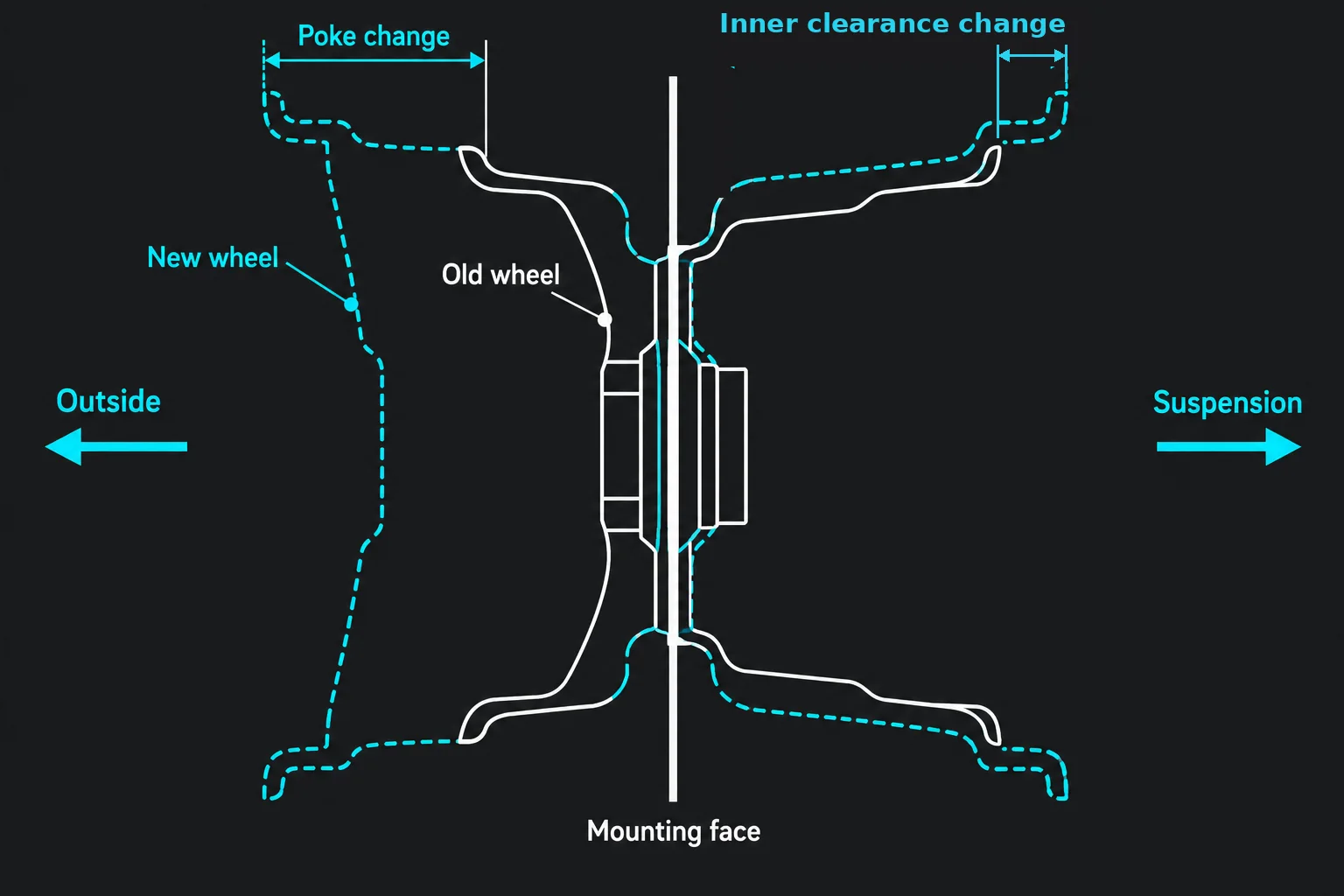
- Outer position / poke - how close the tire sits to the fender lip (see flush fitment)
- Inner clearance - room to struts, springs, control arms and the inner arch
- Brake package - spoke and barrel shape still need caliper room even when ET is right
- Scrub and steering feel - large ET changes alter leverage on the hub; stay within sound engineering for the vehicle
Compare an old and new pair without guessing in the wheel offset calculator. For the relationship between ET and backspacing, see offset vs backspacing.
Offset vs width vs backspacing
| Term | What it measures | Why it matters |
|---|---|---|
| Offset (ET) | Centerline to mounting face (mm) | Primary stamped fitment number |
| Width | Bead-seat (nominal) or flange-to-flange (measured) | Sets how much depth ET distributes inside/outside |
| Backspacing | Inner flange edge to mounting face | Handy for measuring; converts to ET with width |
| Frontspacing | (width / 2) - offset | Outer half; drives poke and fender gap |
At the same width: lowering ET increases frontspacing (more poke) and decreases backspacing (more room inside until other parts interfere). Raising ET does the opposite.
Offset myths worth dropping
- "More negative always looks better" - only until the tire hits the fender or scrub gets ugly.
- "OEM offset is always ideal for aftermarket width" - wider wheels at the same ET gain inner and outer depth.
- "Spacers are the same as ordering the right offset" - they change effective ET but add another interface to torque and center.
- "Tire size changes offset" - it does not. Tire size changes diameter and section; ET stays on the wheel.
Why offset matters more on custom forged wheels
On catalog wheels you filter by the offsets in stock. On custom forged wheels the offset is machined to your brief, so "what is wheel offset" becomes "what offset do we design?" Measure what fits today, decide how much outer movement you want, protect inner and brake clearance, then lock width and ET together before drawings are approved.
Vehicle-specific stance examples live under custom forged wheel builds - for example Camaro, Porsche 911, and Toyota Supra. Those pages show design directions; your PCD, center bore, load and year-fit still come from your vehicle and brief, not from a published chart.
VEXORA does not keep a stock catalog or ready-to-ship inventory. Every wheel is engineered and forged to your vehicle, dimensions and finish. Every VEXORA set is made to order, and custom orders start from a single pair. MOQ: 1 pair (2 wheels).
Wheel offset FAQ
What is wheel offset?
The distance in millimetres from the rim centerline to the hub mounting face, stamped as ET plus a number.
What does wheel offset mean on the stamp?
ET followed by a number, such as ET35, is the offset in millimetres.
Does higher offset tuck the wheel in?
Yes, at the same width: more positive offset moves the wheel inboard.
How do I calculate offset from backspacing?
Offset = backspacing - (overall width / 2). Convert inches with 1 in = 25.4 mm, then round to the nearest millimetre.
Is offset the same as backspacing?
No. Backspacing measures from the inner rim edge to the mounting face. Convert with overall width.
Can I change offset with spacers?
A spacer reduces effective offset by its thickness. A custom machined offset is usually cleaner long term.
Can you machine a custom offset?
Yes. VEXORA forges and machines wheels to the offset in your brief. Production typically takes approximately 20 days once the specification, drawings and finish are approved, confirmed per project. Shipping time varies by destination country. Where DDP (Delivered Duty Paid) is available for your country, orders ship DDP: import duties and taxes are handled and the wheels are delivered to your door.
Next steps
Measure your current wheel, run the calculator, then request a quote with width, measured ET, clearance photos and your vehicle. Email sales@vexoraforged.com or message WhatsApp +86 159 2056 8771.
Choosing diameter next? Compare 18 inch vs 20 inch forged wheels.